A MODEST PROPOSAL FOR INTEGRATING ULTRALIGHT FLYING MACHINES INTO THREE DIMENSIONAL BATTLEFIELD PREPARATIONS

 http://youtu.be/GyO14gRRzU4
Chungking Municipality alone has an estimated population of 30-33 million souls. Given the Communist organizational zeal for workplace and neighborhood spies, unless objectives could be rapidly taken and the Communist organization dismantled without seriously damaging the already low economic situation, a foreign military force would be destroyed within a matter of weeks.
Then a partial response suggested itself: the judicious utilization of ultra lights. Ultra lights have sometimes been described as flying lawnmowers. These machines have the characteristics of low cost, low maintenance, easy operation, and an ability to use readily available regular gasoline. Virtually all of the presently manufactured machines have concealed parachute devices that are easily deployed. A typical machine may have seating for two or be configured for one-person operation and a payload capability of at least three hundred pounds.
A number of military applications readily appear:
* Enemy communications interdiction;
* Enemy air observation;
* Friendly troop carrier capability;
* Re-supply;
* Operational capability in low-visibility situations (Battle of the Bulge);
* Useful to withdraw friendly troops from potential decimation (marines at Chosin resevoir in Korea);
* Precision operations (like the German Paratroopers used in assaulting Belgian forts at the beginning of WWII or the British Paratroopers seizing the Orne River bridges on D-Day);
* Extension of the operational area of friendly forces;
* Active and coordinated protection for medium and heavily armored vehicles
Static thinking makes for static results. Low-technology, judiciously applied can have amazing results. A simple GI came up with the solution for clearing hedgerows in France during the Normandy invasion. In the 1982 Middle East war, the Israelis destroyed the Syrian Air Force on the ground using radio and television-controlled model airplanes. In the 1990s, Peruvian elite troops used flashlights tied to their HK sub-machines in their successful freeing of diplomatic hostages.
There is a tendency for the generals to prepare for the last war--and the losers think more clearly about their mistakes and look for improved solutions.
In World War I, the Germans had problems shifting troops between the eastern and western fronts. After the War, the Treaty of Versailles greatly limited the resources to defend Germany. Eventually, defensive considerations gave way to the Blitzkrieg concept.
There is also a tendency to go for show rather than for substance. The following comments and not intended to decrease the valor of the troops involved. It is true that German Paratroops took Crete. However, the Allies were waiting for them thanks to the Ultra code-breaking of German messages and after battle reports were dismal and the costs in experience and highly trained troopers was so high that such operations were rarely again used by the Germans in World War II. What was almost always was effective was the usage of limited numbers of troops in rehearsed operations against precision targets using high levels of secrecy like the liberation of Mussolini or the neutralization of the Belgian forts in 1940.
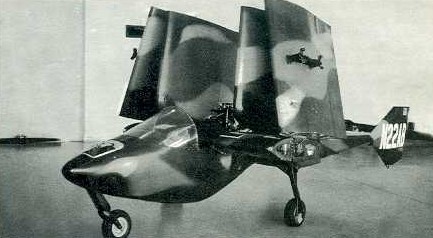
Ultra lights are potential precision military tools in a panoply of tools, which include helicopters; the natural comparison people would make. The first reaction is to raise objections that helicopters are "better". The liberation of Mussolini, the neutralization of Belgian forts and the re-supply at Arnhem and the Bulge might have been easily accomplishable by helicopters. However, with the exception of the precise landing needed on the Belgian fort, fixed-wing ultra light aircraft with STOL capabilities could have done the jobs using truck driver skills and $10,000 vehicles. An objection might be raised that helicopters are armored and ultra lights are not. The lack of armor does not detract from effectiveness. Witness the effective German towed 88mm AA-AT gun with lack of armor or the romanticized PT boat with was largely made of wood. Another objection might be that helicopters are better suited for certain functions like carrying heavy loads or stretchers or rocket launchers. There is no denying this truth. However, there are many applications remaining when it is simply unnecessary to put a highly trained pilot and a multi-hundred thousand-dollar machine at risk where a smaller, more stealthy ultra-light would be able to achieve surprise and maintain secrecy longer. The applications could include direct action missions to more routine mail delivery, individual trooper rotations, simple re-supply of an outpost. While philosophically, no value can be placed upon a human life, it is done daily in the military. Bagging a Russian Hind helicopter in exchange of the expenditure of a Stinger or SA-16 MANPADS missile seems a good exchange from the defensive perspective. Bagging an ultra light in exchange for Chinese missile does not seem such a good exchange from the perspective of the defender.
Ultra lights also have a role to play in protecting medium and heavy tracked and wheeled mechanized/motorized forces. Historically, tanks were desired as protection for advancing friendly troops. Quite quickly, the vulnerability of tanks was discovered, and often-friendly troopers were sent ahead or on flanks to protect armor. Imagine ultra lights as expanding the protected areas in front, back and on the flanks of armor and also serving as eyes in the sky. The ultra-light fixed-wing aircraft is in essence a "manned UAV" if you can accept the oxymoron. The ability of Army mechanized forces to instantly put The accompanying ultra lights into service weighs favorably against calling upon dedicated helicopter forces, which might be minutes and miles away because their pampered nature means they are not co-located by trailers with ground maneuver units.
In conclusion, the consideration of the use of ultra lights serves as an advance into the future, which is sure to present three-dimensional battlefields wherein the side with lowest sustainable technology has the edge.
BREAKING NEWS! Drug Criminals Unhindered by BS Bureaucracy are Using Ultra-Lights to Smuggle Drug Poisins to Murder Americans!

http://news.yahoo.com/aircraft-shoots-3-600-mph-300-seconds-134136783.html?_esi=1
Here's $100M, Now Catch Those Drug Smuggling Ultralights
ABC NewsBy Lee Ferran | ABC News - 2 hrs 4 mins ago
U.S. Customs and Border Patrol is spending big - just under $100 million - to combat drug smugglers who use small aircraft worth only a few thousand dollars each to ferry narcotics into the U.S.
Last week the CBP awarded SRCTec, a New York-based research and development company, a $99,955,087.00 contract for a real-time detection system that is specifically designed to pick out ultralight aircrafts, slow-speed rudimentary manned planes that have a very small radar signature, on America's southern border.
The contract award ended a year-long search for a way to spot ultralights loaded with narcotics - a tactic lawmakers said is being employed more and more in recent years by drug smugglers hoping to buzz back and forth over border fences undetected. Ultralights are easy-to-use aircraft - often little more than an airframe and engine - that can be bought online or constructed at home from kits for a few thousand dollars. Ultralights do not require a pilot's license.
In May 2011, The Los Angeles Times reported that in the previous fiscal year, ultralights - sometimes with armed pilots - had entered U.S. borders illegally at least 228 times, double the number compared to the year before that.
One man died in 2008 when his ultralight crashed into a lettuce field in Arizona, according to the CBP. Nearly 150 lbs. of marijuana was found with the downed aircraft. A year later CBP managed to spot an ultralight using their current radar and followed it to its own crash elsewhere in Arizona. In that case, CBP said the pilot managed to escape but two others believed to be involved were arrested and another 275 lbs. of pot was confiscated - worth an estimated $220,000 on the street.
In 2010, the military reported two F-16s had been scrambled by NORAD to chase down an ultralight near the Arizona border. The fighter jets - capable of flying 1,500 miles per hour - reportedly shadowed the ultralight - which generally has a top speed around 60 miles per hour - for 30 minutes before the ultralight decided to head back into Mexican airspace.
The ultralight's use by smugglers has become so ubiquitous that Congress recently updated their definition of "aircraft" to include ultralights and, therefore, make those caught smuggling drugs with them subject to the same penalties as other aircraft under the Tariff Act of 1930. The legislation, known as the Ultralight Aircraft Smuggling Prevention Act of 2012, was the last bill sponsored by Rep. Gabrielle Giffords (D-Arizona) before she resigned from Congress after surviving an apparent assassination attempt last January.
"The use of ultralight vehicles is yet another example of the extreme measures drug smugglers will use to get drugs into the United States," Sen. Dianne Feinstein (D-California), Chairman of the Senate Caucus on International Narcotics Control, said after the bill passed the Senate.
Ultralights were also feared to have been part of an alleged terror plot uncovered in Spain earlier this month. In that case, three men were arrested before the plot could get off the ground. Authorities said two of them had been practicing flying ultralights and small drones.
The CBP contract winner, SRC Tec, lists what it calls the VantagePoint system under its products. According to the company's website, VantagePoint can "detect and track people, vehicles, and low and slow aircraft, such as [unmanned aircraft systems] and ultralights."
Killer Bees: The Ultralight Combat Aircraft in History
The future of combat aviation is not the expensive, throwaway UAV; its micro-sized MANNED combat aircraft that can be hidden on the ground in BATTLEBOXes and moved by vehicles...Eventually the airplane with BE a ground vehicle iself like the TerraFuegia Transition...
youtube.com/watch?v=iUKFE-UWaN8
AHRLAC
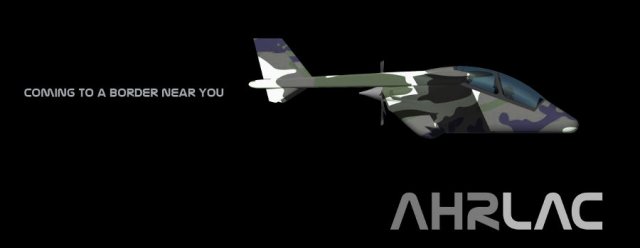
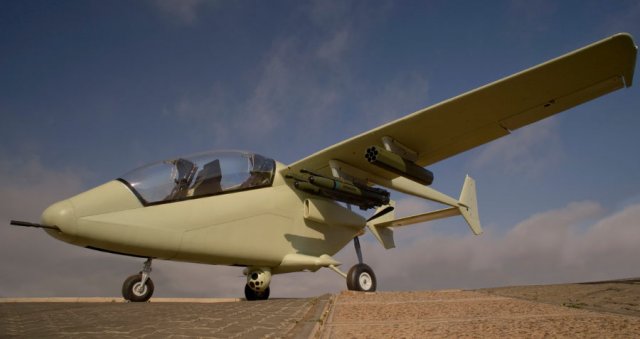
South Africa--an expert at aerial COIN warfare--is now offering a "Mini-OV-10" like aircraft, the AHLRAC...
007 James Bond Short Story Featuring Ultralight Combat Aircraft:
Masquerade: Everything is Not What It Appears!
FEEDBACK!

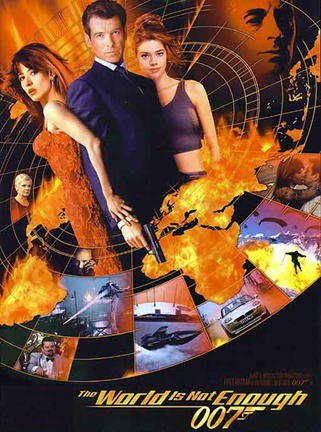
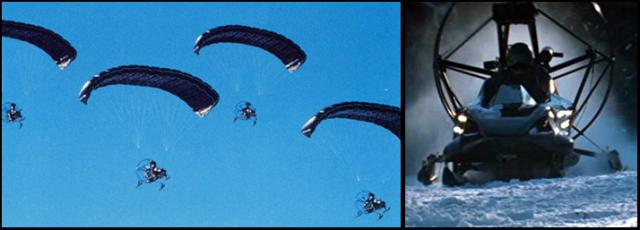
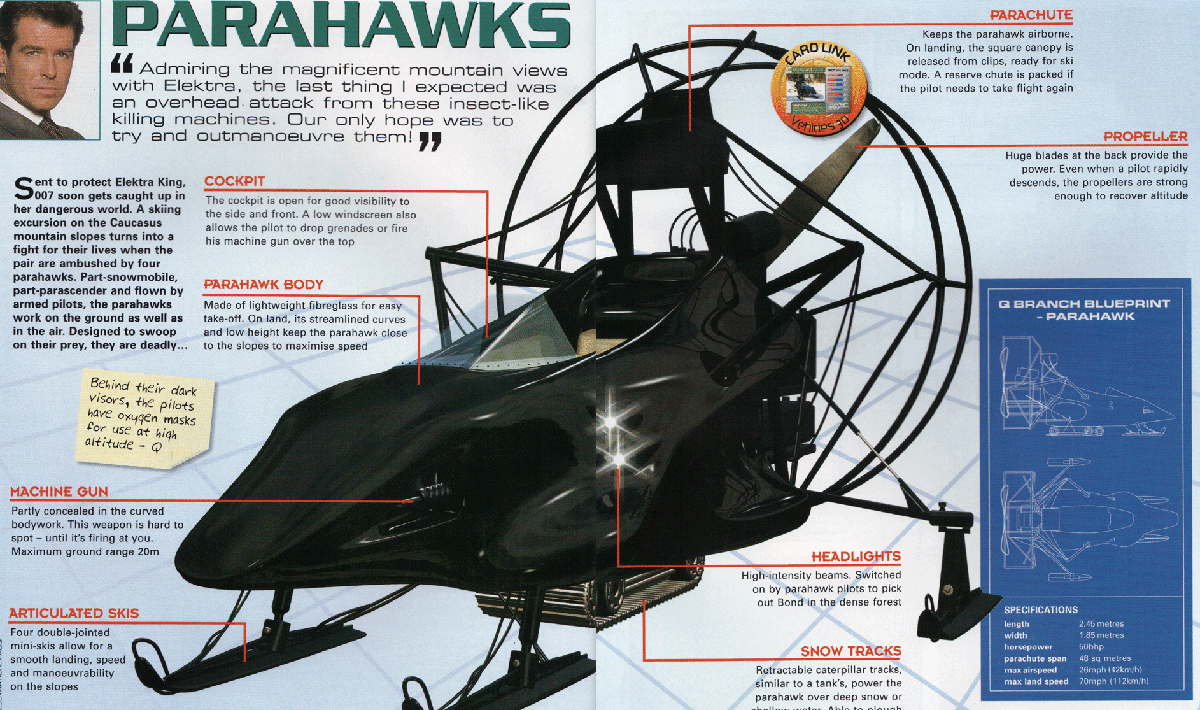
Notice the James Bond movies have been using ultralight autogyros (You Only Live Twice), hang gliders (Live & Let Die, Moonraker), microjets (Octopussy)
youtube.com/watch?v=I5SV1wuemhM
...and powered parachutes (The World is Not Enough) for years to infiltrate Agent 007 in--and out of trouble. Now real life has started to catch up with "art".
 James Bond is Real.