UPDATED 27 July 2012

RANGERS NEED SIDEARMS
IN URBAN FIGHTING
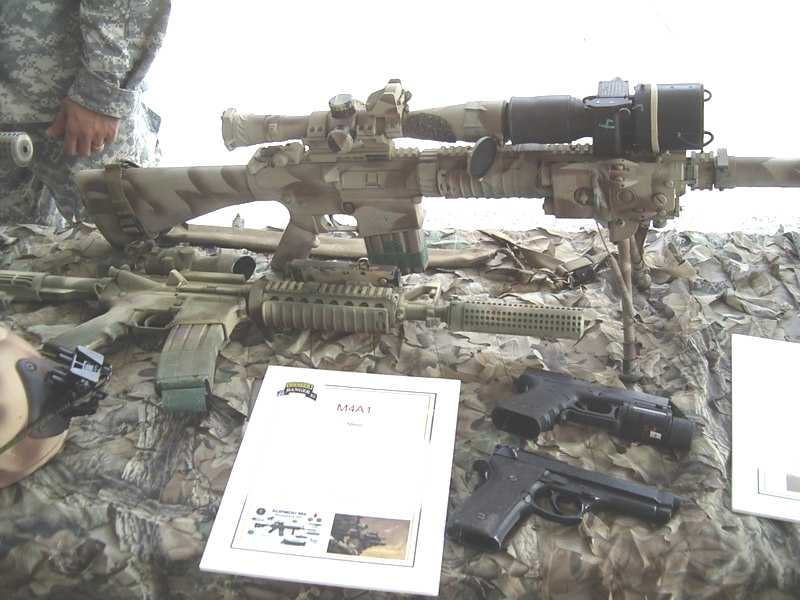

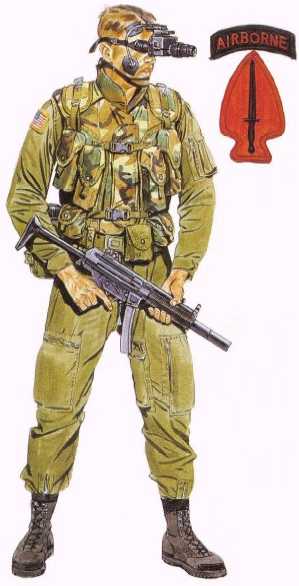
Infantry Magazine, Jan-April 1998, page 4 UPDATED & ILLUSTRATED by the 1st Tactical Studies Group (Airborne)
Has anyone considered what will happen to the combat effectiveness of that Soldier if his weapon is destroyed?
It is common practice for members of U.S. Army Special Forces detachments, elite counter-terrorist units, and Navy SEALs to carry at least the issue M9 9mm Beretta pistol in holsters by their sides to serve as a backup in case their main shoulder weapons are rendered inoperable.
The common sense answer is to issue one of the thousand M9 Beretta 9mm pistols the Army owns to each of its Soldiers likely to be sent into a city fight -- the Rangers. In fact, looking closely at the Rangers in the Discovery Channel documentary, there is a 120mm heavy mortar team, and one of them is wearing a M9 Beretta 9mm pistol in a standard M12 G.I. Bianchi(c) holster. So the 75th Ranger Regiment must have some pistols somewhere in its Table of Organization and Equipment (TOE).
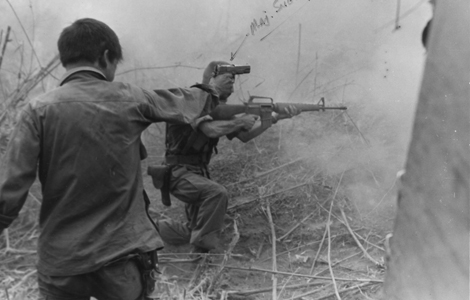
The pistol in a city fight would also enable a Ranger to engage and stop an enemy who charges him as he changes his shoulder weapon's magazines. If he needs a hand free to throw a stun grenade, or if his shoulder weapon is slung as he climbs a rope, he can unholster the pistol more rapidly with one hand and use it against an enemy. Certainly we wouldn't expect him to let go of the rope and fall trying to reach for his carbine. The M9 Beretta has a lanyard loop which a piece of Type III nylon cord ("550 parachute cord") can be routed through to make a wrist lanyard loop that would go around the firing wrist to prevent dropping the pistol if the grip is relaxed for any reason.
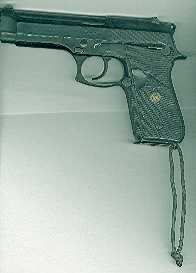
These M9 pistols could initially be fielded in their issue holsters, but for use in Close Quarter Battle (CQB), small organizations like the 75th Ranger Regiment should buy a commercial off-the-shelf low-riding leg holster for faster access in a fight as well as better interface with the Ranger Body Armor (RBA). As time goes on, small infared aiming lights can be added to the pistol grip or the lower pistol receiver frame to project an aiming dot seen by either the naked eye or just through AN/PVS-7B Night Vision Goggles (NVGs).
Once fielded, these pistols need to be integrated into tactical CQB training. At least one Ranger per squad should have the pistol, preferably the point man throwing the stun grenades into the room BEFORE the team enters/clears. In training, ALL Rangers should be equipped with pistols in case they become "point". An evaluator moving with the team during room clearing could call out to the Ranger that his shoulder weapon inoperable, requiring him to finish the exercise using the pistol. Blank rounds do exist for pistols, though dry-firing could suffice. Soldiers must be ready to switch to the pistol whenever the situation calls for its use, and only constant training can produce this readiness.
This training should include the smooth, safe, and technically efficient presentation of the pistol from the holster in various situations, as is standard training for elite police counter-terrorist units that "fight" in cities daily.
The point of contact in the urban fight is often the individual Ranger. We need to issue the side arm and incorporate it into our Ranger CQB training and tactics.
2011 UPDATE: Ranger Battalions recently received Glock 9mm pistols. More details will be posted here as we learn them.
OTHER APPLICATIONS...
Off-Base Security: Troops as Targets or Back to Base Safely?

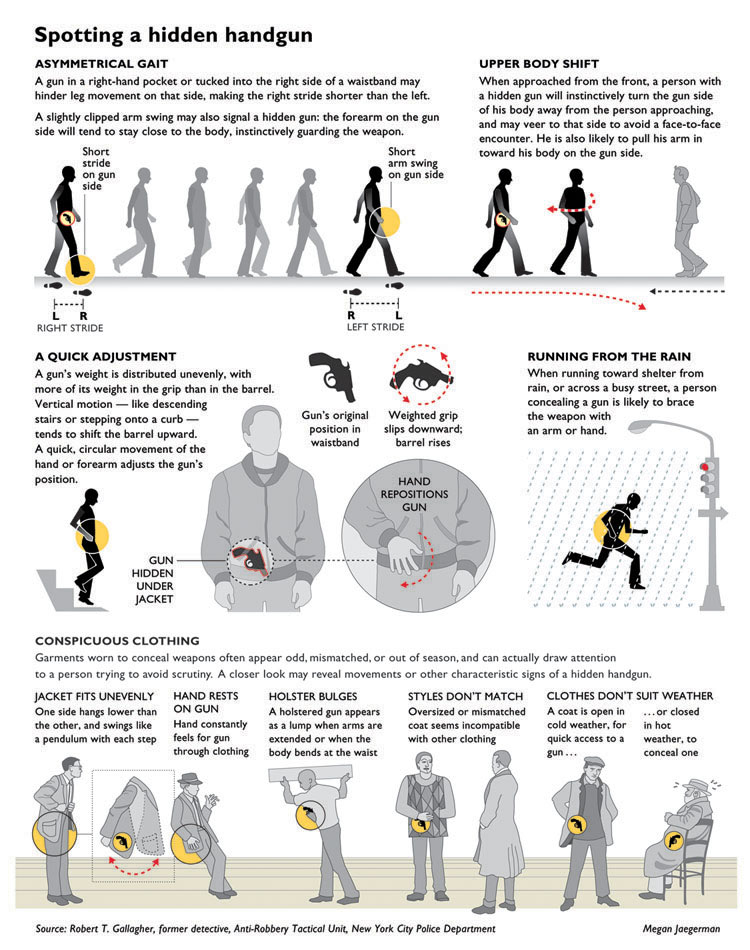
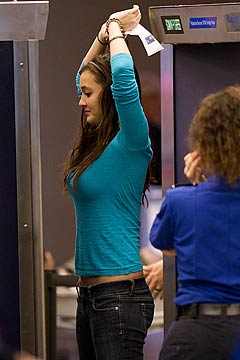 CONcealed Available Body Weapons (CONABs)
If you don't have your gun when you need it, its worthless.
Designated Master-at-Arms to Defend Small Groups of Servicemen on Liberty off-FOB/warship/base etc.
Attack profile we are trying to prevent: terr attacking CF of GIs to get body count bragging rights for evening news
M9 Beretta: only concealable on hip/belt covered up by polo shirt
Other Options:
Sig-Sauer P228 M11
remtek.com/arms/sig/model/228/228.htm
"Pocket Glock" Model 26
gunblast.com/Glock26.htm
Kel-Tech PF9
en.wikipedia.org/wiki/Kel-Tec_PF-9
9mm pistols however, can be more easily concealed on the body than PDWs of a non-drinking trooper to act as a designated security man in small groups of servicemen when off-duty. The individual serviceman when on assignments where he must blend-in as much as possible by wearing civilian attire also needs a concealed pistol to defend against assassination, robbery or abduction. The current case of a CIA agent who successfully defended himself from attack in Pakistan is a positive example of why carrying a pistol is vital in dangerous areas. There are many dangerous areas in the U.S.A., too!
Why Bring a Gun to a Knife Fight?
If someone has a knife and attacks you within 21 feet of distance from you, he/she will stab you before you can draw a pistol from a holster and extend it out with your arm and aim. This is why competent people drill to first lift up their pistol and rotate it immediately after clearing the holster and actually train to fire from the hip. Even if one does this, at least 10 feet of separation is needed to avoid being cut from a knife attacker. This is why the knife/bayonet already attached to the end of a rifle is a good thing when in a war situation:
The pictures below illustrate what a knife attack can do against even an allegedly skilled policeman.
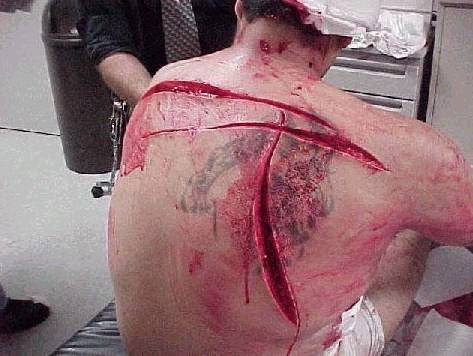
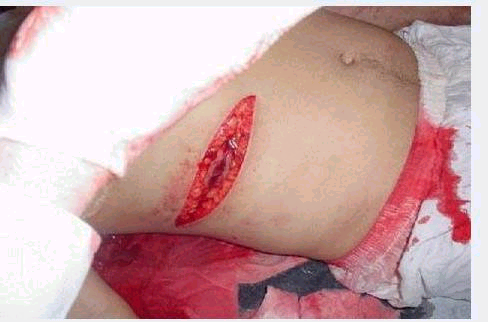
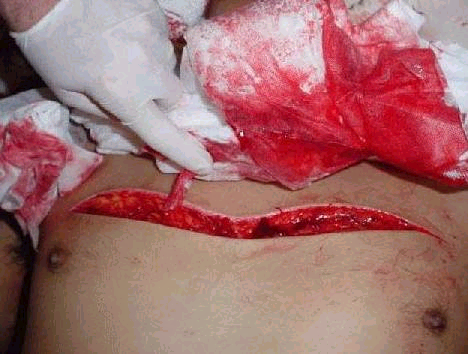
So the best answer is to bring BOTH a knife/bayonet and a gun to a gun or a knife fight.
Why Bring a Gun to a Gun Fight?
2012: 'Nother MKultra Shooter to Discredit 2nd Amendment
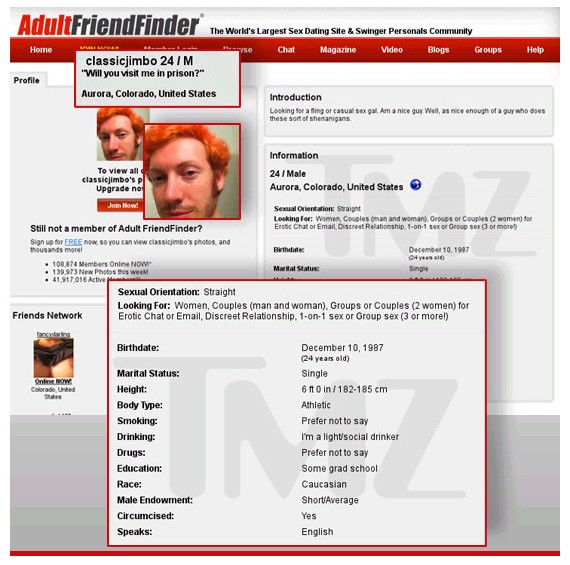
First witness report. Two individuals did the crime.
CRIMINAL CONSPIRACY: Yet Again...
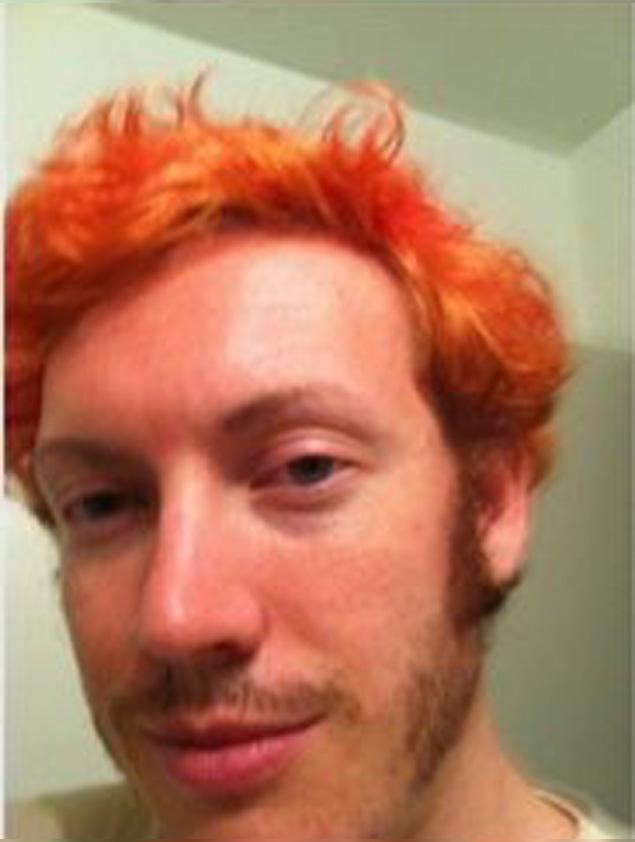
wkyc.com/news/article/252995/396/Witness-Someone-let-gunman-inside-Colorado-movie-theater
Witness: Someone let gunman inside Colorado movie theater
9:42 AM, Jul 20, 2012 | 0 comments
Written by CNN
AURORA, CO -- A man who was at the Colorado movie theater where a dozen people were killed this morning, says he saw the gunman.
He says he thinks someone deliberately let the gunman inside once the movie started.
Here's what he told TV station KCNC this morning live on their newscast.
"As I was sitting down to get my seat, I noticed that a person came up to the front row, the front right, sat down, and as credits were going, it looked like he got a phone call. He went out toward the emergency exit doorway, which I thought was unusual to take a phone call. And it seemed like he probably pried it open, or probably did not let it latch all the way. As soon as the movie started, somebody came in, all black, gas mask, armor, and threw a gas can into the audience, and it went off, and then there were gunshots that took place."
Police arrested 24-year-old James Holmes of Aurora, Colorado, for the shootings.
At least 12 people were killed and 38 others wounded when the gunman opened fire during the midnight screening of the newest Batman film, "The Dark Knight Rises."
MainStream Media (MSM) spin control now offers that Holmes propped the door and went out to his car and then returned armed:
http://news.yahoo.com/police-colo-suspect-planned-attack-months-232812400.html
"After buying a ticket to the movie, Holmes went into the theater and propped open an exit door several minutes into the film, a federal law enforcement official said. The suspect then returned in protective gear and with high-powered weapons and opened fire, shooting scores of people and picking off victims who tried to flee, officials said."
This does not wash with the statement of the actual witness. This smells of a USG-sponsored LIE.
Yet Another Probably CIA-Concocted Gun Murder Spree to Undermine the 2nd Amendment
The Arrestee just sat in the patrol car afterwards in a drugged or mind-control stupo. The shooter allegedly had a mask on so no positive ID could be made. Another mind-kontrolled Sirhan Sirhan-type patsy it seems.
Obviously, this was a False Flag Attack (FFA) on the 2nd Amendment to influence Senate votes after POTUS Obama signs the UN Small Arms Treaty next Friday. The false flag here was that a demented INVIVIDUAL did the shootings, thus individuals cannot be trusted to own firearms to defend themselves or go hunting, target shooting etc. The truth is that the U.S. Government staged this attack through its treasonous, Nazi-originated Central Intelligence Agency (CIA) that has several large building centers around the United States dedicated to MKULTRA-style mind control research. The Virginia Tech and Fort Hood shootings were done by MKULTRA shooters and these locations are near known CIA research centers. Its common knowledge that the CIA murdered President John F. Kennedy and his brother Robert Kennedy--the latter's patsy Sirhan Sirhan is known to be mind-kontrolled even by the general public--YET NOTHING HAS BEEN DONE TO PUNISH THE CIA BY DISBANDING IT.
In our book, James Bond is Real, we detail how assassination by mind-kontrol against the will of the individual is a REALITY warned about by many intelligence professionals like Royal Navy Commander and MI6 operative Ian Fleming in code in fiction books like The Man with the Golden Gun.
In our next book, James Bond is Real 2: Bodyguard of Spies, we argue that as part of murdering President Franklin Delano Roosevelt (FDR) in 1945, the right-wing fascist Rockefeller Illuminati placed their puppet Harry S. Truman in position as Vice President and when he became POTUS, he disbanded the highly effective and moral Office of Strategic Services (OSS)--at the very time America needed them to stop the German Nazis from escaping and the Soviet Communists from stealing our nuclear bomb secrets. Truman dishonestly claimed he disbanded the OSS because he didn't want a "Gestapo" on American soil, then 2 years later created an actual German-Nazi composed Gestapo by signing into existence the CIA--which is controlled the the Rockefeller Illuminati's Wall Street interests and DOES NOT SERVE WE-THE-PEOPLE.
America's local and state law enforcement organizations (LEOs) ARE NOT UP TO THE JOB OF INVESTIGATING GOVERNMENTAL MIND KONTROL crimes.
They are not up to the job of going after the CIA. The FBI is up to the job--but will not do it. The FBI is part of the Nazi take-over of America for the Rockefeller Illuminati.
Here is the cure. Start by disarming both the BATF and FBI's para-military defacto RICO criminal factions. Shut down the CIA technical services division (TSD) where they made hallucinogens, scopolomine derivatives and mind-kontrol drugs. Arrest all spychiatrists in the DOD and American Intel, and any operative or asset using psychotronics or drugs in Nazi style Joseph Mengele mind-kontrol ops. Use the "Patriot Acts" to arrest them. (Tongue-in-cheek) Take them to off-shore black prison sites and torture them until they "confess"--then execute them for admitting guilt (public hanging, televised world-wide).
This will almost eliminate if not totally cease all the school, public gathering shootings, "zombie attacks" and other public MKULTRA "lone nut attacks".
In fact, the ability of any citizen clear of a felonious crime record should have the ability to conceal weapon carry (CCW) firearms to ANY location to include even public gatherings so if government-concocted terrorists attack, they can be stopped. It's high time the RIGHT of the general public to defend itself be elevated and this non-sense that somehow small elites can or will defend a 3, 000 mile wide land mass filled with 300+ million people be stopped.
Drugs + Patsy Shooters = The Big Pharma Connection
Rarely covered in the Mass Media, one of the most important stories of our time. Listing of drug-connected shottings:
http://ssristories.com/index.php
Every school shooting, zombie attack and many murders and suicides are linked to anti-depressants. This is a major profit center for big pharma and allows intel agencies to create "unconscious, programmed shooters or patsies quite easily. This is a story that needs front billing. A major congressional commission needs to be set up with non-pharma, non-intel linked ordinary citizen representatives to investigate these MKultra American Intel "lone nut" shooting and zombie attacks.
All are linked to pharmaceuticals and illegal drugs one way or another, It American Intel was forced to stop all such "experiments" and covert operations through exposure and prosecution, these killing would stop instantly. There are hundreds of Agents and insiders who would come forth and talk if they were offered protection.
Another Motive: Get the Blogger?
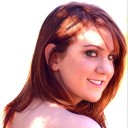
http://news.yahoo.com/colo-authorities-identify-final-rampage-victims-224522288.html
An aspiring sports reporter who recently wrote a blog post about surviving a Toronto shooting was killed, the woman's brother said.
The death of Jessica Ghawi, who was also known as Jessica Redfield, was a "complete and utter shock," said her brother, Jordan Ghawi.
Jessica Ghawi, 24, moved to Denver from Texas about a year ago and friends and colleagues described her as outgoing, smart and witty.
Ghawi blogged at length about surviving the Eaton Centre mall shooting in Toronto that killed two people and sent several others to the hospital.
Jessica Ghawi wrote of the Toronto shooting: "I was shown how fragile life was on Saturday. I saw the terror on bystanders' faces. I saw the victims of a senseless crime. I saw lives change. I was reminded that we don't know when or where our time on Earth will end. When or where we will breathe our last breath."
WTFO?
WHY was Ghawi in TORONTO last month?
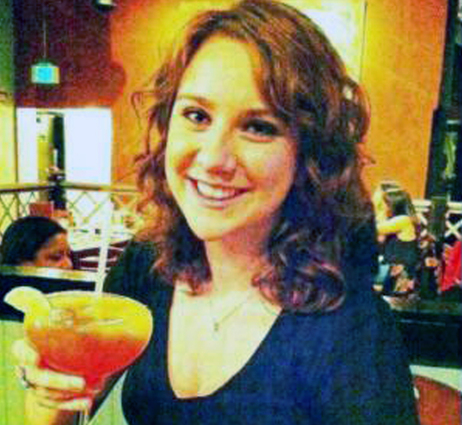
Reports say she was following her boyfriend, James Meloff a minor league hockey player.
thedenverchannel.com/theatershooting/31290959/detail.html
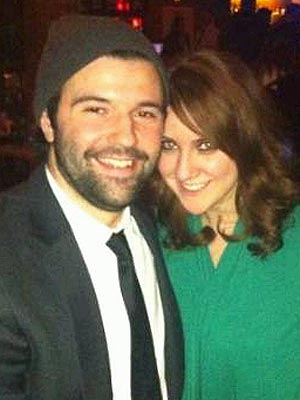
Where did she get the money to be flying around the world ostensibly to watch her BF play hockey?
And did she BECOME THE TARGET by blogging (telling the world about the horror of it all etc.) about the Toronto shootings?
http://jessicaredfield.wordpress.com/2012/06/
Archive for June, 2012
Late Night Thoughts on the Eaton Center Shooting
Posted by Jessica Redfield in Uncategorized on June 5, 2012
I can't get this odd feeling out of my chest. This empty, almost sickening feeling won't go away. I noticed this feeling when I was in the Eaton Center in Toronto just seconds before someone opened fire in the food court. An odd feeling which led me to go outside and unknowingly out of harm's way. It's hard for me to wrap my mind around how a weird feeling saved me from being in the middle of a deadly shooting.
What started off as a trip to the mall to get sushi and shop, ended up as a day that has forever changed my life. I was on a mission to eat sushi that day, and when I'm on a mission, nothing will deter me. When I arrived at the Eaton Center mall, I walked down to the food court and spotted a sushi restaurant. Instead of walking in, sitting down and enjoying sushi, I changed my mind, which is very unlike me, and decided that a greasy burger and poutine would do the trick. I rushed through my dinner. I found out after seeing a map of the scene, that minutes later a man was standing in the same spot I just ate at and opened fire in the food court full of people. Had I had sushi, I would've been in the same place where one of the victims was found.
My receipt shows my purchase was made at 6:20 pm. After that purchase I said I felt funny. It wasn't the kind of funny you feel after spending money you know you shouldn't have spent. It was almost a panicky feeling that left my chest feeling like something was missing. A feeling that was overwhelming enough to lead me to head outside in the rain to get fresh air instead of continuing back into the food court to go shopping at SportChek. The gunshots rung out at 6:23. Had I not gone outside, I would've been in the midst of gunfire.
I walked around the outside of the mall. People started funneling out of every exit. When I got back to the front, I saw a police car, an ambulance, and a fire truck. I initially thought that maybe the street performer that was drumming there earlier had a heart attack or something. But more and more police officers, ambulances, and fire trucks started showing up. Something terrible has happened. I overheard a panicked guy say, "There was a shooting in the food court." I thought that there was no way, I was just down there. I asked him what happened. He said "Some guy just opened fire. Shot about 8 shots. It sounded like balloons popping. The guy is still on the loose." I'm not sure what made me stick around at this point instead of running as far away from the mall as possible. Shock? Curiosity? Human nature? Who knows.
Standing there in the midst of the chaos all around us, police started yelling to get back and make room. I saw a young shirtless boy, writhing on a stretcher, with his face and head covered by the EMS as they rushed him by us to get him into an ambulance. The moment was surprisingly calm. The EMTs helping the boy weren't yelling orders and no one was screaming like a night time medical drama. It was as if it was one swift movement to get the boy out of the mall and into the ambulance. That's when it really hit me. I felt nauseas. Who would go into a mall full of thousands of innocent people and open fire? Is this really the world we live in?
Police start yelling again "GET BACK NOW!" Another stretcher came rushing out of the mall. I saw a man on a stretcher, the blanket underneath him spotted with blood. Multiple gunshot holes in his chest, side, and neck were visible. It's not like in the movies when you see someone shot and they're bleeding continuously from the wound. There was no blood flowing from the wounds, I could only see the holes. Numerous gaping holes, as if his skin was putty and someone stuck their finger in it. Except these wounds were caused by bullets. Bullets shot out of hatred. His dark skin on his torso was tinted red with what I assume was his own blood. He was rushed into the ambulance and taken away.
More people joined the crowd at the scene and asked what happened. "There was a shooting in the food court," kept being whispered through the crowd like a game of telephone. I was standing near a security guard when I heard him say over his walkie talkie, "One fatality." At this point I was convinced I was going to throw up. I'm not an EMT or a police officer. I'm not trained to handle crime and murder. Gun crimes are fairly common where I grew up in Texas, but I never imagined I'd experience a violent crime first hand. I'm on vacation and wanted to eat and go shopping. Everyone else at the mall probably wanted the same thing. I doubt anyone left for the mall imagined they witness a shooting.
I was shown how fragile life was on Saturday. I saw the terror on bystanders' faces. I saw the victims of a senseless crime. I saw lives change. I was reminded that we don't know when or where our time on Earth will end. When or where we will breathe our last breath. For one man, it was in the middle of a busy food court on a Saturday evening.
I say all the time that every moment we have to live our life is a blessing. So often I have found myself taking it for granted. Every hug from a family member. Every laugh we share with friends. Even the times of solitude are all blessings. Every second of every day is a gift. After Saturday evening, I know I truly understand how blessed I am for each second I am given.
I feel like I am overreacting about what I experienced. But I can't help but be thankful for whatever caused me to make the choices that I made that day. My mind keeps replaying what I saw over in my head. I hope the victims make a full recovery. I wish I could shake this odd feeling from my chest. The feeling that's reminding me how blessed I am. The same feeling that made me leave the Eaton Center. The feeling that may have potentially saved my life.
This smells like the handiwork of the MILINDCOMP; find a minor celebrity and connect him/her to the upcoming tragedy. The Congressman Gifford shooting featured a bonus victim thrown-in-the-mix.
Maybe the SPECIFIC, TACTICAL TARGET for the Denver shootings was Ghawi to magnify the fear-mong?
The STRATEGIC target is to fear-mong Congress and the general public to attack the 2nd Amendment?
If that couldn't be accomplished, then to push for a ban on 100-round drum magazines like the shooter is alleged to have used? Remember the 32-round magazine hysteria during the Gifford shootings?
Loose Lips Sink Tweeters: Don't Tell the Entire World Your Personal Details
 youtube.com/watch?v=Ss_sLBOAurU
To instigate the assassination of Ghawi (disgusting in itself to kill a woman) would be EASY, SHE HAD NO OPerational SECurity (OPSEC). Tweeting what she was doing every second of her life. Typical of the weak-egoed sheeple of an increasingly fascist America. Certainly, her killers would know she wanted to go see the new Batman movie at a public theater... This idiotic tweeting and FACEBOOK BS has to stop...
people.com/people/article/0,,20613638,00.html
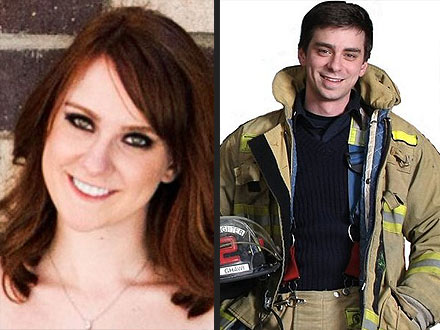
Jordan Ghawi received one of the most horrific phone calls imaginable early Friday morning.
His mother, "hysterical and almost unintelligible," phoned with news that his sister, 24-year-old Jessica Ghawi, had been shot at a midnight showing of The Dark Knight Rises in Aurora, Colo., Jordan blogged Friday.
Twelve people were killed and 59 more injured by alleged gunman James Holmes, who reportedly later called himself The Joker.
Jordan, 26, a student, firefighter and paramedic in Texas, traveled to Colorado on Friday morning and wrote in detail about his sister's final moments, as told to him by their mutual friend Brent.
"Jessica and Brent were seated in the middle portion of the theatre when a device was thrown into the theatre that produced a 'hissing' sound," Jordan wrote. "The theatre then began to fill with smoke which is when patrons began to move from their seats. At that time, shots were fired."
He continued in chilling detail.
Brent and Jessica dropped for cover. "Brent then heard Jessica scream and noticed that she was struck by a round in the leg," Jordan wrote. "Brent, began holding pressure on the wound and attempted to calm Jessica."
"It was at this time that Brent took a round to his lower extremities. While still administering first aid, Brent noticed that Jessica was no longer screaming. He advised that he looked over to Jessica and saw what appeared to be an entry wound to her head."
Jordan later wrote that he received word from the coroner's office that his sister indeed died from injuries sustained during the shooting.
"Let us remember the names of the victims and not the name of the coward who committed this act," Jordan Tweeted Friday afternoon.
A total of 71 moviegoers were shot at the Century 16 Theater at the Town Center Mall in Aurora.
The Anti-Gun "Payload"
http://news.yahoo.com/blogs/lookout/police-press-motive-denver-area-movie-massacre-232932177.html
Movie theater gunman had been stockpiling arsenal
By Jason Sickles, Yahoo! | The Lookout - 56 mins ago
AURORA, Colo. - The gunman who blasted his way through a packed movie house early on Friday, killing 12 people and injuring 58 others, had apparently been planning his attack for weeks.
"In the last 60 days he purchased four guns at local metro gun shops, and through the Internet he purchased over 6,000 rounds of ammunition," Aurora Police Chief Daniel Oates said Friday night.
The suspect, 24-year-old former medical student James Holmes, had also been stockpiling magazines to carry the gun ammunition. One clip recovered at the scene could hold 100 rounds for his assault rifle.
"As far as we know, it was a pretty rapid pace of fire in that theater," Chief Oates said.
Police are trying to learn more about the man's motives but have thus far been unable to access his booby-trapped apartment near the Colorado medical school where he recently withdrew from classes.
Investigators have described the apartment as being filled with chemicals, trip wires, jars of ammunition and possible mortar rounds.
"It is a very vexing problem how we'll get into that apartment safely," Chief Oates said. "I've personally never seen anything like what the pictures show us."
A law enforcement official familiar with the explosives left in the suspect's apartment described them as "pretty sophisticated" improvised explosive devices.
"These are not ordinary pipe bombs," said the investigator, who told Yahoo News on the condition his name would not be used. "No doubt it was meant to kill or maim any first responder that went into that apartment."
Officials said it could be Saturday or later before they get the suspect's home defused. If not, the investigator told Yahoo News, serious damage to the entire apartment building is a risk.
The thermal liquids left behind "could certainly heat up that room pretty quickly," he said. "We're not going to destroy a building."
Holmes is being held in the Arapahoe County Jail. Chief Oates said the man has an attorney, but refused to say if the alleged gunman is cooperating.
"I won't talk about his admissions," the police chief said. "The most important thing is that there is justice for these victims, and justice will occur in a courtroom."
Holmes is scheduled to make his first court appearance at 8:30 a.m. local time on Monday in Aurora.
Witnesses have given chilling descriptions of the scene at the movie theater.
"He was dressed in head-to-toe armor and looked like he meant business," said Jordan Crofter, who escaped the theater unharmed. "He just walked around like he was having fun. It was just target practice. His goal was to kill as many people as he could." [EDITOR: Why didn't you tackle him, asshole?]
The number of casualties makes the incident one of the largest mass shootings in recent U.S. history.
What provoked the madness may not be clear anytime soon.
Holmes, a former college honors graduate who moved to Colorado to attend medical school, is not talking to investigators, a law enforcement official briefed on the investigation told The Associated Press.
The official spoke on condition of anonymity in discussing the ongoing case. Police also found jars of chemicals in Holmes' booby-trapped Aurora apartment with wires nearby.
"This is the act ... of a very deranged mind," said Colorado Governor John Hickenlooper.
Aurora Police Chief Dan Oates said hundreds of calls came in starting at 12:39 a.m. MDT on Friday, and officers were on the scene within 60 to 90 seconds. Some 200 officers eventually responded.
It is believed that Holmes acted alone, and the FBI said there was no indication of ties to any terrorist groups.
While some witnesses said the gunman entered through a side-door emergency exit at the front of the theater, a federal law enforcement official, speaking on condition of anonymity, said Holmes bought a ticket and went into the theater as part of the crowd. [EDITOR: This is fucking ubber BS. State your name and be connected to this lie. Otherwise, we are to believe movie theater operators LET a guy heavily armed buy a ticket and enter the theater? Not likely.]
The official said Holmes then apparently propped open an exit door in the theater as the movie was playing, donned the protective ballistic gear and opened fire, the AP reported.
Chief Oates said officers found an AR-15 assault rifle-the civilian form of the M-16-a Remington 12-guage shotgun and a .40-caliber Glock handgun in the theater and another identical handgun in the car. The gunman set off two devices that released a smoke or an irritant to distract the crowd.
"There were bullet (casings) just falling on my head. They were burning my forehead," said Jennifer Seeger, one of the first to spot Holmes as he stormed inside.
"I was just a deer in headlights. I didn't know what to do," she said. Then she ducked to the ground as the gunman shot people seated behind her.
She said she began crawling toward an exit when she saw a girl of about 14 "lying lifeless on the stairs." She saw a man with a bullet wound in his back and tried to check his pulse, but "I had to go. I was going to get shot."
"Every few seconds it was just: Boom, boom, boom," Seeger said. "He would reload and shoot and anyone who would try to leave would just get killed."
Some of the victims were treated for chemical exposure apparently related to canisters thrown by the gunman. Those hurt included a 4-month-old baby, who was treated at a hospital and released.
New York City's police commissioner said he was told the gunman had painted his hair red and called himself the Joker-Batman's nemesis-but Aurora police would not confirm that.
For a few moments, many moviegoers thought the initial commotion might have been a promotional stunt tied to the film's opening.
Quentin Caldwell said they were about 15 minutes into the film when he heard a very distinct "pop, pop, pop, pop."
"My wife jumped, and I just kind of sat there like, 'Oh, it was probably just really good special sound effects,'" he told CNN.
But Caldwell and his wife soon saw injured people and knew they needed to escape.
"There were people still sitting there waiting for the movie to continue," he said. "I looked at them like, 'This is real, there's something wrong, we need to leave now.'"
Those who knew Holmes as a youth describe him as a shy, intelligent person raised in California by parents who were active in their well-to-do suburban San Diego neighborhood. He played soccer at Westview High School and ran cross-country before going to college, the AP reported.
A University of Colorado-Denver spokeswoman said Holmes enrolled in a Ph.D. program in neuroscience a year ago but was in the process of withdrawing at the time of the shooting.
Police released a statement from Holmes' family: "Our hearts go out to those who were involved in this tragedy and to the families and friends of those involved."
It was the worst mass shooting in the U.S. since the Nov. 5, 2009, attack at Fort Hood, Texas. An Army psychiatrist is awaiting trial for killing 13 Soldiers and civilians and wounding more than two dozen others.
In Colorado, it was the deadliest since the Columbine High School massacre on April 20, 1999, when two students opened fire in the Denver suburb of Littleton, killing 12 classmates and a teacher and wounding 26 others before killing themselves. Columbine High is about 12 miles from the theater.
(This story was compiled by reports from Associated Press writers P. Solomon Banda and Thomas Peipert, and Yahoo! News staffers Tim Skillern, Tim Sprinkle, Ron Recinto and Torrey AndersonSchoepe.)
WHY Wasn't At Least One Military Person ARMED to Stop the Gunman?
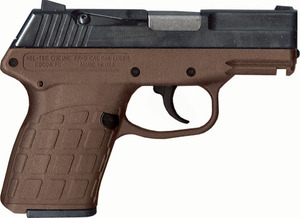
To live on post and have privately owned guns is a bitch. If in barracks they stay in the arms room. If in post housing, you can't legally carry concealed on post--so it makes leaving or entering post CCW a bitch.
CONCLUSION: USMIL personnel are sheeple, too. Not defenders of squat--and this is BS. We ain't defending shit--much less ourselves. Consider the Fort Hood shootings...just one CCW person and day is saved. Same applies in Colorado. That American servicemen would have to be both MORAL and COMPETENT to be trusted with CCW powers--and not become gun spree killers themselves--is a situation the MILBUREAUCRACY doesn't want lest they have wise people not willing to be door mats sent on fool's errands for the Illuminati's goals.
http://news.yahoo.com/u-military-members-among-colorado-shooting-casualties-154534235.html
U.S. military members among Colorado shooting casualties
Reuters - Fri, Jul 20, 2012
WASHINGTON (Reuters) - U.S. military personnel apparently were among the casualties in the shooting at a "Batman" movie in Colorado Friday but it was not immediately clear whether any were killed, the Defense Department said.
Initial indications are that some service members were casualties and the alleged shooter did not have any military ties, spokesmen for the Pentagon and the military's joint chiefs of staff told reporters. They did not immediately have any numbers for the military casualties.
(Reporting By Jim Wolf; Editing by Eric Beech)
More Details:
http://news.yahoo.com/colo-authorities-identify-final-rampage-victims-224522288.html
Navy cryptologist John Larimer went to the theater with three other sailors from nearby Buckley Air Force Base, Navy Cmdr. Jeffrey Jakuboski said. Larimer was shot and killed, and Jakuboski said losing Larimer felt like losing "one of my sons."
"Losing a Sailor, whether it's in combat or whether it's in a horrific domestic situation like this, it's hard. It's tough," he said.
Larimer's family said his brother is working with the Navy to take his body home to Crystal Lake, Ill.
An Air Force reservist who worked at Buckley also was killed in the rampage. Sgt. Jesse Childress, 29, was a cyber-systems operator from Thornton, Colo., said Air Force Capt. Andrew Williams.
Williams described Childress as knowledgeable, experienced and respectful. He says Childress was athletic and played in a kickball and volleyball tournament on base. "He was always our star," Williams said.
LESSON: PEOPLE IN THE USMIL SHOULD BE AUTOMATICALLY EMPOWERED TO CARRY CONCEALED WEAPONRY--EVEN OFF-DUTY TO THWART ATTACKS.
Here's the Anti-Gun Owner "Payload": We Can't Trust Individuals to Have Guns--Even Rich, Smart People Can Be Psychos
http://news.yahoo.com/colorado-suspect-brilliant-science-student-230349806.html
Colorado suspect was brilliant science student
Associated Press
By DAN ELLIOTT and MICHAEL R. BLOOD | Associated Press - 6 mins ago
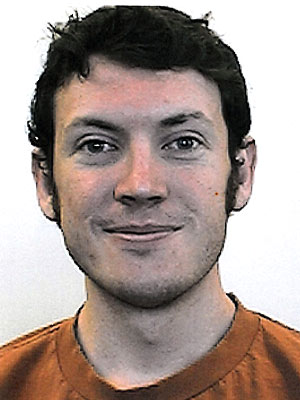
This photo provided by the University of Colorado shows James Holmes. University spokeswoman Jacque Montgomery says 24-year-old Holmes, who police say is the suspect in a mass shooting at a Colorado movie theater, was studying neuroscience in a Ph.D. program at the University of Colorado-Denver graduate school. Holmes is suspected of shooting into a crowd at a movie theater killing at least 12 people and injuring dozens more, authorities said. (AP Photo/University of Colorado)
This photo provided by the University ...
DENVER (AP) - James Eagen Holmes came from a well-tended San Diego enclave of two-story homes with red-tiled roofs, where neighbors recall him as a clean-cut, studious young man of sparing words.
Tall and dark-haired, he stared clear-eyed at the camera in a 2004 high school yearbook snapshot, wearing a white junior varsity soccer uniform - No. 16. The son of a nurse, Arlene, and a software company manager, Robert, James Holmes was a brilliant science scholar in college.
The biggest mystery surrounding the 24-year-old doctoral student was why he would have pulled on a gas mask and shot dozens of people early Friday in a suburban Denver movie theater, as police allege.
In the age of widespread social media, no trace of Holmes could be found on Facebook, LinkedIn, MySpace, Twitter or anywhere on the Web. Either he never engaged or he scrubbed his trail.
[EDITOR: FALSE. We have an alleged Holmes profile on Adult Friend Finder.]
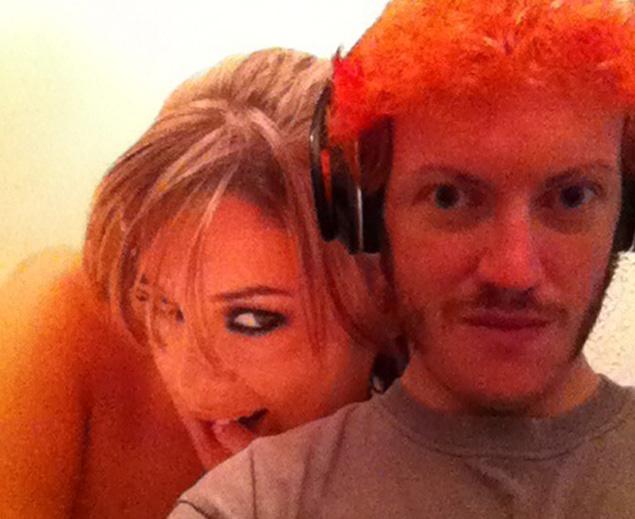
A longtime neighbor in San Diego, where Holmes grew up, remembers only a "shy guy ... a loner" from a churchgoing family. In addition to playing soccer at Westview High School, he ran cross country.
The bookish demeanor concealed an unspooling life. Holmes struggled to find work after graduating with highest honors in spring 2010 with a neuroscience degree from the University of California, Riverside, said the neighbor, retired electrical engineer Tom Mai.
Holmes enrolled last year in a neuroscience Ph.D. program at the University of Colorado-Denver but was in the process of withdrawing, said school officials, who didn't provide a reason. The school later said in a statement that he left the program in June 2012.
As part of the advanced program in Denver, a James Holmes had been listed as making a presentation in May about Micro DNA Biomarkers in a class named "Biological Basis of Psychiatric and Neurological Disorders."
In academic achievement, "he was at the top of the top," recalled Riverside Chancellor Timothy P. White.
Holmes concentrated his study on "how we all behave," White added. "It's ironic and sad."
From a distance, Holmes' life appears unblemished, a young man with unlimited potential. There are no indications he had problems with police.
Somehow, the acclaimed student and quiet neighbor reached a point where he painted his hair red, called himself "The Joker," the green-haired villain from the Batman movies, according to New York City Police Commissioner Ray Kelly, who said he had been briefed on the matter.
Authorities say Holmes arrived at the theater dressed in black, outfitted in a gas mask, ballistic helmet, vest and leggings, black tactical gloves and protectors on his throat and groin. He was armed with an assault-style rifle, a shotgun and Glock handgun.
[EDITOR: this is uber USG bullshit hearsay of the highest order.]
Police said he started his attack by tossing two gas canisters into the theater, where he had bought a ticket for the midnight showing of "The Dark Knight Rises," the new Batman movie.
A federal law enforcement official, speaking on condition of anonymity because of the ongoing probe into the rampage, said Holmes bought four guns from retailers in the past two months.
Holmes bought his first Glock pistol in Aurora, Colo., on May 22. Six days later, he picked up a Remington shotgun in Denver. About two weeks later, he bought a .223 caliber Smith & Wesson rifle in Thornton, Colo., and then a second Glock in Denver on July 6 - 13 days before the shooting, the official said.
A high-volume drum magazine was attached to the rifle, an assault weapon, the official said. Aurora Police Chief Dan Oates said that a 100-round drum magazine for the rifle was recovered from the scene.
"I'm told by experts that with that drum magazine, he could have gotten off 50 to 60 rounds, even if it was semiautomatic, within one minute," Oates said at a news conference. "And as far as we know, it was a pretty rapid pace of fire in that theater."
Julie Adams, whose son played junior varsity soccer with Holmes, said her son remembered little about the suspect, which was unusual for the tight-knit team.
"I don't think many of the kids (teammates) knew him. He was kind of a loner," she said.
Jackie Mitchell, a furniture mover who lives several blocks from the suspect's apartment building in Colorado, said he had drinks with Holmes at a bar on Tuesday night, though he showed no sign of distress or violence.
After Holmes approached him, "we just talked about football. He had a backpack and geeky glasses and seemed like a real intelligent guy, and I figured he was one of the college students," Mitchell said.
When Mitchell saw Holmes' photo after the shooting, "the hair stood up on my back," he said. "I know this guy."
Holmes is not talking to police and has asked for a lawyer, according to a law enforcement official briefed on the investigation. The official spoke on condition of anonymity to discuss the case. Police found jars of chemicals in Holmes' booby-trapped apartment with wires nearby, the law enforcement official said.
When he surrendered meekly in the movie house parking lot, Holmes told authorities what he'd done at his residence in the Denver suburb of Aurora, the third most populous city in Colorado.
"Our hearts go out to those who were involved in this tragedy and to the families and friends of those involved," Holmes' family said in a statement Friday. "We ask that the media respect our privacy during this difficult time."
San Diego Superior Court spokeswoman Karen Dalton said there were no records found under his name, not even for a traffic ticket. Riverside County prosecutors also have no criminal record for him, said John Hall, a spokesman for the district attorney's office. The only mark on his record in Aurora was a speeding summons from October, Oates said.
On Friday morning, police escorted the suspect's father from the family's San Diego home. The mother stayed inside, receiving visitors who came to offer support.
San Diego police spokeswoman Lt. Andra Brown spoke to reporters in the driveway of the Holmes' home, on behalf of the family.
"As you can understand, the Holmes family is very upset about all of this," she said. "It's a tragic event and it's taken everyone by surprise."
[EDITOR: Says who? This event did not take everyone by surprise, certainly not the perps who instigated it.]
___
Blood reported from Los Angeles. Associated Press contributors to this report include Elliot Spagat and Julie Watson in San Diego; Eileen Sullivan, Alicia A. Caldwell and Pete Yost in Washington; Tom Hays in New York; Amy Taxin in Orange County, Calif.; Colleen Slevin in Denver; and Eric Carvin and AP researcher Judith Ausuebel in New York.
1985: 4 Lax U.S. marines Slain in El Salvador
http://en.wikipedia.org/wiki/1985_Zona_Rosa_attacks
The Zona Rosa attack was a guerrilla attack that took place in the Zona Rosa nightclub area of San Salvador, El Salvador at approximately 21:30 on June 19, 1985. The attack was conducted by gunmen dressed as Salvadoran Soldiers, and in total twelve people were killed: four United States Marines, two United States businessmen, a Guatemalan, a Chilean, and four Salvadorans. A left-wing guerrilla group, the Central American Revolutionary Workers' Party (PRTC), and its terrorist arm, the Mardoqueo Cruz Urban Commando (CMC) claimed responsibility for the attack.In July 1985, as part of the Combat Terrorism Act, the United States offered a reward of $100,000 U.S. dollars for information leading to the conviction of the attackers. By September 1985, the Salvadoran government had arrested four men, one of them was Américo Mauro Araujo, a high-ranking Salvadoran Communist Party official. Seven others who were involved in the attack, however, were never apprehended.[1]
The attack
The four marines sat down at an outside table at Chili's restaurant in the area known as the "Zona Rosa" in the San Benito district. They were regular customers known to the owners of restaurants and cafes in the area and to those who worked there. They used to go there in groups whenever they were off duty.
The four marines were Staff Sergeant Bobby J. Dickson, Sergeant Gregory Weber, Staff Sergeant Thomas T. Handwork, Sergeant Patrick R. Kwiatkowski, who were with two other marines, were responsible for security at the United States Embassy. The marines, although not in uniform, were easily identifiable as United States marines by their haircuts, clothing, and security radios.[citation needed] There is no evidence that they were carrying weapons. After a while, two of them left the group and went to sit down at a table in the Flashback restaurant a few yards away from their companions at Chili's. One witness said the marines were approached by a young man who briefly spoke with them and then bicycled away. Ten minutes later, at about 9 p.m., ten men-wearing camouflage shirts and caps and riding in a light-colored pickup truck-arrived in front of a group of four adjacent sidewalk cafes. The patrons of the cafes dismissed the group as a military patrol conducting a search or a document check.
The truck parked on the street in front of Chili's where the marines were seated. The attack element jumped from the truck and turned toward the customers while others from their group deployed to adjacent security positions. The attackers moved directly toward the table where the marines were seated while firing on full automatic with U.S. M16s, German G-3s, and Uzi submachine guns. Fire was initially directed at the marines but was then turned against other patrons. One marine was reportedly chased into "Las Pizzas" cafe and killed. Several other armed men provided security by directing gunfire towards the Brazilian Embassy across the street.[citation needed]
On June 21, 1985, a juvenile delivered an envelope to the Salvadoran National Police containing a communique he said he found in a telephone booth. The envelope contained a note from a Salvadoran guerrilla group called the Central American Revolutionary Workers' Party (the Partido Revolucionario de los Trabajadores Centroamericanos or "PRTC"), which was one of the guerrilla groups constituting the Farabundo Marti National Liberation Front (FMLN). The communique stated that the FMLN claimed responsibility for the "annihilation attack against American military advisors".[citation needed]
Attackers
In 1992, three men were convicted of taking part in the gun attack. They were released the same year, having served their sentence.[2] The mastermind of the attack, Pedro Antonio Andrade, was arrested in 1989 but was allowed to remain in the United States after giving help to authorities until 1997,[citation needed] when he was deported to El Salvador.[3]
Lax USAF "Security Police" Get Gunned Down By Akbar-Idiot in Germany
The Aktard Idiot
As if one needs more proof that U.S. military personnel need to be ARMED at all times, especially when overseas despite what the stupid "mother may I?" bureaucracy says. Here is a perfect example of a GROUP of servicemen that needed at least ONE of them armed with a concealed pistol. Families should be complaining about how the USAF bureaucracy let these men become such soft targets in the first place and demand that every group of USMIL men have at least one designated master-at-arms to protect them.
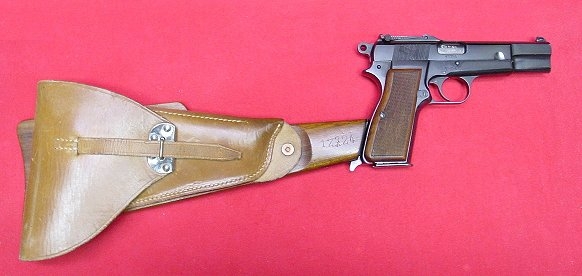
Moreover, U.S. military personnel active, guard or reserve should also be able to own and fire pistols with integral or attached stocks connected together to boost range so they can hit fleeing gunmen like the akbartard out to 50 meters by a steadier aim--not improved ballistics since the barrel length is unchanged.
http://righttruth.typepad.com/right_truth/2011/03/arid-ukas-pistol-jammed-after-killing-two-american-airmen-injuring-two-more.html
March 04, 2011
Arid Uka's pistol jammed after killing two American airmen, injuring two more
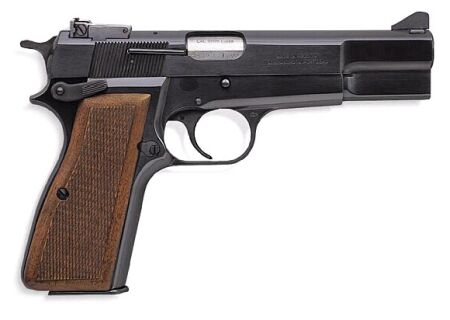
http://en.wikipedia.org/wiki/Browning_Hi-Power
But for a jammed FN 9mm pistol the terrorist in Germany could have killed at least six other Americans - the
Arid Uka is one of many terrorists who fall under the fairly new term "virtual jihadi" because, as we are informed so far, his inspiration came from the internet. I find it interesting that his grandfather
There is no word where the terrorist got the gun he used to kill Americans. I heard on Fox that this was the first time he had fired the gun.
www.msnbc.msn.com/id/41902481/ns/world_news-europe/
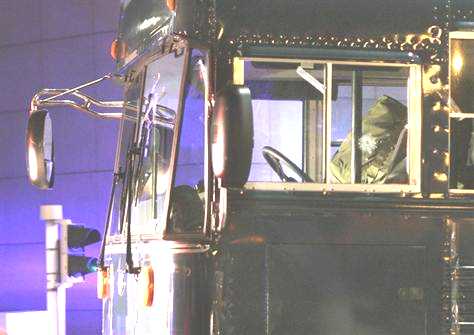
KARLSRUHE, Germany - U.S. Senior Airman Nicholas J. Alden was standing outside of a bus at Frankfurt airport when a young man first asked him for a cigarette, then whether he was bound for Afghanistan.
When Alden answered yes, the man fatally shot him, point blank, in the back of the head, then stormed aboard the bus shouting "Allah Akbar" - Arabic for "God is great." He shot and killed Airman 1st Class Zachary R. Cuddeback, who was at the wheel, then shot and injured two others, German authorities said Friday.
The gunman, identified as Arid Uka, a 21-year-old Kosovo Albanian, then pointed his FN 9mm pistol at yet another airman seated on the bus. "He pointed his pistol at his head and pulled the trigger twice, but the pistol jammed and no shots came out," prosecutor Rainer Griesbaum told reporters in Karlsruhe. (
MSNBC)I understand that Germany will not extradite criminals to countries where the death penalty is a possibility, so the question of what will happen to Arid Uka is unclear at this time...
The full MSNBC article reports:
"Jammed, empty shell casings prevented the weapon from firing again."
Not exactly the best advertisement for the Browning Hi-Power which has had otherwise an amazing career since 1935 in the hands of moral people actually fighting for a worthy cause like the SOE/OSS operatives and Allied forces fighting Nazism in WW2; epic fail for Mr. Aktard.
MSNBC continues:
When he saw the busload of 16 airmen parked outside Terminal 2 awaiting transport to the nearby Ramstein Air Base, he approached Alden, 25, from South Carolina, who was assigned to the 48th Security Forces Squadron at RAF Lakenheath in England.Cuddeback, 21, hailed from Virginia and was assigned to the 86th Vehicle Readiness Squadron at Ramstein Air Base in Germany. He was the only airman in uniform. The others were dressed in civilian cloths.
After his weapon jammed, Uka fled, authorities say. The 22-year-old airman he last tried to shoot chased him into the airport terminal, where he and police overpowered the attacker.
By 9mm pistol skills being "bread and butter" to each individual Ranger and eventually every Soldier, the force is then able to use side arms to personally protect themselves if in civilian clothes off-duty in a foreign land (re: the 4 marine security guards gunned down sitting at a street cafe in El Salvador), and pistols can be used in a silenced form to take out sentries/guards or enemy personnel if they encounter a Ranger Recon team in a hide location without alerting the enemy to their presence. The M9 Beretta is easily silenced by switching out barrels to one with threads to accept a silencer.
As an aside, the drivers of USMIL vehicles should at the very least wear concealed body armor since they are critical to the lives of everyone on board. If Cuddeback had been wearing a vest he may be alive today.
Night Fighting with Pistols
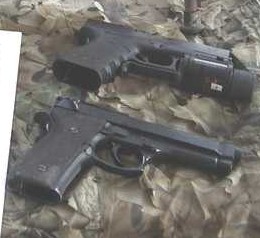
Ranger Glock 19 with Light and Beretta Model 92SBF Pistol
Tiger McKee writes in his article, "Low Light Combatives" for American Cop magazine:
Yet, the bulk of our preparation for combative use of firearms occurs during daylight. If your training doesn't include a healthy dose of low-light practice you're not equipping yourself for the conditions you'll likely be fighting under.
Another important matter to consider is the fact low-light conditions exist 24 hours a day. Step into one of the barns that surround the countryside of rural Alabama where I live. It's going to take a while for your eyes to adjust, making it difficult to see a snake lying in a corner, much less an attacker who's trying to hide. Urban environments are rife with dark structures. Then there are special circumstances like the New York City blackout of 2003. Even in situations where carrying a weapon isn't feasible, a light should be part of our gear - day and night.
To read the rest of his superb article:
Violent encounters typically take place within arms reach, happen in the blink of an eye, and the vast majority of these confrontations - more than 70 percent - occur in low light environments. Even Joe Average, who always sticks to the "nice" parts of town must occasionally make that late night run to the quick-stop, and dark parking lots are a favored hangout for nocturnal trouble makers.
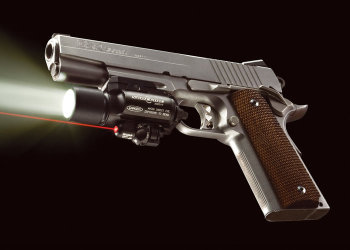
If you have a VISIBLE white light attached to your pistol directly or held separately in your non-firing hand, you can turn it on briefly to get a flash front sight picture with which to fire. The federal agents searching the dark room with small flashlights while holding a pistol has become a cliche' ever since the X-Files TV show began in the late 1990s.
Another option is to have an INVISIBLE infared light to move and search in dark areas but you must be wearing night vision goggles (NVGs) which are not likely to be on your person if attacked unless you are James Bond with image intensifiers built into your sunglasses (NOT). If you are in deliberate combat operations, this is the way to go. Invisible red dot aiming lasers are also an option with NVGs.
Since it's unlikely you will have NVGs, seeing to maneuver and aim is a problem with iron sights and a flashlight is needed. VISIBLE red dot lasers can be attached to the pistol in the grip (Crimson Trace crimsontrace.com), under the barrel in the guide rod (LaserMax lasermax.com) and on the end using a rail. The SureFire X400 below is an example:
www.surefire.com/X400product
If your Beretta Model 92 doesn't have a rail underneath its barrel; no problem attach the "Tick" to get one:
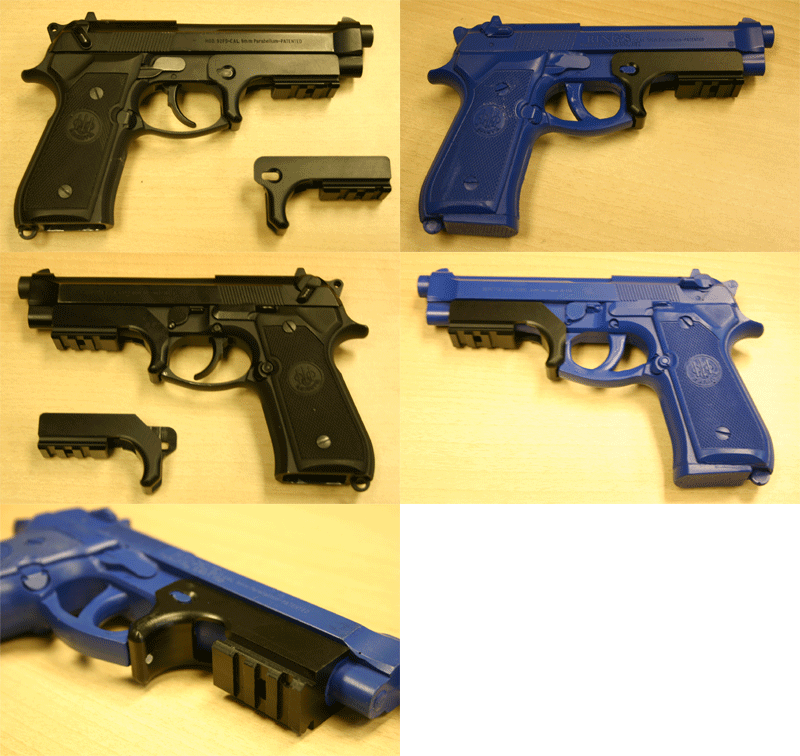
www.trgear.com/osc/eshop/product_info.php/products_id/211
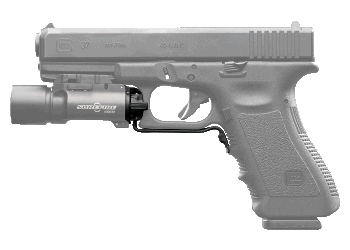
However, the problem with attaching a light under the barrel of your pistol is it throws off your holster sizing and demands special load carrying means that might harm your concealability. The red dot laser beams in the grip or under the barrel don't throw off your gun leather--but they only give you an aim point and don't help your eyes to see to maneuver or acquire the target.
You can quick attach/detach a flashlight under your pistol if it has a rail using the SureFire DG (Dev Group AKA Seal Team 6) option for their X300 or X400 flashlights...have your pistol flashlight in a separate pouch on your person until needed.
www.surefire.com/DG-Remote-Tailcap-Switch-X-Series
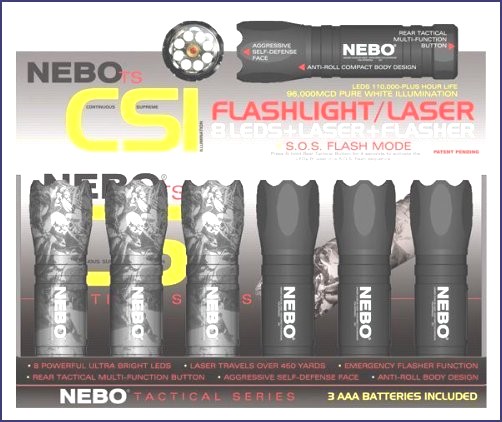
Another option is to hand-hold a separate flashlight with your pistol using the Harries or Chapman/Graham technique if on/off button is on end of flashlight) or the Ayoob technique if flashlight has button on body. The Nebo light is both a flashlight and a visible red dot laser beam to empower this method.
www.youtube.com/watch?v=Cm9exAwYD9w
There are several models of Nebo Tools Tactical and "CSI" flashlights to choose from--and they are in the affordable $25 price range. We showcase the Model 5067. You can order these from Fox Home Center in Illinois:
www.foxhomecenter.com/hand_tools/nebo.htm
Changing Magazines While your Non-Firing Hand is Holding a Flashlight?
The downside of holding a flashlight in the weak hand is what do you do when you need to change magazines?
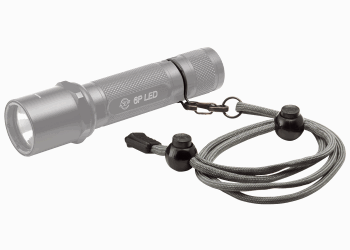
We suggest having that flashlight on a lanyard around your wrist so you can let go and free your hand for mag changes and have it dangle at your wrist. SureFire offers a lanyard to connect to 1" diameter flashlights like the Nebo light.
www.surefire.com/Z33-Lanyard-System
CQB Pistol Reload TTP: Heresy for the Status Quo
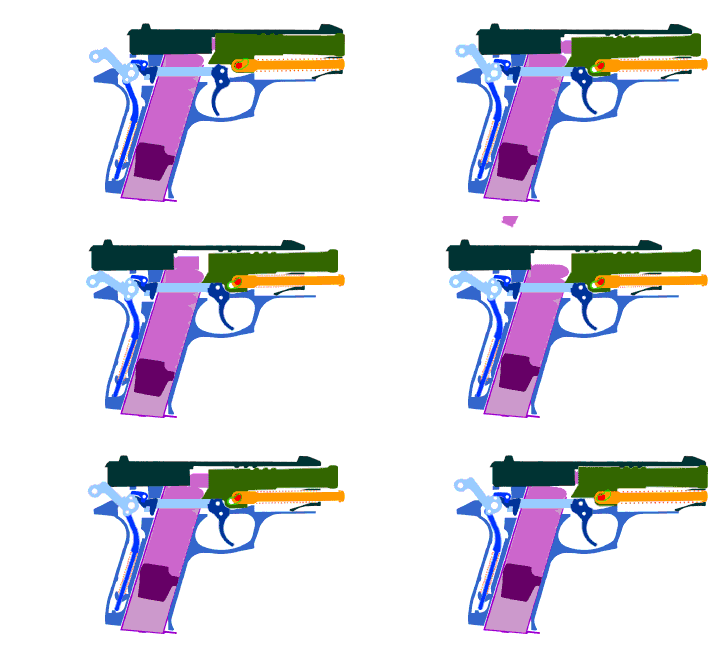
1st Tactical Studies Group (Airborne) weapons research has concluded that like for long guns, pistol magazines need to be retained by utilizing a pull-carry loop which can be improvised using gutted 550 parachute cord or buying replacement floor plates with a stiff plastic loop like Magpul offers. Below are replacement plates for the Glock Model 9:
www.tactical-kit.co.uk/ekmps/shops/tacticalkit/images/magpul-speedplate-for-glock-9-40-large-loop-3-pack-in-black-902-p[ekm]230x230[ekm].jpg
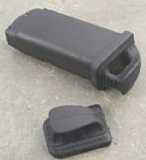
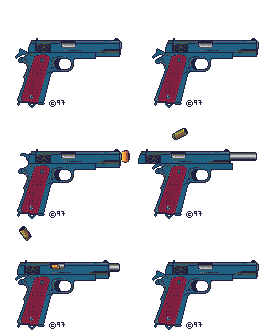 While it's true that in a CQB pistol fight, you usually only have what's carried on your body--and that is already loaded in magazines--so you don't have boxes of loose pistol ammo in say a daypack or rucksack to reload, it's still not wise to be dropping your magazines to have at the end of the firefight a chunk of metal that cannot be fired unless you get BOTH new magazines and ammunition. This explains why Army SOF units that use chubby .45 caliber cartridge-shooting pistols are big on dump pouches. Especially those units that use single-stack 7-round magazines for the Colt .45 ACP.
The concern that retaining pistol magazines will fatally slow down reloading is not true if our RAPid MAGazine CHANge and RETention (RAPMAGCHANGERET) TTP is utilized.
combatreform.org/tactipulresearch.com
Whether you can realize that your ammo supply is running low or the slide locks to the rear evident to both you and your enemy, you need to have in your muscle memory the action of dropping down to one knee to duck behind cover when reloading. Standing reloads when charging the enemy and dominating him with fire must also be drilled--but this is the exception not the rule.
As you are going down to one knee, your firing hand is turning the pistol sideways and bringing it tight into your belly while your non-firing hand's pinky finger pulls out the empty (or near-empty magazine) simultaneously as the trigger finger hits the magazine release button. Hands can meet hands even in the dark and under stress. The non-firing hand opens the pouch and grasps the new magazine with index finger running along pointy bullet side and pushes it into the magazine well the short distance required. Next, the firing hand trigger finger releases the slide lock and it flies forward to chamber the new round as the pistol is brought forward into the preferred firing position stance/grip to continue the fight. As you fight, place the empty magazine in your pocket.
Now some may argue that under a high stress situation hitting the slide release is unrealistic and one should reach up and grab the rear of the slide and pull back a bit and release it to sling shot it into battery. You can still do this while holding an empty mag by your pinky finger, but if the slide is hot from a lot of shooting you may burn your fingers and if it has a de-cocking lever like the Beretta 92SBF (M9) has, you might fumble and turn the SAFETY ON.
Pistol RAPMAGCHANGERET
KPG-PRF
K neel to get under cover or at least minimize profile
P ull on magazine loop while pressing magazine release button as pistol brought in to belly
G rab new magazine from pouch
P ush in new magazine into magazine well at belly
R elease slide lock and bring up to fighting stance/grip
F ight by squeezing trigger with sight alignment/picture--put extracted magazine into pocket
Night CQB Pistol RAPMAGCHANGRET with Non-Firing Hand Holding Flashlight
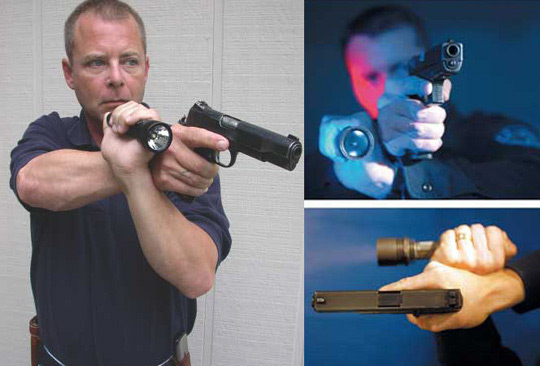
At night, if you don't have your flashlight connected on your pistol or are using night vision goggles + infared aiming dot, your non-firing hand is holding a flashlight using the Harries or other stance/grip. You cannot free your hand to change mags without wasting time putting the flashlight in your mouth or a pocket or absurdly dropping it to the ground/floor. This is why its crucial that your flashlight be held to your wrist by a lanyard so you can let go and it will dangle there so you can do RAPMAGCHANGRET or any other reloading technique you prefer.
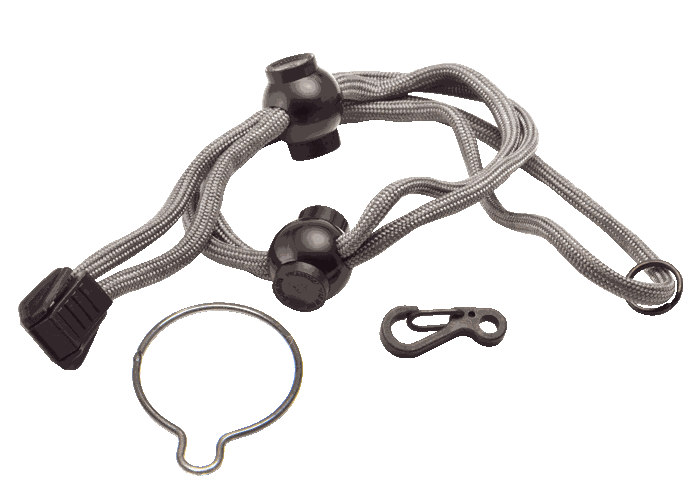
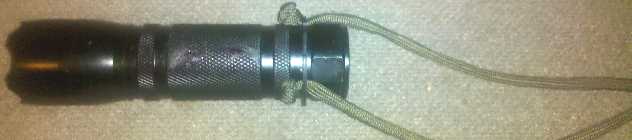
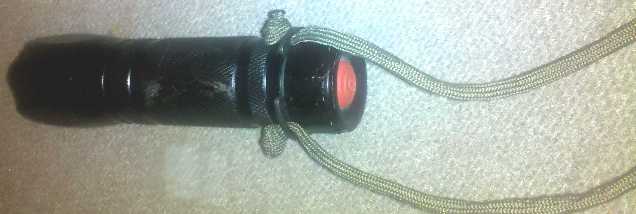
You don't need an uber-expensive SureFire flashlight, but if you have one, they offer lanyard kits. If you use the Neebo flashlight like I do because it has a red laser aiming dot, go to a hardware store and buy a black metal 1 1/8" retaining ring (see photos below).
Cut about 12 inches of 550 cord and remove its 7 inner strands. Tie an overhand knot on each end. Undo the metal end cap of the Neebo flashlight and place both the ends of each cord and the retainer clip around it and screw them all together into the flashlight.
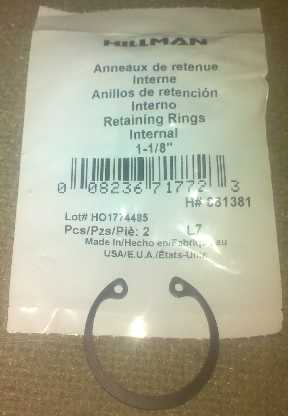
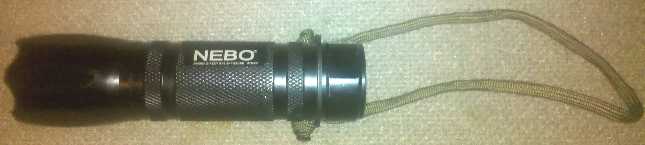
You will have to place your wrist into the loop and then through trial & error pinch the cord to figure out where to shift the knot to get the desired tight fit. Once you have ascertained the desired loop length, fuse with a flame the ends of the gutted 550 cord knots to prevent fraying.
REALISTIC CQB Pistol Shooting Exercises: Don't Let the USMIL Bureaucracy Say "NO"
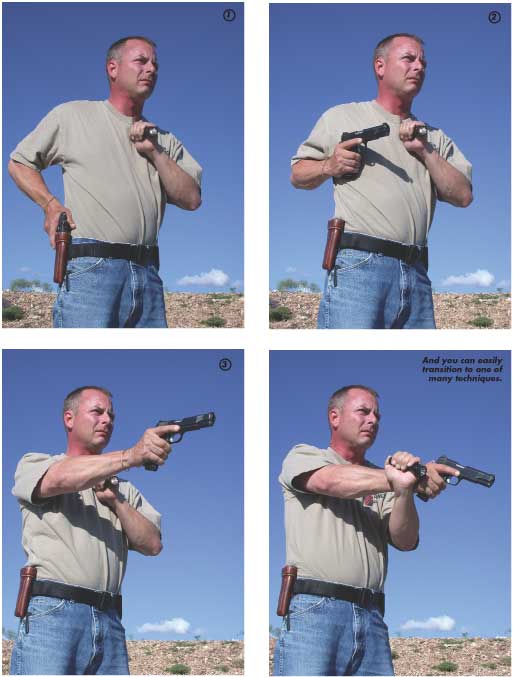
The USMIL bureaucracy cannot handle the pistol being fired from the hip after step 1 in the presentation from the holster to thwart attackers with a knife or bayonet who if less than 21 feet have the advantage. Immediate hip firing using the body as the pointing "index" frees the non-firing arm/hand to block assailants if necessary to give the crucial seconds needed to blast them with bullets--but this style of shooting actually has to be practiced. The USMIL bureaucracy is so afraid of its subordinates that it abuses daily, that it can barely bring itself to have them "qualify" as cannon fodder each year--and then the pistol has to be either on a table or held at full arm's length "down range"--not even close to the kinesthetic skills needed to handle pistols well to dominate a close quarters fight from concealed carry and its dynamic, rapidly-changing situations. For example, Soldiers need to move laterally seeking cover as they return fire with pistols--not "stay-in-their-firing-lane" as on an Army range.
What should we do?
Pistols don't have Blank Firing Adapters (BFAs) like our long guns do.
So the only readily available options are to put a laser in or on a pistol and have a coach/scorer watch for the red dot and note it on a clipboard--or to shoot live ammunition which the bureaucracy is terrified of and will only tolerate in a weak, uninspired way.
IDPA and National Tactical Innovations have broken the code on how to run realistic, Force-On-Target (FOT) pistol shooting exercises with LIVE AMMUNITION. The USMIL should study their methods and incorporate them to empower our Master-at-Arms security concept.
Realizing that even though safe and REALISTIC CQB pistol shooting exercises can be done the USMIL bureaucrats will fear for their job security if "someone gets killed", we must take the extra step of obtaining Simunition/UTM barrels and ammunition that are colored soap bullets that even Private Murphy cannot kill himself or another G.I. even if he tried. Moreover, Simunition/UTM ammo can also be used for Force-On-Force (FOF) war practice with other Soldiers acting as enemies if they wear the necessary protective gear.
REFERENCES
FM 23-35 Combat training with pistols/revolvers
http://155.217.58.58/cgi-bin/atdl.dll/fm/23-35/fm23-35.htm
NOTES
Does it Pay to Work for the Mercenary outfit formerly Known as "Blackwater" mis-Lead by the Prince?
Weapons Self-Defense Lessons From the Davis Case: Better to Be Judged by 12 than Carried by 6?
We have seen it many times in the movies, now we see it in real-life: the protagonist is being followed by the evil doers and he blows them away. Unlike James Bond 007, he is captured by the local police and being accused of murder. His government has not gotten him off for self-defense. It's the classic scenario depicted in the movies that the protagonist once being threatened now has a legal right to shoot, drive cars at high speed and what not--that always made me wonder if the establishment--that wants you most definitely to be a victim--would tolerate it in real life?
Question #1: Why Did Davis Get Caught?
Pakistan is a rough and dangerous place full of criminals so that Davis thought he was being robbed is no surprise. If he fired a 9mm Glock pistol 10 times it would make significant noise and leave spent shell casings on the ground so the question is did he stay at the crime scene or leave? If he was indeed danger, leaving the scene would be logical and not a sign necessarily that he was a pre-meditated murderer. If in fact, he had stayed at the scene, this would seem to be most unwise even though it would appear as a sign of transparency that he was indeed innocent and acting in self-defense etc..
Lesson 1: Don't Stick Around a Crime Scene in a Hostile Jurisdiction
In a corrupt location, sticking around and expecting justice is lunacy: RUN. Explain your motives later--in a location that at least will hear your side of the story. Why Davis' two rescuers have fled the country--and not Davis is a big question mark.
Lesson 2: Silent Weapons
MOSSAD agents carry puny .22LR Beretta pistols for self-defense that are neither powerful or loud. Crack! Crack! is all the noise they make facilitating a departure hopefully without detection--much less arrest. If .22LR lack of stopping power demands you must have 9mm then carry a silencer...SureFire is maker ever smaller and smaller versions that can be carried attached in a concealed holster for immediate use.
Question #2: Why is Davis Still Being Held?
Lesson 3: Double-Tap and No More--Make Your Shots Count
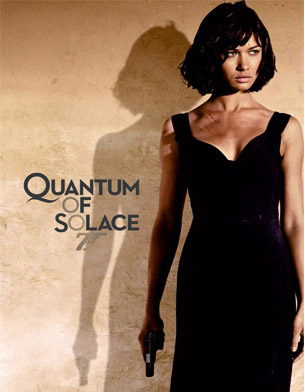
In Quantum of Solace, Daniel Craig as James Bond tells megasexy Olga Kurylenko's character to just shoot once and make sure her 9mm round hits the center mass of her target--a 250+ pound man. Most of us cringe when we hear this bad advice because in real life, to insure stopping your man, SOP for most police, militaries and secret agencies is to keep shooting or even empty the magazine to insure the target goes down. However, maybe Bond's advice is not so far off the mark in adverse legal situations where the locals are against you and looking for an excuse to paint you as the aggressor. Maybe 1-2--a doubletap--is all the hits you can afford to do and still be seen acting in self-defense since the general public does not understand nor accept the realities of pistol bullet weakness. All they see is HOW MANY TIMES YOU "PULLED" THE TRIGGER to draw conclusions about your mental state's amount of passivity or aggression.
If Davis had double-tapped his two assailants for a total of 4 shots he would be in less legal jeopardy than he is in now having shot 10 times. Of course, if with those 4 shots, his assailants LIVED, then they could be spewing forth all sorts of lies and excuses. So if all you got is 2 shots per assailant--make them count and kill them. This does not mean 1 shot to chest then another to head which would signal the malevolence needed to paint you as the aggressor--two shots to the chest.
Lesson 4: Don't Work for the Company
Most people realize the CIA is a corrupt and evil agency working for the interests of Wall Street--not WE THE PEOPLE. That's why they know not to work for them from a moral perspective and its no surprise in a pinch the Agency will throw its employees under-the-bus in a heart beat. Ask ubersexy Valerie Plame. Now add Raymond Davis.
Having said the above, look however, at how angry the Pakistani government is at Davis...if he had just killed two street criminals there would be no uproar. No, the fact that they are pissed indicates that the two assailants were indeed working for Pakistani ISI and at the very least tailing him, got detected and Davis chose not to or could not break-away. As a foreigner unused to Pakistani slums, Davis would be at a severe disadvantage to try to lose his tail without letting them know he knew they were following him. They may have gotten too close or even threatened him as he claims. Were they armed? Regardless, two men can attack another man with bare hands and murder him, so one doesn't have to wait for them to present a knife or gun in order to use lethal force to prevent being attacked. FWIW, in Virginia, I recall the law is if 3 men unarmed attack anyone they are authorized to go to lethal force immediately. It's a good law--and I think it should be amended to 2 men.
So what this seems to be is a case of corrupt Pakistani ISI agents being detected by a corrupt U.S. CIA operative and killed in self-defense; with Davis possibly not knowing they were ISI--if he knew they were ISI he should have known to flee the country--or thinking they were indeed street thugs and naively thinking he could throw himself at the mercy of the local authorities. We all know better now.
Whenever working in areas where you might have to use a weapon in self-defense all possible scenarios need to be worked out beforehand and the best course of actions determined and ready--in case it happens.
www.guardian.co.uk/world/2011/feb/21/raymond-davis-pakistan-cia-blackwater?INTCMP=ILCNETTXT3487
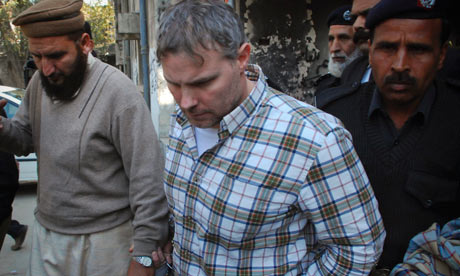
U.S. gives fresh details of CIA agent who killed two men in Pakistan shootout
U.S. reveals that CIA agent Raymond Davis worked for private security firm Xe, formerly known as Blackwater
Ewen MacAskill and Declan Walsh
guardian.co.uk, Monday 21 February 2011 21.48 GMT
* Raymond Davis, held in Pakistan on double murder charges for a shooting in Lahore last month, is employed by the CIA as a contractor. Photograph: Reuters
* U.S. officials have provided fresh details about Raymond Davis, the
* Davis was attached to the CIA's Global Response Staff, whose duties include protecting case officers when they meet with sources. He was familiarising himself with a sensitive area of Lahore on the day he shot dead two Pakistanis.
The New York Times, Washington Post, Associated Press and other media outlets reported for the first time that Davis is a CIA employee. They said they had been aware of his status but kept it under wraps at the request of U.S. officials who said they feared for his safety if involvement with the spy agency was to come out. The officials claimed that he is at risk in the prison in Lahore. The officials released them from their obligation after
Davis shot dead two Pakistanis in Lahore last month who he says had been trying to rob him. A third Pakistani man was killed by a car driven by Americans apparently on their way to rescue Davis.
Confirmation that he worked for Xe could prove even more problematic than working for the CIA, given the extent of hatred towards Blackwater, whose staff have gained a reputation in Pakistan as trigger-happy. [EDITOR: Bad for Davis, good for the Agency] For Pakistanis the word "Blackwater" has become a byword for covert American operations targeting the country's nuclear capability. Newspaper reports have been filled with lurid reports of lawless operatives roaming the country.
U.S. officials have reiterated their concern about Lahore's Kot Lakhpat jail where Davis is being held, saying he had been moved to a separate section of the prison, that the guards' guns had been taken away from for fear they might kill him, and that detainees had been previously killed by guards. They are also concerned about protesters storming the prison or that he might be poisoned, and that dogs were being used to taste or smell the food for poison.
However, the authorities in Pakistan stressed the stringent measures they have put in place to protect Davis in Kot Lakhpat following angry public rallies in which his effigy was burned and threats from extremist clerics.
P.J. Crowley, the U.S. state department spokesman, said: "Obviously, we are concerned about his safety. We have had multiple conversations with the government of Pakistan regarding his current surroundings. They have told us that he is in the safest possible location in Lahore. And clearly, we hold the government of Pakistan fully responsible for his safety."
Surveillance cameras are trained on his cell in an isolation wing, and a ring of paramilitary troops are posted outside. About 25 jihadi prisoners have been transferred to other facilities.
The revelations about Davis will complicate further
Until Sunday, the U.S. had said Davis was a diplomat, doing technical and administrative work at the embassy. It says that because he has diplomatic immunity, he should be released immediately.
The Pakistani prime minister, Yousaf Raza Gilani, told parliament on Monday he would safeguard the country's "sovereignty and dignity" as it sought to resolve the diplomatic impasse with the U.S. "We are firmly resolved to adopt a course that accords with the dictates of justice and the rule of law. My government will not compromise on Pakistan's sovereignty and dignity," said Gilani.
The [Pro-CIA] Obama administration is exerting fierce pressure on Pakistan to release Davis. But President Asif Ali Zardari's government, faced with a wave of public outrage, has prevaricated on the issue, and says it cannot decide on immunity issue until 14 March. For many Pakistanis the case has come to represent their difficult relationship with the U.S., in which multibillion dollar aid packages are mingled with covert activities targeting Islamist extremists.
Davis is currently on Pakistan's "exit control list", meaning he cannot leave the country without permission. But the two men who came to his rescue in a jeep that knocked over and killed a motorcyclist are believed to have already fled the country. Davis claimed to be acting in self-defence, firing on a pair of suspected robbers. But eyebrows were raised when it emerged that he shot the men 10 times, one as he fled the scene. Pakistani prosecutors say Davis used excessive force and have charged him with two counts of murder and one of illegal possession of a Glock 9mm pistol. There have also been claims that the dead men were working for the Inter-Services Intelligence (ISI) agency, with orders to follow Davis.
The military spy agency cooperates with the CIA in its tribal belt drone programme, but resents U.S. intelligence collection elsewhere in the country. In spite of the lurid conspiracy tales in Pakistan about Blackwater, U.S. officials say that in reality Blackwater has had two major contracts in Pakistan - loading missiles onto CIA drones at the secret Shamsi airbase in Balochistan, and supervising the construction of a police training facility in Peshawar. The Davis furore has not, however, stopped the controversial drone strike programme. News emerged of a fresh attack on a militant target in South Waziristan, the first in nearly one month. Pakistani intelligence officials told AP that foreigners were among the dead including three people from Turkmenistan and two Arabs.
Rocky relations
The CIA and Pakistan's ISI have long had a rocky relationship. It started in the 1980s jihad, when the ISI funneled billions of dollars in CIA-funded weapons to anti-Soviet rebels in Afghanistan.
But the two fell out in 2001 over CIA accusations that the ISI was playing a "double game" - attacking some Islamist militants while secretly supporting others.
In August 2008 the CIA deputy chief, Stephen Kappes, flew to Islamabad with evidence suggesting the ISI plotted the attack on the Indian embassy in Kabul that killed 54 people. The ISI, in turn, complained that the U.S. came with unrealistic expectations and an aggressive attitude.
Yet at the same time the agencies co-operated closely, mostly on the CIA drone campaign against al-Qaida militants along the Afghan border.
In 2009 the ISI praised the CIA for killing the Pakistani Taliban leader Baitullah Mehsud. But recently things soured again. Last December the CIA station chief was forced to quit Pakistan after being publicly identified (U.S. officials blamed an ISI leak); while Pakistani spies were angered that their chief, General Shuja Pasha, was named in a U.S. lawsuit brought in a New York court by victims of the 2008 Mumbai attacks.
Are U.S. Navy Sailors Mature Enough to Be Armed Off-Duty? Or Must they Be Thug and Terraist Fodder?

http://news.yahoo.com/s/ap/20110302/ap_on_re_us/us_destroyer_commander_removal
Navy pulls 10 from destroyer after port troubles - Yahoo! NewsBy BROCK VERGAKIS, Associated Press Brock Vergakis, Associated Press - Wed Mar 2, 4:17 pm ET
NORFOLK, Va. -
The U.S. Navy fired a destroyer commander and a top aide and removed eight sailors from their ship in the Mediterranean after misbehavior by the crew in overseas ports that included drunk and disorderly conduct. The U.S. 6th Fleet said Cmdr. Nathan Borchers was relieved from the USS Stout on Tuesday. Borchers had taken command of the Norfolk-based ship in December. The Navy said it had lost confidence in Borchers' ability to address what it called a pattern of unprofessional behavior by his crew that included fraternization, orders violations and disregard for naval standards. "We hold our leaders to a high standard. Our nation expects no less and our sailors deserve no less," Vice. Adm. Harry B. Harris Jr., commander of the U.S. 6th Fleet based in Naples, Italy, said in a statement. The port calls involved liberty leave for the sailors in Haifa in Israel, in Palermo and Augusta Bay in Sicily, Italy, and Souda Bay in the Greek Island of Crete, said Lt. Nate Curtis, a fleet spokesman.
The Navy did not identify what misbehavior may have occurred in a specific port. None of the misbehavior led to complaints by host nations, Curtis said. Curtis declined to specify which orders involving port call were violated, but indicated one possibility was ignoring orders to go out with a "liberty buddy" for safety and security reasons, and instead going out alone. The USS Stout's problems are part of a recent string of command changes in the Navy because of misbehavior. In January, the Navy relieved the commander of the carrier USS Enterprise after raunchy videos were made public that he had showed thousands of sailors aboard the ship in 2006 and 2007. Last month, the command master chief of the USS Ashland was relieved from duty because of an investigation that he had inappropriately touched another sailor.
The Navy said an investigation into allegations of crew misconduct on the USS Stout found there was a substandard command climate on board. The Navy also removed Master Chief Susan Bruce-Ross, the highest ranking enlisted sailor aboard the ship. Borchers, Bruce-Ross and the other unidentified Sailors were being reassigned to jobs in Norfolk. One Sailor is undergoing an independent review to determine whether the Navy will proceed with a court martial, said Lt. Cmdr. Bill Urban, spokesman for Naval Surface Force Atlantic.
The Navy said Cmdr. Sylvester Steele was scheduled to board a plane Wednesday to begin preparations to command the Stout. Steele was most recently the executive officer of the destroyer USS Ramage. Urban said Steele was chosen for "his experience, stellar record and readiness to assume command." Bruce-Ross will be replaced by Command Master Chief Anthony Cole, who most recently served at Naval Surface Force Atlantic headquarters in Norfolk.
Associated Press Correspondent Frances D'Emilio contributed to this report from Rome.
An experienced Light Infantry NCO writes:
"1. ALL Rangers should have a pistol and 2 spare mags. Additionally, ALL "troop leaders" (team leader and above, including leading NCOs) in ALL infantry units should have a pistol and at least 1 spare mag. As much as a pistol (especially 9mm ball) sucks compared to a rifle or carbine, sometimes you just need a 'handgun', not a 'handSgun'. . . and there's no time to go chase down the captain and ask to pretty please borrow his. . . These pistols (issued in addition to, not instead of, rifles/carbines), while issued to that leader, should be considered a 'unit', rather than 'personal' weapon, just like a SAW or M203, and should be loaned to whoever needs it the most at that time -- like the SAW gunner in a defensive pos who needs to take a dump. Also, whoever has a handgun needs to carry it 24/7 when in theater. . . even if in a 'safe' area. (If you thought you were going to need a gun, you'd bring your rifle and all the ammo you can hump, wouldn't you? Well, what if you're wrong, and the Martian People's Liberation Front takes that day to kill some GIs standing down in the "secure" capital zone?)
2. As pistols are an oft-neglected weapon, Basic should be modified so that _every_ Soldier (except those medics and chaplains who are conscientious objectors and currently cannot be required to handle any weapon) learns to maintain and operate the standard service pistol (M9), including a live-fire "familiarization". At least they'll be able to make the damned thing go BANG! if their Humm-Vee flips and the only gun they can reach is their (very dead) CO's. . . call it 4 hours of training per company (including admin BS timewasters that always crop up). . . they can shoot it on the BRM 'zero' range while waiting on the rest of the company (in other words, everyone goes "on line" again after they zero their rifles). 10 meters at a full-size target, 2 five round magazines (so they have to do a tactical mag change), should do it fine. . . use about a half-dozen positions at one end of the range, with target racks placed in buried soup cans. Every Soldier should be able to operate and maintain the standard pistol, rifle, LMG, and MMG, regardless of MOS. (Why not more emphasis on the pistol if I think it is that important? Because while every Soldier should know how to shoot the common small arms, the risk that they will need to do so in combat without further training doesn't justify the additional resources needed to make them crack shots with a 'non-duty' weapon. Pistol skills are SO perishable that 100% Army wide maintenance of real proficiency is unrealistic. . . I'll settle for safe operation, with real proficiency focused on those issued pistols.)
3. ALL Soldiers in a combat zone should be permitted to carry a personal pistol, provided that they supply all logistics needs (ammo, cleaning supplies, accessories, etc.), that it is a U.S. approved service pistol design, it is loaded with U.S. milspec type ball ammo (to avoid 'Hague' problems), it is carried in a U.S. milspec holster in a fashion consistent with the Soldier's duties, and that the Soldier qualifies on the standard course with the specific pistol in question. In other words, if some PFC wants to carry a Colt M1991 (not a typo -- the "bare bones" civilian M1911A1), a Beretta M92SB, or a SigSauer P228 or P229 in 9mmP (type classified for MPs, aviators, etc.) in a standard U.S. holster, he should be allowed. I DO NOT wish to see some stainless steel Colt Python in a shoulder rig or 'gunfighter' holster. If you can't trust Snuffy with a handgun, shouldn't you consider chaptering the irresponsible lout, anyway? I _like_ handguns, as a gun you _always_ have. Not every war will be a 100-hour wonder. . . Snuffy _will_ be wandering around the local economy, going to chow, etc., where a rifle isn't thought to be needed.
4. Concerning blanks, remember that pistols also need blank adaptors. With pistols that aren't already threaded for a suppressor, the easiest way is to use a plugged barrel. (Easy enough, take a barrel that has _interior_ wear and damage, and plug it. If you don't want to contact a Hollywood prop-maker and buy $50 "blank modified" barrels, probably the easiest and safest way is to tap the muzzle for tight threads for 2-3 inches, screw a bolt matching those threads, saw off the head, and paint the exposed parts red. Personally, I prefer getting a purpose-made plugged barrel that will not chamber 9x19mm ball, perhaps by only accepting 9x17mm crimped blanks. That way, there's no way to accidentally chamber live ammo.) THIS BARREL MUST BE PAINTED RED, and the chamber remarked "BLANK ONLY", so that all concerned can tell at a glance it's blank adapted (witness negligent discharge incidents that police SWAT teams have experienced, because they forgot about "blanking" the pistols). Shouldn't present a "tactical visibility" problem, given the ranges that handguns are good for.
5. Even better, use Simunitions for QCB training with handguns.
Simunitions replaces the barrel, slide, magazine (I think), and springs of
YOUR pistol with ones that only chamber and fire the low-powered paintball
marking rounds. They are also color-coded blue, to avoid any mixups. (For
some reason, probably because they are "auxiliary" weapons, handguns are the
most likely to be forgotten about safety-wise during force-on-force
training.) These register somewhat painful hits (of course, you _are_
wearing vest, kevlar, gloves, and goggles at a minimum, aren't you?
6. All pistols need to be lanyarded, ALWAYS. I like attaching the lanyard
to the holster, so the cord can be dumped inside there, snag-free. Adjust
your lanyard so that it just reaches your shooting position. . . that way it
provides some extra tension to pull against, for recoil control. If you
thought losing a canteen because you dropped it when you dove for cover was
annoying, imagine losing your drawn pistol (which kinda indicates you're SOL
for a rifle already) in combat and being reduced to a knifefighter in a
gunfight. . . (I vividly recall the feeling of realizing I'd let go of my
canteen when the firebees rolled arty sims on my pos ONLY because the thing
was trailing behind me on it's dummycord. All I wanted to do was put
200-300 meters between me and the impact zone ASAP. . . )
7. The Army can increase pistol proficiency at little cost by promoting
'off-duty' shooting events (such as IDPA matches oriented towards military
equipment and scenarios) with volunteer Army-qualified ('carded') range
safety staffs and allowing soldiers who have qualified with a pistol to
sign a pistol out (duty/supply permitting) for such, and allowing Soldiers
to purchase 'surplused' ammo directly from the command at cost plus. This
same philosophy should be extended to ALL basic small arms and 'casual'
practice (still need a volunteer 'carded' range safety team) situations.
Troops punching holes in targets, even in blue jeans at known distances, are
troops who aren't getting into trouble in town, and they WILL develop better
shooting skills. Even when they are trying something dumb, like the
'gangsta' sideways pistol technique, they will quickly learn what works. . .
and if they are never allowed to experiment, they will not develop real
proficiency."
Another hard-charger writes in:
"Just saw your page on equipping Ranger Regiment with pistols. Two
observations:
As Clint Smith once told me, 'the only reason to use a pistol in combat
[including CQB] is to fight your way to the rifle you never should have put
down in the first place.' Pistols are a good idea for any Soldier as a
backup weapon, but they're not particularly suited for any sort of combat
situation except peacekeeping (where long arms are forbidden or discouraged,
but a pistol in the 'Mexican carry' gets by) and vehicle crewmen.
I've had pistol CQB training, and I'll take an M4 any day - save for
overpenetration issues, the rifle wins hands down, and I'm not a cop.
Second, you *can* screw a can (silencer) on an M9, but you're not going to
have a silenced weapon. The gas all escapes from the slide, and you only
have a bit of sound suppression. The real purpose of suppressors on military
weaponry is to make the report less directional, for purposes of
counterfire. Rangers don't tend towards stealth in firefights (nor does
anybody in MOUT situations), and adding a big suppressor to a big pistol
ends up using most of the space of your M4 - with incompatible ammo.
My answer? Tape a vanilla Glock and a spare mag to the front plate of your
Ranger body armor, and don't waste too much rifle time working on pistol
proficiency.
Regards,
XXXXXXXXXX
Our reply:
1. Please get CSM Haney's Inside Delta Force and read it regardless. "Short guns" as they call pistols is for CQB to not overpenetrate and kill hostages as you see what befell Mr. Burnham in the jungle recently during the meeting engagement. The lack of an ability to carry CS tear gas grenades like we used to before Bush Senior banned riot control agents has really hurt U.S. operational tactics especially in situations where you need to scatter folks.
2. I think like you and would rather have a full-size M16 or shorty M4 shooting more powerful 5.56mm in combat, even hostage rescues and hope to not shoot through a bad guy and kill a hostage--but Delta thinks differently.
3. Why not have the lead man that throws the flash bang armed with a pistol? His hands will be more free with a pistol.
4. Rangers as potential Delta back-ups should have the pistol skills. Also if they deploy undercover they need the pistol skills to defend themselves. Heck every Army Soldier should know how to shoot pistols for this reason.
5. The biggest people group that need to get away from the pistol mentality is Army Aviators; if they get shot down they need a 5.56mm M4 carbine or Personal Defense Weapon (PDW) minimal to ward off whoever shot their helicopter down. Just consider Roberts' Ridge incident in Afghanistan a few months ago.
Thanks for the feedback!
1st TSG (A) Staff