 PROJECT AFAC-DRAGONFLY
EXCLUSIVE! OA-37B Dragonfly in ACTION video clip!
"The large ground organization of a modern air force is its Achilles' heel."
--Basil Henry Liddell Hart, Thoughts on War, 1944
There are two types of human war, nation-state conflicts and campaigns against sub-national groups. The U.S. military has been caught unprepared for sub-national conflicts in Afghanistan and Iraq by solely equipping, training and preparing for peer competitor nation-state wars. However, the assumption that the smaller-scale means that are needed for sub-national conflicts have no application in larger nation-state wars is not true. We can and we must be prepared for both types of war; if we do this wisely we can do it without having to have two separate, different U.S. military establishments.
Sub-National Conflict Optimization lost after Desert Storm
In Vietnam, we flew several types of manned observation/attack fixed-wing Airborne Forward Air Control (AFAC) "grasshopper" aircraft that were slow enough to detect the ground enemy and actively investigate for on scene destruction and/or relaying information to a Quick Reaction Force (QRF) to finish the enemy off. Military forces always have a battle against the parameters of the earth itself. One of these limitations is that if you fly too fast and high you will simply not see ground enemies and even if your sensors did your aircraft's aerodynamics will not provide lower speed flight agility and armored robustness to investigate and verify it's a target and not a decoy or worse yet innocent civilians. The desirability for speed, altitude and now stealth aircraft is a response to the Integrated Air Defenses (IADs) of a nation-state foe. After Vietnam, we abandoned the observation/attack aircraft we needed to win sub-national conflicts out of fear of IAD vulnerability as testified by two USMC OV-10s being shot down over Iraq in Operation Desert Storm in 1991. We retired both USMC OV-10 "Broncos" and Army OV-1 "Mohawks" based on the idea that we would no longer need long-endurance manned observation/attack AFAC capabilities that are always needed regardless of war type encountered. Faster jet attack aircraft that can penetrate enemy IADs but still slow enough to see ground targets like the 400 mph A-10 were not up-engined for more maneuvering power and given a second-seat observer to compensate for the lack of AFAC aircraft. The current thinking is to remove men from aircraft entirely through Unmanned Air and Combat Vehicles (UAVs/UCAVs) and fly them remotely or autonomously into enemy IADs to destroy them to clear the way for manned aircraft to strategic and interdiction bomb. UAVs/UCAVs embodied in the Predator at $3.8 million each because of the costly electronics to fly them without men are no longer "throw away" items that can be fielded in great numbers to get the desired battlefield effects. Without a human survival instinct on board UAV/UCAVs are crashing during routine training flights draining the USAF budget. Even if these bugs were worked out, UAV/UCAVs lack the human eyesight and on-scene instincts to be effective AFACs due to their narrow field of vision sensors. The results of the attempt to solely rely on increasingly costly UAV/UCAVs for all air surveillance has been over 13,000 U.S. casualties in Iraq alone from an enemy free of air intereference to lay roadside ambushes upon our men.
Meanwhile, Close Air Support (CAS) in support of Army/marine ground maneuver languishes as the A-10s are not upgraded properly and without being re-winged will be retired in favor of STOVL F-35 Joint Strike Fighters. The F-35 is a fine aircraft, but even if a 2-seat model existed using its STOVL capabilities to operate close with ground maneuver units at Forward Arming And Refueling Points (FAARPs) will still fly too fast 600 mph+ and be unarmored to slow down and investigate where the enemy is as an AFAC. We need slower, armored, more agile at low-altitude AFAC aircraft.
AFAC capability needed in both national and sub-national conflicts through a new class of aircraft

What we propose is that the AFAC needs of both sub-national and nation-state conflicts CAN be meet if the aircraft has the aerodynamics that enables it to fly fast enough to penetrate IADs at high subsonic speeds yet can fly slower to in the absence of the IAD threat to detect, locate, mark and kill/suppress fleeting sub-national group targets. We must also remember successful sub-national group C3D2 tactics can be applied on a larger scale by nation-state armies as the Chinese did in the Korean War when they used excellent camouflage and small group infiltration tactics to avoid aircraft detection. Modern day versions of the Chinese straw blankets are mylar space blankets and even neoprene suits used by Hezbollah in South Lebanon to avoid Israeli Air Force infared "thermal" sensors. To destroy enemy IAD nodes we need dozens of strike aircraft available at low-cost that if they are lost the USAF budget doesn't go empty.
The good news is that such aircraft already exist: the hundreds of Cessna T-37 "Tweets" the USAF owns and operates that are soon to be retired. As a jet trainer the T-37 can slow for very safe student take-offs and landings. During Vietnam, this low-speed agility was recognized by both the Army and Air Force resulting in the up-engined and stronger winged A-37 "Dragonfly" attack aircraft. The amazing thing about the A-37 was that not only could it fly slow enough with a second seat observer to act as a defacto AFAC to spot the enemy accurately, it can fly very fast up to 507 mph-much faster than the current A-10's 437 mph. If properly fitted with IRCMs and other counter-measures the A-37 can penetrate enemy air defenses at least as well as other unstealthy non-supersonic aircraft can, which all aircraft are when they carry bombs on external racks. The A-37 only weighs 6,000 pounds itself yet can carry a 9,000 pound ordnance load! The A-37 is thus fast, slow when it has to be, safe, easy to maintain and operate, durable, and available now at zero cost.
We propose that retiring T-37s be modified into a new, revolutionary aircraft type, an Unmanned/Manned Combat Air Vehicle or U/MCAV. The U/MCAV would be used unmanned and remotely piloted to penetrate and destroy enemy IAD nodes during nation-state wars. After the IADs have been removed, the U/MCAVs would fly with an pilot and a JTAC enlisted observer as an AFAC to locate and mark targets for USAF A-10s for CAS and otherwise surveil and provide continuous overhead presence (COOP) for Army maneuver forces to effect Chuck Myers' "Maneuver Air Support" (MAS) concept. The U/MCAV Dragonfly would feature:

· New turbofan engines and a SLEP by Snow Aviation
· Strengthened, High-G wings with attack ordnance hard points that fold for trailer mobility
· Tandem two-seating fuselage plugs for better attack visibility/tactics
· Counter-measures package for IAD penetrations
· Self-sealing fuel tanks, crew armor, recovery parachute
· Special armored Sea/Air/Land ISO Container boxes and trailers to move U/MCAV Dragonflies overseas by ship/air transports and around the ground when not needed in the air and to effect FAARP and covert operations
The Maneuver Gap: when aircraft cannot fly they become farther and farther from the action to point of irrelevance
Another truth not admitted is that in some weather conditions, the "Battle against the Earth" gets the best of us and aircraft are grounded. When aircraft cannot fly, ground maneuver units still have to fight. This is a huge reason why we need to still have field artillery and naval guns to ballistically launch ordnance without need of aerodynamic flight-friendly weather. The Battle of the Bulge was nearly a strategic defeat because the Germans attacked in the dead of snowy winter when our aircraft could not fly. The recent sand storms in our two latest wars against Iraq resulted in ground maneuver elements not having ANY air support at times.
Where was Army Aviation and all its helicopters as the rest of the the Desert Storm and OIF forces in ground vehicles advanced?
Were they not at a fixed, static base becoming farther and farther away from the action as maneuver forces on the ground in tracked AFVs moved ahead? With helicopters having such limited range to begin with, were they not becoming irrelevant to the fight? Wouldn’t more and more fuel be required to get them to the ground fight as this gap increased?
Therefore, wouldn’t it be beneficial then that when fighter-bombers and helicopters are grounded by bad weather---they become GROUND MOBILE by folding their wings and then being towed in armored ISO container “battle boxes” to conserve fuel and flight times following in trace of the maneuver elements, ready to fly as soon as the weather cleared from hasty FAARPs?
What’s the point of V/TOL helicopters if they cannot operate alongside ground forces like Stukas and P-47s could in WWII? If our helicopters have become so needy of pamperment then maybe its time we went "retro" to a simpler, fixed-wing A-1 SkyRaider, OV-1 Mohawk or A-37 Dragonfly type aircraft that has good enough short take-off and landing capabilities that they can be towed in battle boxes and put into the air on the spot without all this we need an air base, we need this, we need that drama?
We know that the Army lost its OV-1 Mohawk two-seat fixed-wing observation/attack "grasshopper" aircraft because Grumman was bought out by Northrup who wanted to push their JSTARS 707 airliner BS as the answer to battlefield reconnaissance. And when that didn't work we wore out Navy P-3 Orion ASW planes just to get battlefield digital video relayed. The Army should have hundreds of OV-1s with humans inside that can scout for the enemy and VERIFY by human investigation whats "sheep dung" and what’s "T72". If we do this smart, the aircraft could be unmanned if the enemy air defenses are too hot—ie it becomes a defacto UCAV.
The Need for Ground Mobility to avoid enemy fixed-base targeting and better offer Air Power
Much has been written, particularly by RAND about fixed air bse vulnerability. Alan Vick is a leading expert on the subject. He writes:
The unprecedented success of the U.S. Air Force (USAF) during the 1991 Gulf War was achieved at the cost of just 14 aircraft lost to ground-based air defenses. Potential adversaries are likely to invest considerable resources on strategies - such as the use of special operations forces, terrorists, information attacks, or weapons of mass destruction - that will ensure that the USAF does not inflict so much damage at so low a cost in a future conflict. PAF examined how potential adversaries could use readily available commercial and military technology to modify conventionally armed cruise and ballistic missiles to attack USAF aircraft on the ground at theater operating bases. It also considered what steps the USAF could take to minimize the threat of such attacks.Emerging Threat Technology
Until recently, only a few nations had the technological sophistication necessary to develop ballistic and cruise missiles that were accurate and robust enough to be used effectively against military targets. Now, however, global positioning system (GPS) guidance devices provide a fairly cheap and effective way of improving the guidance system of the ballistic and cruise missiles used in most of the world. If missiles equipped with GPS guidance were armed with submunitions rather than unitary warheads, they could pose a serious threat to U.S. aircraft on the ground.
The study assumed that an adversary would use small, slow cruise missiles-i.e., unmanned aircraft designed to fly a one-way attack mission-to slip under the current USAF radar umbrella. These missiles are significantly different from the high-performance fighter-size weapons U.S. defenses were designed to detect during the Cold War. Because they are small aircraft that cruise at about 70 knots, they would be difficult for current air defense systems to detect. In fact, existing U.S. air defense systems are designed specifically to ignore aircraft traveling at this speed so that attacking aircraft can be distinguished from ground-vehicle clutter. Some systems can detect and track slower targets, but only in narrow sectors and for short periods of time before the number of potential targets exceeds the system's data-processing and display capabilities.
Surface radars are less affected by ground clutter than are airborne radars, but they suffer from limited line of sight. Patriot and AEGIS could acquire and track a slow-moving cruise missile, but only above the radar horizon, which is less than 20 miles for a cruise missile flying at 100 to 130 feet.
Operational Impact
In the study's scenario, Iran uses an Iraqi succession crisis that has become a civil war as an opportunity to invade southern Iraq. The United States responds in a variety of ways, including deploying USAF combat aircraft to several bases on the Arabian peninsula: Dhahran, Doha, Riyadh Military, and Al Kharj.
These bases have a total of 14 potential parking areas with a total area over 44 million square feet-the equivalent of almost 1000 football fields. However, the number of GPS-guided cruise missiles armed with submunition warheads and ballistic missiles required to attack this area is remarkably small. Assuming a 20-foot lethal radius for the 1-lb submunitions and standard USAF aircraft-parking procedures, it would take only 30 M-9 and 30 M-18 ballistic missiles and 38 small cruise missiles to achieve a 0.9 probability of kill. The total cost of this force would be about $101 million.
Attacking the tent cities at all four bases and a Patriot or theater high-altitude air defense (THAAD) radar at each requires an additional 40 ballistic missiles and 8 cruise missiles, raising the total cost to about $163 million-about the cost of four Russian Su-27 export-version fighters. Such a force could destroy a large number of aircraft, living quarters, most personal equipment, and some work centers, and would have a devastating effect on USAF sortie generation.
William Story's thesis also warns us about the improving Theater Ballistic Missile (TBM) Threat. Enemy Mobile TBMs are not going to be destroyed by our air and ground attacks. He writes:
"Mobile TELs proved elusive and survivable. Fixed targets, however, were vulnerable. The technological race appears to be between the defender's ability to locate and destroy mobile missiles and the attacker's ability to decrease CEPs to airfield boundary size. Hussein's violation of the principles of concentration and objective may not be counted on again. Had he launched 14 missiles simultaneously on Daharan, the potential to inflict significant damage on coalition air operations was great. Improving Scud technology will heighten the missile's ability to deny an enemy command of the air. Should North Korea, for example, in some future war concentrate its Scuds (which are more accurate than those of Saddam Hussein) on Kunsan or Osan air bases, the impact on air operations would likely be tremendous. The disruptive effect of taking cover alone would significantly reduce the tempo of air operations.Iraq continued to fire Scuds until the last day of the war. Its most devastating strike took place only hours before the war ended. What if that strike had been nuclear? Aside from the civilian loss, the impact on the Coalition's air effort would have been massive. What the Iraqis accomplished with conventional Scuds, with limited accuracy, does not augur well for air forces in the future.
Although Saddam's Scuds failed to achieve his objective of drawing Israel into the war and destroying the coalition, coalition air power failed to destroy the Scud threat. The problems of finding mobile targets with air power may prove very difficult to overcome. First, the prevailing regional weather and open, flat terrain in Iraq actually favored the hunters. Continual overcast and rugged terrain, such as might be encountered in North Korea, would be even more challenging for the Scud hunters. Second, even a slight increase in the number of TELs and MELs would probably require an exponential increase in air power to suppress, much less destroy, all of the launchers. Third, air forces of the future will be smaller, and a higher percentage of sorties for Scud hunting is likely to have a debilitating impact on an air force unless there is a revolutionary breakthrough in technology to locate TELs.
The coalition was surprised by the mobile Scuds' impact on the conflict. Scud-B CEP was approximately 1,000 meters, while that of the al Husayn was 2,000 meters. If Scud accuracy had been slightly better (resulting in a reduced CEP), their military and political impact might have dramatically increased. As it was, a Scud nearly hit the USS Tarawa."
Add to this the ground attack threats which defeated the Soviet Air Force in Afghanistan. In "Snakes in the Eagle's Nest: Ground Attacks on Air Bases, 1940-1992" RAND researcher Alan Vick explains:
Current research on global airpower trends suggests that, for the foreseeable future, few opponents will be able to challenge the U.S. Air Force (USAF) in the air. Potential adversaries, therefore, are likely to look for alternative means of countering U.S. airpower. A recent RAND study considers various ways that adversaries can threaten U.S. air operations during a future conflict. A part of this larger study, Snakes in the Eagle's Nest: A History of Ground Attacks on Air Bases, focuses on air base attacks from 1940 to 1992. The research shows that ground attacks on air bases have been much more frequent and successful than is commonly appreciated. In typical cases, small and lightly armed units, striking quickly, succeeded in damaging and destroying valuable aircraft and equipment. The study considers hundreds of such attacks, giving primary attention to three case-study regions in which most of the examples occurred: Crete and North Africa during World War II and Southeast Asia during the Vietnam War. To identify useful lessons for future conflicts, the author proceeds by seeking answers to the following questions:What were the objectives of the attacks?
What attacker tactics and weapons were most effective?
How were attacking forces inserted into the enemy rear area?
What defensive countermeasures worked?
Were any promising defensive measures overlooked?
What were the strategic effects of the attacks?Four Basic Objectives
Ground attacks on air bases may be classified in terms of four separate objectives: (1) capture the airfield, (2) deny defenders use of the airfield, (3) harass defenders, and (4) destroy aircraft and equipment. Of the 645 attacks analyzed in the study, 384 (60 percent) attempted to destroy aircraft and equipment. Efforts to capture airfields were rare, especially after World War II, making up only 6 percent of the total. Only 7 percent of the attacks had the primary aim of denying use of airfields. The remaining 27 percent had harassment of defenders as their main goal. During the Vietnam War, virtually all air base attacks focused on only two objectives: destroying aircraft and harassing defenders.
Attack Characteristics
In the World War II examples, penetration of air bases was the most common attacking tactic. In Southeast Asia, however, Viet Cong and North Vietnamese Army attackers used standoff weapons 96 percent of the time. Recent attacks have used both techniques: Kurdish and Filipino insurgents used penetrating tactics; insurgents in El Salvador and Afghanistan relied on standoff weapons. The size of the assaulting forces has varied according to the objective. Whereas attempts to capture airfields may have required forces of regimental strength, most efforts to destroy aircraft and equipment have needed only limited forces. Such attacks have usually been conducted by teams no larger than platoons.
Insertion Techniques
With the exception of some motorized raids during World War II, virtually all air base attackers had arrived at the bases on foot. Indeed, all 493 attacks from the Vietnam War era were conducted by forces unaided by motorized vehicles. Foot travel was the most common insertion technique in the other conflicts, closely followed by combined vehicle-and-foot insertion, primarily during the British North Africa operations.
Defense Measures--Successful and Overlooked
Most large-unit attacks on airfields succeeded because defending forces were outnumbered, outgunned, or outclassed. Against both standoff and penetrating attacks intended to destroy aircraft, shortages in high-quality rear-area security forces and a lack of surveillance assets were the most common weaknesses. Axis forces in North Africa demonstrated another weakness: a notable slowness to develop countermeasures to penetrations. Conversely, U.S. forces in Vietnam made base penetration all but impossible by extensive use of minefields, fences, guard posts, and lights. These measures forced attackers to rely on standoff weapons such as mortars and rockets. In response, U.S. defensive measures included greater dispersion of aircraft, construction of revetments, and, ultimately, construction of concrete shelters for fighter aircraft. The most effective means to deter and prevent standoff attacks would have been to control the standoff belt that extended to 11 kilometers around each base and required defenders to patrol an area that covered over 200 square miles. Some success at reducing the threat from this standoff belt was achieved by helicopter reconnaissance flights and patrols by friendly ground forces. However, large civilian populations living near the airfields and the rugged terrain surrounding them hampered these efforts. Military Assistance Command, Vietnam (MACV), could have diminished the standoff threat by making air base defense a high priority for U.S. ground forces and airborne surveillance assets. MACV's refusal to do so made this threat difficult to counter and kept USAF bases vulnerable to the end of the war.
Strategic Effects of the Attacks
In one case--British special forces' attacks on Axis airfields in North Africa--the loss of aircraft from ground attacks was so severe and the airpower balance so precarious that these small actions made a major contribution to the Royal Air Force's battle against the Luftwaffe. In other instances, the loss of airfields to attacking forces enabled the attacker's air force to move in and extend its range. The U.S. island-hopping campaign in the Pacific during World War II, for example, was focused on capturing airfields. The Japanese attack on Midway sought to capture the island for its airfield; Japanese failure to do so while suffering heavy losses marked a turning point in the war.
In the Vietnam War, ground attacks caused loss of aircraft, materiel, and personnel over a period of seven years. In addition, the threat forced defenders to devote substantial resources to the protection of airfields. However, despite a number of publicized incidents and repeated attacks on several bases, the level of destruction was not high. Most attacks did little or no damage, and only a handful of high-value aircraft were damaged or destroyed. Although these attacks constrained operations on several occasions, the aircraft losses they caused (only 4 percent of total USAF losses) were not significant and do not appear to have materially affected the outcome of the war.
Conclusions
The analysis of airfield attacks shows that basic techniques have not changed dramatically over the past 50 years. With good intelligence, mission-planning, and weapon skills, low-technology forces have demonstrated an ability to inflict considerable damage. Their simple- but-effective tactics and the strategic rationale for the attacks are as relevant today as they were in 1940. Indeed, the centrality of airpower to modern warfare makes airfields even more tempting targets than they have been. If the historical experience is any indication, standoff threats will pose a particularly daunting challenge, especially since new precision-guided munitions for mortars and other standoff weapons could give small standoff attacks a lethality that they lacked in the past. Advances in technology, of course, offer new opportunities for defenders as well. It remains to be seen which side will exploit such opportunities most effectively.
----------
RAND research briefs summarize research that has been more fully documented elsewhere. This research brief describes work done in the Strategy, Doctrine, and Force Structure Program of RAND's Project AIR FORCE and documented in Snakes in the Eagle's Nest: A History of Ground Attacks on Air Bases, by Alan Vick, MR-553-AF, 1995, 165 pp., $15.00, which is available from RAND Distribution Services, Telephone: 310-451-7002; FAX: 310-451-6915; or Internet: order@rand.org. RAND is a nonprofit institution that helps improve public policy through research and analysis. RAND's publications do not necessarily reflect the opinions or policies of its research sponsors.
RB-22
REVELATION:
<<<
Why not smash Liddel-Hart, Douet and other's predictions of fixed air base disasters? "An ounce of prevention still beats a pound of cure". Making our fighter/attack aircraft ground mobile to avoid enemy targeting in the first place is cheaper and more effective than trying to shoot down a missile with another missile!
In his April 2004, AIR COMMAND AND STAFF COLLEGE AIR UNIVERSITY paper, "CURRENT AIR BASE GROUND DEFENSE DOCTRINE: Are We Postured to Meet the Expectations of the AEF?" Herbert T. Brown, Lieutenant. Colonel, USAFR writes:
www.au.af.mil/au/awc/awcgate/acsc/01-031.pdf
"During World War I, U.S. Air Forces operated from bases located in close proximity to static, unchanging trench lines, and enjoyed a high degree of security from ground attack. Airfields in the forward areas were no more than open grass fields with areas to park or maintain aircraft and generally provided little in the way of lucrative military targets for the enemy to attack. Additionally, most air units were displaced throughout the rear area supporting changing Corps objectives. With the general absence of fixed facilities, they could easily be displaced prior to facing any organized enemy ground threat."
Being ground mobile was also not a problem in WWII with even our fighter-bombers that could land on grassy fields ie: nearly anywhere. This capability saved the Royal Air Force in the Battle of Britain:
http://216.239.41.104/search?q=cache:N4XfartsiEIJ:www.century-of-flight.freeola.com/Aviation%2520history/WW2/Battle%2520of%2520Britain%2520tactics.htm+luftwaffe+fighters+grassy+fields&hl=en&ie=UTF-8
Suggestions were made that the fighters should be pulled back north of the Thames, but Dowding and Park knew that this was exactly what the Germans wanted, effectively giving them air superiority over the intended invasion area. So the 11 Group squadrons stayed and fought for their lives.
To keep up the pressure, the Germans began night raids, to stop the defenders repairing damage overnight. On one night raid, some aircraft bombed civilian areas of London by mistake; a mistake which was to become a crucial turning point in the Battle. Attacks on civilian centers were something which had been specifically banned by Hitler, who was still hoping at this time that the hoplessness of the situation would cause the British to sue for a negotiated peace. The German High Command knew that widespread civilian casualties would only harden the resolve of the nation to fight on. In reply to this accidental attack, the British bombed Berlin. Fears grew that cities would be raided more often, so children were evacuated again in a second mass exodus to places of safety in the country, as they had been during the Phoney War of 1939.
However, just when it seemed that the country and 11 Group in particular couldn't continue for another day, the Germans changed their tactics.
The Blitz
Hitler was enraged by the attack on Berlin and because it seemed that the attacks on airfields were not destroying enough RAF fighters, he ordered a change of targets. By attacking cities and industry, the Germans hoped to break British morale and to destroy the factories that built fighter aircraft. They also hoped that RAF fighters would gather in force round the cities to protect them, which would make it easier for the Luftwaffe to shoot them down in the numbers required to establish air superiority.
The change of plan was a mistake for a number of reasons. It gave 11 Group a chance to repair their airfields and radar sites, so the defences became fully operational again. The German Me 109 fighter could only carry enough fuel for 20 minutes flight over Britain, so London was on the edge of its limited range. Finally, the German raids now came within the range of 12 Group, and their large formation tactics known as "Big Wings".
www.airpower.maxwell.af.mil/airchronicles/apj/apj03/win03/muller.html+luftwaffe+fighters+grassy+fields+defense+camouflage&hl=en&ie=UTF-8
In "Losing Air Superiority: A Case Study from the Second World War", Dr. Richard R. Muller of the Air University at Maxwell AFB writes:
The ground organization learned sophisticated techniques of camouflage, concealment, dispersal, and mobility as means of reducing losses of materiel and personnel to air attack. Drawing on its experiences on German territory, the Luftwaffe deployed mobile flak batteries, especially the quadruple 2 cm antiaircraft gun. This useful weapon, often mounted on a trailer, truck, half-track, or even a tank chassis, provided dense and highly mobile fire support for important targets, including airfields, bridges, and trains.[32] For protection of ground units, the Germans concentrated their flak batteries in the front and rear of the columns, with weapons at the ready. German commanders designed quick and responsive aircraft-alert procedures, and when an enemy aircraft was sighted, the column would stop, and the antiaircraft vehicles would deploy to the sides of the road, providing massed antiaircraft fire against low-flying Allied “Jabos.”
The effect of Allied air superiority was far worse than even the most pessimistic Luftwaffe planners had envisioned. A Luftwaffe officer reported that enemy air activity rendered all daytime convoy traffic impossible, with the exception of fully armored units.[33]
Camouflage and dispersal almost became art forms, with aircraft uncovered immediately before a sortie and whisked under cover quickly after the propeller stopped turning. Antiaircraft forces came under an airfield-defense commander, responsible for training, implementing new defense measures, and actually conducting operations if the base came under attack. Flak commanders took advantage of the fact that Allied fighter-bombers pounced on everything that moved on the Norman roads by creating ingenious “low-flying-aircraft booby traps.” They deployed mobile canvas dummies equipped with glass panels to simulate glare from vehicle windshields. When fighter-bombers dove to the attack, massed antiaircraft artillery (AAA) guns, usually camouflaged as shrubbery, opened fire.[39]
Early in the summer invasion, the Germans experimented with attempts to fly aircraft away from threatened airfields and disperse them to emergency strips. These “evacuation flights” soon ceased. For one thing, they tended to consume scarce stocks of aviation gasoline; for another, the airspace over Normandy proved far more dangerous than the ground.
German air commanders drew inspiration from these developments. In the Luftwaffe’s rear areas one found an assortment of obsolete training and reconnaissance aircraft, as well as many captured types. These aircraft had little role in major air operations, but—given the size of the theater and the dispersal of the Luftwaffe’s fighter and bomber wings—most commanders adhered to the philosophy that “any unused aircraft is helping the enemy.”[53] The Luftwaffe made extensive use of these antiquated aircraft, grouping them into night ground-attack units. Virtually undetectable by radar or other means, the aircraft attacked Soviet supply depots, partisan encampments, enemy airfields, and other vulnerable targets with light fragmentation bombs and machine-gun fire.[54] That these crude aircraft were able to operate so effectively should not be surprising; even 60 years later, under certain circumstances, light aircraft can penetrate even sophisticated air-defense systems.
Despite the apparent gulf between the Luftwaffe experience and any future scenario, this historical case study offers relevant lessons. One of the more striking conclusions concerns the unwillingness of modern air forces to make sweeping changes in their operational doctrine. To suggest that the Luftwaffe’s fixation on offensive operations was the sole—or even primary—cause of its defeat is to oversimplify the situation, but its adherence to cherished beliefs regarding the proper employment of airpower certainly delayed and hampered its response to the loss of air superiority. The costs of maintaining an offensive capability proved enormous, and for the Luftwaffe this was largely a self-inflicted wound.
Reliance upon ground-based defenses also offers a great number of lessons. By mid-1944 the flak arm could claim responsibility for most of the Allied aircraft destroyed by German forces. Although the massing of heavy AAA tubes around important targets may seem a cost-ineffective way of doing business, the protection of tactical targets with massed small-caliber weapons was a different story. Since Allied aircraft immediately pounced upon every moving vehicle, it became a simple matter to lure them into well-concealed flak traps. Even humbler measures such as camouflage, concealment, smoke screens, shelter construction, and evacuations should not escape notice. Their cumulative effect enormously complicated the task of the Allied air planners. As Milch summed up, “If the last war taught us how to dig in, this war has taught us camouflage.”[55] Inexpensive and requiring little training and preparation, such methods quickly lend themselves to the repertoire of any nation that faces air dominance by an enemy. Moreover, concealment and mobility may prove an effective counter to precision-guided munitions, since these weapons often contain only a small warhead and depend on accuracy for their effectiveness. A future adversary would do well to study the German example.
In failing to halt the Allies, even the cleverest German countermeasures acquired an aura of total futility. The increased casualties inflicted by some of the measures were unlikely to divert the Allies from their stated goal of unconditional surrender. Yet, in a different political and social context, the capability of prolonging a conflict or driving up the casualty bill may be enough to force a major power to rethink its investment. As fruitless as the German measures were in a total war between nation-states, the ability to inflict unexpected casualties on the U.S. Air Force, its coalition partners, or friendly populations might pay a future adversary disproportionate dividends."
PROBLEM: the "American Way of War" = huge, fixed bases invite enemy attack on Non-Linear Battlefields
Actual photos from the Vietnam War: what the enemy sees = a huge clusterfuck of soft targets
What aircrews and maintenance personnel live in: easily destroyed barracks made at huge costs to taxpayers by contractors and left to enemy after we leave
The false sense of security U.S. troops feel in these mini-slices of America
Enemy attacks these bases: if we are lucky only some buildings are damaged
However, if enemy is capable men's lives are lost, aircraft destroyed: here a fuel farm burns in Vietnam after an enemy sapper attack
Here $11M of ammunition goes up in flames as USAF personnel laugh like it is a lark, its not their money etc.
SOLUTION #1: Modularize and make mobile EVERYTHING we take to war and house ALL our personnel in these modules.
Clearly, the "American Way of War" does not work on non-linear battlefields where enemies can easily attack fixed bases occupied by support troops who think they are safe in some kind of non-existant "rear" area. We need to stop throwing together buildings and have EVERYTHING ready-to-deploy in ISO container "Battle Boxes":
Sea/Air/Land Containerize the Entire U.S. Military
SOLUTION #2: Make aircraft ground-mobile and not dependant upon fixed air bases.
French Tow F8 Bearcats by trucks into air bases during the 1st Indo-China War
VIDEO
www.combatreform.com/attackaircraftinfirstindochinawar.wmv
http://worldatwar.net/chandelle/v3/v3n1/frcoin.html
ANALYSIS
Quotes:
"Initially, success proved more illusive in the field. French planners counted on achieving localized superiority in numbers and firepower to offset the superior human and material resources their opponents could muster in the overall theater of operations. Small, highly motivated bands of commandos would do the work of the much larger conventional armies that France lacked. This strategem presumed a high degree of mobility that was, unfortunately, all but unobtainable under the conditions prevailing in the colonies. In Indochina, trucks bogged down as soon as they strayed from a few easily blocked, ambush-prone roads."
COMMENT: Same is true today for Stryker/Humvee trucks in Iraq/Afghanistan.
"In North Africa, they got stuck in desert sand or broke down on rocky, mountain tracks. Armored vehicles proved incapable of providing adequate covering fire. Aging M-8 armored cars bogged down almost as badly as the trucks."
COMMENT: A metal box on top of wheels IS a truck. Not being able to comprehend the essence of things ruins tactical understanding and adaptations needed for excellence.
"In Indochina, Stuart and Chaffee light tanks could not ford the myriad waterways or use more than a handful of the bridges."
COMMENT: non-amphibious, steel tracked tanks--even light ones---are not suitable for 3D maneuver. We must use aluminum alloyed armored hull and amphibious M113 Gavin type tracked tanks to pursue elusive enemies with 3D maneuver.
"In Algeria, tanks proved too slow, too short on range, and too noisy for hunting small, dispersed bands. They gave away their presence before they could close with the enemy."
COMMENT: diesel engines increased range to 300 miles over gas-powered tanks with 150 mile ranges the French used. Today, Hybrid-Electric Drive (HED) promises at least a 30% increase over diesel engines with mechanical transmissions and electrical power only "stealth" mode. Band tracks can be fitted to eliminate track slap noise.
"Amphibious vehicles, particularly the little, jeep-sized Weasels, could operate anywhere in Indochina. But, with little or no armor and limited payload, they could neither survive nor fight."
COMMENT: the M113 Gavin combines Weasel-like amphibious, tracked mobility with armor protection and firepower.
"The élite commandos were frequently confined to a relative handful of garrison towns, where their special skills were useless and their vaunted morale vulnerable to boredom and frustration."
COMMENT: narcissists can be kept busy if they have Air-Mech-Strike 3D air-ground maneuver means.
"Air power was thus crucial to counterinsurgency strategy. When airplanes and helicopters replaced vulnerable, ambush-prone road convoys, the pace of operations and, with it, the likelihood of success increased enormously. Guerillas could not concentrate rapidly enough to overrun outposts before reinforcements arrived. Nor could they easily disperse or evade pursuit. Since route security was no longer necessary, far fewer troops were necessary. Major operations could be mounted by relative handfuls of professional light infantry—Foreign Legionaires, paras and marine commandos."
COMMENT: but WHAT forces on the ground were aircraft delivering? Foot sloggers once orphaned onto the ground found themselves fighting the enemy "even" or at a disadvantage. Ground vehicles not only are transportation means from A to B, THEY HELP YOU FIGHT, especially overcoming enemy bullets, grenades, mortars, RPGs. They also carry your supplies, too so you can fight longer. Connecting light tracked, amphibious armored fighting vehicles (TAFVs or "tanks") to aircraft transportation for 3D maneuver is an important adaptation required for non-linear warfare.
"It was even hoped that, in the absence of aerial opposition, modern combat aircraft could give the airborne force the firepower that light infantry had lacked in the past. With napalm, rockets, fragmentation bombs, and machine guns, a few pilots could, perhaps, do most of the killing from the safety of the air, before the infantry arrived. Survivors could then be kept constantly on the run and never allowed to rest or regroup. Most importantly of all, air power could greatly reduce the political vulnerability of colonial operations. By reducing the need for large numbers of French troops, air strikes minimized casualties and obviated much of the need for unpopular, large-scale conscription."
COMMENT: let's not forget enemy ground opposition to aircraft in the form of heavy machine guns and MANPADS. Factor in "modern" V/STOL helicopter over-complexity reducing flight availability, ranges and speeds and you might have ZERO continuous overhead aircraft presence. Clearly, we need SIMPLE, GROUND-MOBILE by towing, fixed-wing STOL aircraft for observation & attack as well as not be handicapped on the ground by foot slogging via aircraft delivered light TAFVs.
Mobile Air Basing Attempted, Yet to be Exploited
With the advent of jets needing long paved runways the problem reached dire proportions during the Cold War. The Italians create the G91 fighter-bomber that had fat, low-pressure tires to operate from grassy fields. The French tried a cart with etra wide tires to launch its fighter-bombers. The British developed a vectored thrust strike fighter that became the Harrier. The U.S. developed a reliable and effective ZEro length Launch (ZEL) rocket system on a towed trailer to get its fighter-bombers off the ground, ANYWHERE.
F-84 Thunderjet ZEL take-off!
The tragedy is that just because the fighter-bomber would need to land on a long runway, the USAF gave up on ZEL. The Harrier was considered a one-way nuclear strike aircraft--NOT a CAS aircraft. It still is too vulnerable to do CAS with its co-located fuel tanks, engine and thrusters. The point is if you can take-off anywhere....landing can be done on stretches of road; the aircraft placed on its trailer and brought back to its ZEL launch site or a new site.
F-100 Super Sabre on ZEL truck/trailer
Photos courtesy of Greg Goebel's superb ZEL web page: www.vectorsite.net/avzel.html
The point today is that while we could use ZEL rockets, a less ambitious approach is easily possible using trailers to move around small Short Take-Off and Landing (STOL) aircraft like the T-37 "Tweetybird" or its armed version, the A-37 "Dragonfly".
In fact, the Dragonfly is such a small aircraft that its easily hid inside ISO containers on a container ship, a tractor-trailer or USAF transport aircraft such that hundreds of these "Killer Bees" could be secretly massed into FAARPs and be in position to launch a surprise strike to take out an enemy nation-state's IAD nodes and even their sitting air force, 1967 Israeli-6-day war style.
Exploiting small attack aircraft for ground mobility opens revolutionary air power possibilities.
1/72 scale models of the Fighter-in-a-box ISO container combat system
THE SYSTEM
ARMORED, ARMED PRIME MOVER
MAINTENANCE IN AN ARMORED, CLIMATE-CONTROLLED ISO CONTAINER
AIRCRAFT LEAVES ITS ARMORED BOX ONLY FOR MISSIONS TO PRESERVE SECRECY
FOLDING WING OA-37D DRAGONFLY SMALL ENOUGH TO FIT INTO ISO CONTAINERS
GETTING READY FOR ACTION
TOP-VIEW OF SYSTEM
STOL CAPABILITIES OF DRAGONFLY MAXIMIZE COVERT, ARMORED GROUND MOBILITY OF ISO BOX/TRAILER/PRIME MOVER SYSTEM
A-37s HAVE UNIQUE FOD SCREENS FOR OPERATING FROM UNIMPROVED STRIPS
All we need to attain this capability is to re-wing, re-engine and add remote flight electronics to our T-37s after they are withdrawn from pilot training duties. After the enemy IADs have been taken down, their air forces smashed, manned Dragonflies could then scour the fleeing and hiding enemy to finish the nation-state conflict, empowering A-10 strikes and Army ground maneuver synergism. Such an Unmanned/Manned Combat Air Vehicle (U/MCAV) is not without precedent: Boeing has a Little Bird U/MCAV helicopter under development now for the U.S. Army (see story below). If the conflict continues as a sub-national guerrilla war, the Dragonflies could do counter-insurgency (COIN) patrols and attack on their own, or if the Army operated its own OV-1 Mohawk type surveillance/light observation/attack aircraft the Dragonflies would remain on strip alert with small bombs, rockets and guns to respond to calls for air strikes. Because Dragonflies land and take-off at slow speeds, have wide track landing gear with high-floatation fat tires, foreign object inlet screens and thrust deflectors they can take-off from very short, unimproved runways to be close to Army ground units via FAARPs when the call comes to take-off and strike what Army scout aircraft and ground units find. During sub-national conflicts the AFAC/Strike aircraft team could be an Army OV-1 Mohawk and an OA-37D Dragonfly U/MCAV. During nation-state conflicts, the AFAC/Strike aircraft team could be an OA-37D Dragonfly and an USAF A-10. While the OA-37D U/MCAV would be armored its not near as armored as the A-10 is.
One fact we have to face is that the "throw-away" inexpensive UAV/UCAV is not likely to happen anytime soon.
Even the Israeli model aircraft lawn-mower engine variety UAVs they use costs in the hundreds of thousands of dollars to purchase and operate. The very electronics needed to fly a plane without a human pilot are costly and things we do not want to throw away let alone give to the enemy. When the OA-37D U/MCAV is flown remotely it may get battle damaged to the point where its not safe for the humans on the ground to try to land it on a runway. In these cases a recovery parachute (RP) would be deployed to repair the plane or at the very least salvage whatever we can from it.
Special Missions now possible
This may be startling, but one of the things an OA-37C U/MCAV could do is rescue downed pilots in high-risk enemy-held areas if a suitable landing and take-off location is found by the evading air crew. Upon signal of the evaders, the U/MCAV would be flown to the recovery location remotely or autonomously. The Dragonfly lands on its own and 1-2 aircrew could get in and if unable to fly the plane manually due to injuries or lack of training on that specific aircraft type, takes off again on its own. Once in the air, the able bodied aircrewmen could fly the Dragonfly to aggressively evade back to friendly bases. During WWII fighters were cow pasture STOL capable and many similar rescues were done, one celebrated case by German Stuka ace Hans Rudel earned him yet another decoration for valor.
Fisher Photo Gallery
During Vietnam, Bernie Fisher landed his A-1 SkyRaider to rescue a downed comrade facing certain death at the hands of the Viet Cong, earning him the Congressional Medal Honor.
www.vtol.org/news/issues604.html
Boeing now hopes to fly an unmanned AH-6 Mission Enhanced Little Bird (MELB) by September to begin company-sponsored demonstrations of the optionally-manned helicopter for the U.S. government. Plans call for the Unmanned Air Vehicle (UAV) demonstrator to retain its conventional cockpit controls, enabling an on-board pilot to fly the aircraft in self-rescue or other scenarios.
Boeing engineers are currently integrating a commercial off-the-shelf control package with a wideband Tactical Control Data Link (TCDL) from L3 Communications and the same control station used on a Longbow Apache for the AMUST Baseline helicopter-UAV demonstration in 2000 and 2001.
Boeing Philadelphia is performing the integration on behalf of Boeing Unmanned Systems in St. Louis. The company bought a new MD530F helicopter representative of the current AH/MH-6 air vehicle In March. The basic platform provides 500 nm range and up to 8 hours endurance with a 1,000 lb payload. Long used by US Army Special Operations Forces, the Little Bird provides a UAV compatible with existing Army support systems.
Plans call for the MELB UAV to fly with a variety of payloads. The initial configuration will include a WESCAM 15D FLIR/TV gimbal with laser designator. The program goal is for the MELB UAV to use the same sensors, mission planning system, as the A160 Hummingbird recently acquired by Boeing.
Other Military Aircraft Possible Box-Mobile: A-4s, A-10s, F-35s, Helicopters....
Actually the easiest aircraft to be box and trailer-mobile are helicopters because their rotors can fold/detach and they are V/TOL. The MD500 Little Bird is already moved by small trucks by 160th SOAR.
In fact, OH-58D Kiowa Warriors and AH/MH-6 Little Birds can be carried INSIDE and transported in ISO containers!
www.tpub.com/content/hseries/TM-55-1520-400-14/css/TM-55-1520-400-14_170.htm
C 1, TM 55-1520-400-14 CHAPTER 8 TRANSPORTABILITY GUIDANCE, OH-6 HELlCOPTER
Section I. TRANSPORT OF THE OH-6 HELlCOPTER IN CONTAINER
NOTE
Minimum disassembly applicable to all surface modes is removal of main rotor blades and horizontal stabilizer. CAUTION TM 55-1520-214-S will be consulted before any disassembly and loading takes place.
CAUTION
Only container chassis trailers equipped with soft ride suspension system will be used to transport the container by highway to the port. The use of soft ride suspension chassis trailers within the port is not necessary. Deviations from the procedure will be authorized only by Commander. TSARCOM. Stuffing the container at locations other than the port is not recommended.
8-1.
Preparation Disassembly, preservation, and packaging are accomplished in accordance with TM 55-1520-214-S. Additional guidance may be obtained through contact with personnel of the U.S. Army Troop Support and Aviation Material Readiness Command, St. Louis, MO. To reduce congestion in the vicinity of the loading area, the main rotor blades, vertical and horizontal stabilizers, tail rotor, and mast and rotor head are removed prior to positioning the helicopter at the loading site. The main rotor blades are packed in a plywood container; the mast and rotor head secured to a skin-mounted base; the horizontal stabilizer is placed in a fiberboard carton; that is secured to the prefabricated metal spreader bar (para 8-4a): and the tail rotor and vertical stabilizer are wrapped in a protective material and secured in the helicopter cabin.
NOTE Remove antennas as necessary; wrap, identify, and stow in cargo compartment, as required.
8-2. Positioning For Loading
The loading site should be a loading platform equal in height to the height of the container floor. The helicopter can be moved short distances over smooth surfaces by means of ground-handling wheels, tow bar, and warehouse tractor. Maneuver the helicopter (with the aid of the ground-handling wheels) to the rear of the container and align the container door for loading.
8-3. Loading
CAUTION
Extreme care must be taken in loading and unloading helicopters to prevent gouging, scratching, or tearing the airframe skin.
a. General. Bridging material is to be placed directly in front of the landing skids. It consists of ½-inch (1.2 cm) thick plywood or ¼-inch (.6 cm-) thick steel plate sufficiently wide to accommodate the ground-handling wheels and landing skids and long enough to span the distance between the loading platform and the inside of the container; extending beyond the rear door header. When safety requirements do not restrict, paste soap or grease may be applied on the bridging material to facilitate skidding the helicopter through the container door. The ground-handling wheels are removed and reinstalled after the high point of the helicopter clears the container door header. To help reduce the height of the helicopter, the landing skid struts may have to be extended to their maximum position and secured in the extended position, this is done with prefabricated spreader bars or with notched and cushioned 4- by 4-inch (10- by 10-cm) lumber spreader tiedown pieces. Approximate measurements of major removed and packaged components for each helicopter are as follows: Main rotor blades: 144- x 10- x 17 in. (366- x 25- x 43-cm) Mast and rotor head: 30- x 30- x 30-in. (76 x 76- x 76-cm) 8-1
CHAPTER 4 TRANSPORTABILITY GUIDANCE, OH–58 HELICOPTER
Section I. TRANSPORT OF OH–58 HELICOPTER IN CONTAINERS
CAUTION
TM 55-1500-338-S will be consulted before any disassembly and loading takes place. Container chassis trailers equipped with soft-ride suspension system will be used only to transport the container by highway to the port. The use of soft-ride suspension chassis trailers within the port is not necessary. Deviations from this procedure will be authorized only by Commander, TSARCOM. Stuffing the container at locations other than the port is not recommended.
Preparation 4–1.
Disassembly, preservation, and packaging are accomplished in accordance with TM 55–1500– 338-S. Additional guidance may be obtained by contacting the U.S. Army Troop Support and Aviation Material Readiness Command (TSAR- COM), St. Louis, MO 63166. To reduce congestion in the vicinity of the loading area, the main rotor blades are removed and protected with cushioning material for later loading under helicopter cabin. The following items are re- moved, wrapped with cushioning material, and secured in the helicopter cabin: pitot tube, top anticollision light fixture, engine exhaust stacks, main rotor hub, main rotor drive shaft, main rotor mast, tail boom support, tail rotor blades, and antennas (as necessary). The verti- cal fin and horizontal stabilizer are removed and boxed. The tail boom section is removed, and the tail rotor rods are removed from the tail boom; then the tail boom is mounted on top of the helicopter fuselage.
4–2. Positioning for Loading
The loading site should be a loading platform with a height equal to the height of the container floor. Two ground-handling wheel assemblies are used for moving the helicopter on the ground. Each assembly consists of a wheel, support, and lever that is used to retract or extend the wheels. The wheels are manually oper- ated and are held in place by a lock pin. The helicopter (with the aid of the wheels) should be maneuvered to the rear of the container and aligned with the container door for loading.
4–3. Loading
CAUTION
Extreme care must be taken in loading and unloading helicopters to prevent gouging, scratching, or tearing the air- frame skin. a. General. Bridging material is placed be- tween the loading dock and container in front of the landing skids. It consists of ½-inch-(1.27-cm) thick plywood or ¼-inch-(.63-cm) thick steel plate of sufficient width to accommodate the widest point on the helicopter and of sufficient length to span the distance between the loading platform and extending into the container beyond the rear door header. Approximate measurements of removed and packaged com- ponents for each helicopter are as follows: Vertical fin assembly: 86- x 45¼- x 6¼-in. (218- X 115- X 15.9-cm) Horizontal stabilizer: 81- x 20- x 7-in. (205.7- x 50.8- x 17.8-cm) b. Two Helicopters on Loading Skids in 35- or 40-Foot Containers. The two boxed vertical fins are placed on end, one on each side at the front of the container. The first helicopter is moved into the container nose first, with the aid of ground-handling wheels, and is positioned 4 inches (10 cm) from the front of the container with left rear end and right front end of the landing skids close to the sides of the container (fig. 4-1). The two boxed horizontal stabilizers are then placed side by side between the landing skids under the helicopter. The second helicopter is moved, tail first, into a position similar to that of the first helicopter with the nose 4 inches (10 cm) from the door of the container. The main rotor blades are protected with cushioning ma- terial and secured to the main rotor blade tiedown fixture under the second helicopter (fig 4-1
Here is a picture of two OH-58s in an ISO container:
Thus, the small Army OH-58D Kiowa Warrior and AH/MH-6 Little Bird attack/transport helicopters could be hid in ISO containers and trucked to FAARPs and operated clandestinely.
Small fixed-wing aircraft and/or ones that can fold or detach their wings are also easy applications of fighter-in-a-box:
A-4 SkyHawk-in-a-box or on a trailer!
86 x A-4 SkyHawks are sitting in storage at Davis-Monthan AFB!
OA-10B Warthog-in-a-box
The A-10 fleet needs new wings; why not replace them with wings that fold?
F-35 STOVL Joint Strike Fighter; ZEL trailer-mobile!
COIN Aircraft Applications of Fighter-in-a-Box
In COunter INsurgency operations a number of writers have cited the leadership and success of using simple fixed-wing aircraft by such legends as General Heinie Aderholdt and Richard Secord in Indo-China and Latin America. One very successful aircraft is the armored Thrush AY-65 crop-duster, which can be armed. These COIN fighters would be simpler than U/MCAVs and have just manned missions to perform; however they would have two: a civilian and a military mission.
Thrush AY-65 V-1-A Vigilante as COIN Aircraft
You may say, "But it's a crop-duster!!"
Yes... but it's much faster than Army helicopters at 200+ mph, its armored, can take a heck of a lot more battle damage than a helicopter, can carry 4,200 lbs of weapons, can stay airborne for 7 hours, and is highly responsive since crop-dusters have to be able to avoid telephone lines and vehicles at the ends of fields when they make their low-level runs. It is also cheap (about $1M each), uncomplicated and easy-to-maintain. Its simply a PT6 turboprop engine on a sturdy monoplane like an AU-27 Caravan except its volume is for liquids not solids and has a fighter-pilot style tandem seating. Like an AU-27 it has civilian applications other than just finding bad guys and killing them; it can crop dust to help grow food to boost the economies of third world countries. It can also fire fight. If there are crops we don't want grown like drug crops we can spray to kill these plants. Narco-Terrorism is a part of 4th Generation Warfare through sub-national groups; the sooner we realize its also a military as well as a police and cultural corruption problem, the better off we will be.
In the 1980s the United States faced a worsening drug problem and adopted a policy of spraying coca plantations in South America and parts of Asia through the U.S. State Department in cooperation with the respective countries' governments. Surplus OV-10 Broncos were modified and used for these roles but the growers threw considerable resources against them, including machine guns, anti-aircraft cannon and even shoulder launched anti-aircraft missiles. It was later realized that the Broncos were vulnerable in the high-threat, low altitude environments they had to operate in. There were also problems integrating the various ducts and spray-bars to the Bronco and the resulting drag compromised performance and degraded handling.
In the interim, the U.S. State Department approached Ayres Corporation of Albany, GA (Now called Thrush Aircraft) to help develop a new "drug eradicator." Ayres specialized in making crop-dusters and owned the rights to the Rockwell Thrush Commander. The resulting aircraft, rolled out in 1983, used an uprated Pratt and Whitney PT6A-65AG turbine engine offering 1,376 hp driving a 9-foot-3-inch five bladed propeller and had an armored two-seat dual control cockpit, an armored back-up fuel tank and provisions for sophisticated communications and navigation equipment. Nine aircraft were delivered to the US State Department inder the designation Turbo-Thrush S2R-T65/5400 NEDS (Narcotics Eradication Delivery System) and were reportedly used in Burma, Thailand, Columbia, Mexico, Guatemala, and Belize.
The U.S. State Department and the U.S. Army Electro-Optical Survivability Program funded development of a modified NEDS for strike duties. The resulting aircraft, dubbed AY-65 V-1-A Vigilante, was identical to the NEDS except that it was equipped to carry weapons instead of spraying equipment. There are 11 hardpoints (four under each wing and three tandem pylons under the fuselage) with a combined ordnance capacity of 4,200 lbs, possible weapon fits including 2.75-in. Hydra 70mm folding-fin aerial rocket pods, napalm canisters, Stinger air-to-air missiles and a variety of bombs. The aircraft can also be fitted with a variety of surveillance equipment including FLIR an LLTV night vision cameras, video recorders and digital data-links for transmitting images to ground stations.
The U.S. Border Patrol successfully tested the Vigilante in the nocturnal border-surveillance role but funding for the aircraft was not available and the program ended.
The NEDS and Vigilante have a maximum speed of 250 mph and an economical cruising speed of 170 mph. Stall speed with flaps extended is 58 mph. With light loads the aircraft can take-off in 395 feet. Fully-loaded it will take off in 1,250 feet.
The Vigilante is said to cost only $1 million each and has an existing worldwide support network, since over 2,500 Thrush crop-dusters have been sold to over 65 countries. An added benefit to using the Vigilante in COIN duties is its low political visibility. It is harder to for the propaganda arm of an insurgent group to demonize before the world press a low-tech modified crop duster than purpose-built military aircraft. The type is also simple enough and may be suited for local production, both for internal security and in the aircraft's primary configuration for agricultural spraying and aerial fire fighting.
COIN Vigilante Main Points
1. Its no problem adding underwing hard points to his aircraft.
2. Thrush just sent an entire crop duster aircraft IN AN ISO CONTAINER to the Far East.
The entire Thrush/AY-65 Vigilante takes 2 days to assemble/disassemble out of a STANDARD ISO CONTAINER. Think about it! An entire COIN Air Force containerized....ship it overseas PROTECTED in ANY container ship. Not this shrink plastic crap we do to Army helicopters, that requires them to be on top decks.
Once overseas, we TRUCK the ISO container Air Force to its forward Operating base (FOB). Unpack the Thrush Vigilante Armored COIN attack plane (2 seats with observer and FLIR) and within 2 days you have an Air Force.
3. Once the aircraft is together the 660 model has pin-on wings that can detach in half a day so the aircraft and its wings can be put on a M1100 trailer (used to transport 12-foot wide M1 tanks. The span of the aircraft's landing gear is 9 feet. We throw a custom cover over the aircraft and if the weather doesn't allow us to fly we can TOW the mini-Air Force to where its next FOB co-located with ground troops are for MAS operations. If the airfield is not made yet, we truck the Vigilantes and have the bull dozer(s) plow out a 1,000 foot strip and we are in business.
4. This is DO-ABLE N-O-W without aircraft redesign. I think a mix of these aircraft and multi-sensor COIN aircraft like the OV-1 Mohawk and the vulnerable unarmored, unarmed Iraqi Seeker (keep it away from trouble) as hunters/killer teams would be great for the U.S. Army though we might have to start with the Iraqi and Afghanistan Air Forces first.
U.S. Army UAV debacle: Its AOK in DoD's mind to have UAVs and UCAVs "in a box", why not manned aircraft, too? Who are the ones here not "thinking out of the box"?
Chuck Myers writes:
"My observation: Here we go again; a significant batch of 82nd troops are destined to become non-combatants thus further aggravating the 'tooth-to-tail' problem (less trigger pullers). The pilotless support crews eat/drink water/are targets, etc. The logisics burden just increased. Need more C-130s which are already overbooked; need special fuel, parts, technicians, etc. The cost of operating the 82nd just increased a significant amount. Where is the analysis that portrays the benefit vs burden for such operations or is that 'old think' to even ask such a question?"
My observation:
So here we have two narrow field-of-view model planes that cannot attack the enemy for $36,000,000.
When for the same money we could have 18 x AY-65 Vigilante armored and armed crop dusters with human observation powers of two people, a pilot and an observer, PLUS infared, image intensifier optical sensors.
Do the math.
18 aircraft beats two.
18 armed aircraft beats two that cannot attack (0).
18 sensor platforms beats 2.
18 platforms with 36 humans with sensors beats two without human sensors (0).
18 platforms with 36 humans with a vested interest in returning to base intact beats 2 platforms with no survival instinct that will soon crash.
I guess we are stupid and just don't want to do what it takes to win the war in Iraq. We want to play with technotoys as our men get clobbered on the ground below because the enemy without any air surveillance is free to ambush with RPGs, roadside bombs and AK47s. Man! What a waste of money.
Pilotless Plane Guides 82nd
By Kevin Maurer, Staff writer
A plane that is too small to carry a pilot and does not have any weapons is expected to make the 82nd Airborne Division more deadly.
The Shadow 200 is the latest in unmanned reconnaissance planes. It will allow the 82nd to scout targets, call in artillery fire and track the enemy without placing Paratroopers in danger. Adding the unmanned planes to the 82nd's arsenal is part of the Army's efforts to streamline and update its fighting force.
The 82nd, like the rest of the Army, is incorporating the lessons it learned in Iraq as it prepares for its next deployment. Part of what it learned is the usefulness of the unmanned reconnaissance planes.
''It makes the division much more lethal than it has been in the past. It doesn't allow the enemy to know we are coming. They can not hide," said Capt. Matt Gill. He worked with the vehicles in Iraq.
''It can provide on-time, real-time target description. We can put intelligence that is only seven minutes old in the hands of a battalion commander," he said.
Gill said a unit from Fort Hood, Texas, that operated the planes was attached to the 82nd while it was deployed in Iraq. They gave the division the ability to track insurgents who attacked the division and get intelligence about them before Soldiers attempted to capture them.
Next time, the 82nd will have its own planes.
Two platoons from the 313th Military Intelligence Battalion are training with the aircraft. Each platoon has two planes. By 2006, the division will have five platoons operating the reconnaissance planes.
Gill says having the planes as part of the division instead of attached to it makes a big difference.
''We can support more customers and spread our coverage," Gill said.
Smaller than Predator
The Shadow 200 is smaller than the more widely known Predator.
Unlike the larger versions, the Shadow can not be armed.
The plane resembles a high-speed radio controlled plane. The propeller-driven aircraft is powered by what is essentially a souped-up lawn mower engine and sounds like a gas weed trimmer when it is airborne.
The plane is flown and landed by remote control. The system can be deployed anywhere using three C-130 aircraft.
The Shadow takes off and lands like a fighter on an aircraft carrier. It is shot from a ramp and lands by catching one of four wires stretched across a runway. A net at the end of the runway acts as a failsafe.
The whole operating system - which includes two planes - costs about $36 million. The aircraft costs about $275,000.
Most of the Shadow pilots are volunteers.
''It is more of a rush that you are in control of something in the sky," Pfc. Ryan Evans said.
The Shadow is flown mostly by choosing commands on various menus. For security reasons, the Paratroopers would not say exactly how the vehicle is flown. They did say that being good at video games is not necessary. ''I am sure it wouldn't hurt if you can read instruments," Pfc. Josh Reed said.
One of the hardest parts of flying the unmanned planes is being aware of what is around you. ''You are limited because of the camera," Sgt. Zeke Jaramillo said.
Chief Warrant Officer Darren Strock has worked with unmanned planes for more than nine years and has seen the technology and capabilities improve.
Strock said that in the end the vehicles make soldiers safer. ''Any time I can see what is behind the door for the guy kicking in the door, that is saving a life," he said.
LAND-BASED "AIRCRAFT CARRIERS"
One of the few things the tardy-to-Baghdad USMC did during the invasion of Iraq in 2003 was land KC-130s on stretches of road to offload fuel bladders to their fustercluck of rubber-tired, vulnerable trucks. The 3rd Infantry Division during its "thunder run" to take Baghdad DIDN'T HAVE ANY AIR COVER after the 11th Aviation's AH-64 Apaches got shut up attacking the Medina division to get the deep attack mission glory all for themselves. This is unacceptable. Maneuver forces MUST HAVE AT ALL TIMES MANEUVER AIR SUPPORT AIR OBSERVATION/ATTACK. We proposes fighters-in-a-box owned BY THE MANEUVER BRIGADES TO INSURE THIS TAKES PLACE.
Roy Ardillo writes: Survey the roads, plan where to place the equipment, fly the people and equipment in on lighter planes, and fly in the heavy lifters. It is my understanding that the C-17 can turn around within its own arc. But, it would make much more sense to me to have a runway part, an offloading part and a takeoff part.
If the planes land and take off into the wind, then this would solve the problems of ramp space, too. Gravel can be brought in to the offload area to get the equipment quickly away from the
area.
I think it would look like this.
I===============I----------I===============I <-------wind
2 x 3,000 foot highway section plus off load area ahead. C-130 or C-17 taxies all the way to FORWARD END of offload area; offloads. We could easily have 4 planes off-loading...just like a LAND-BASED AIRCRAFT CARRIER. Do off-loads fast (TAFVs are inside or push pallets off) and planes shuttle forward to take-off runway section---NO NEED TO TURN AROUND AT ALL AND TAXI DOWNWIND FOR UPWIND TAKE-OFF.
When not receiving USAF transports, we're only talking about 1,000 foot or less for Army AY-65 armored crop dusters, A-37s and OV-1 Mohawks doing this all the time from the land-based aircraft carrier.
During the Vietnam war, Caribous could land and take-off from 2, 000 foot runways. Here are photos showing from the air how small these strips can be. Dong Xoai is nothing more than a road widened in one spot! Caribous actually landed on the road by accident from time to time!
New Fighter-In-A-Box MAS Mission: Anti-UAVs
IAF needs a two-seat manned observation & attack plane to patrol their border areas and be already in the air to hunt down and destroy terrorist UAVs. And so does the U.S. Army!
Where do you think TBM and CM targeting info will come from?
It can come from spies, being poorly located in obvious tent cities, but if we are smart on the ground and are dug-in and in camouflaged "Battle Boxes" the enemy will need to try air recon to get targeting info using UAVs. We need to be smart in the air, too and deny them UAV recon capability.
http://news.yahoo.com/news?
tmpl=story&u=/nm/20050411/wl_nm/lebanon_israel_dc_3
Hizbollah Flies Drone Over Northern Israel
Mon Apr 11, 4:47 PM ET
By Hussein Saad
TYRE, Lebanon (Reuters) - Lebanon's Hizbollah guerrillas flew an
unmanned surveillance drone over northern Israel on Monday, the group
and the Israeli army said.
"In response to repeated and continuous enemy violations of Lebanese
airspace, the surveillance plane Mersad 1 carried out a
reconnaissance mission in the skies of occupied northern Palestine,
flying over several Zionist colonies," a Hizbollah statement said.
The flight at 5.15 p.m. (1015 EDT) flew as far south as Acre on the
Israeli coast, the statement said.
Israeli security sources said the small aircraft flew for several
minutes over Israeli territory and then returned to Lebanon before
Israeli aircraft could intercept it.
"A short while ago, a UAV (unmanned aerial vehicle) flown by the
Hizbollah terrorist organization flew over western Galilee in Israeli
territory," an Israeli military spokeswoman said in Jerusalem.
Witnesses said Israeli warplanes broke the sound barrier over the
southern Lebanese port city of Tyre and a nearby Palestinian refugee
camp just after Hizbollah announced the flight.
The United Nations Interim Force in Lebanon (UNIFIL), which monitors
the border between Israel and Lebanon, said it was checking the
report. "There have been a few violations by drones and jets today,"
a UNIFIL spokesman said.
TENSIONS
A senior Israeli airforce official voiced concern that Hizbollah had
sent the aircraft to escalate tensions along Israel's border with
Lebanon while Syria was withdrawing its forces from Lebanon after
U.S.-led pressure.
"It is an attempt to harass us and send a message that Hizbollah is
still there," the official told Reuters.
"Hizbollah is aiming for massive disruptions ... Hizbollah
understands that Syria's move away (from Lebanon) is a chance to
shore up its agenda to fight (Israel)," he said.
The U.N. Security Council in September called on Hizbollah, backed by
Syria and Iran, to disarm.
Hizbollah said in November it had flown a small reconnaissance drone
into Israel for the first time in response to repeated Israeli
violations of Lebanese airspace.
Hizbollah said the November flight had taken photos of Israeli towns
and returned safely to base. But witnesses said they saw a drone
crash into the sea.
The United Nations said in January it was gravely concerned about a
flare-up of violence between the Jewish state and Hizbollah, which
wants to drive Israeli forces from the disputed Shebaa Farms border
area.
Syria, Lebanon and Hizbollah say the area is Lebanese. The United
Nations says it is Syrian land.
Hizbollah was one of the main forces behind Israel's withdrawal from
southern Lebanon in 2000.
www.strategypage.com/dls/articles/2004111220.asp
Iranian UAVs Over Israel
by James Dunnigan
The Lebanese based terrorist group Hizbollah took credit for a small
UAV that came down Israelis Mediterranean coast on November 7th, flew
over an Israeli town for 15 minutes and then flew back into Lebanon.
Hizbollah called their UAV "Mirsad 1", but it was probably an Iranian
Ababil. The Iranians have been developing UAVs for nearly a decade.
Their Ababil is a 183 pound UAV with a ten foot wing span, a payload
of about 80 pounds, a cruising speed of 290 kilometers an hour and an
endurance of 90 minutes. The Ababil is known to operate as far as 120
kilometers from its ground controller. but it also has a guidance
system that allows it to fly a pre-programmed route and then return
to the control by its ground controllers for a landing (which is by
parachute). The Ababil can carry a variety of day and night still and
video cameras. There are many inexpensive and very capable cameras
available on the open market, as is the equipment needed to transmit
video and pictures back to the ground.
The Israeli air defense organization was embarrassed by this
undetected UAV flight. In 1987, a Hizbollah commando flew undetected
into northern Israel using an ultralight vehicle (somewhat larger
than the Ababil), landed near a military camp, and killed six
soldiers before he was killed. This led to the air defense system in
northern Israel being upgraded to prevent that sort of thing
happening again. Since then, the Israelis have detected other
ultralights and small aircraft trying to enter Israel, and have
stopped them. But during the November 7th flight, the UAV moved at an
altitude of under 300 feet, and was the smallest aircraft the
Israelis have had to deal with so far. Nevertheless, the Israeli air
defenses were apparently supposed to be capable of spotting something
like an Ababil UAV.
What the Israelis fear most is low flying Ababils coming south
carrying a load of nerve gas, or even just explosives. Using GPS
guidance, such a UAV could hit targets very accurately. Moreover,
there's nothing exotic about UAV technology, at least for something
like the Ababil. It was no surprise that Iran began using home made
UAVs in the late 1990s. After all, they had received some UAVs from
the United States in the 1970s (Firebee target drones.) The Israelis
immediately tagged Iran as the supplier of the Hizbollah drone,
because Iran has long supplied that terrorist organization with cash,
weapons and equipment for decades.
www.globalsecurity.org/military/world/iran/ababil.htm
Ababil (Swallow) Unmanned Air Vehicle [UAV]
Iran has been attempting to develop a UAV industry, and some of its
UAVs were used operationally in 1997 to shadow US Navy operations in
the gulf. Iran has developed the tactical Ababil-5, a medium-range
reconnaissance and surveillance UAV, the Ababil-T, a short/medium-
range attack UAV, and the Ababil-B and -S. Iran recently announced
the production of two new variants of its indigenously developed
Ababil UAV, one of which, dubbed Ababil-S, was designed specifically
for ISR operations.
The Ababil Unmanned Air Vehicle [UAV] is a canard configuration. Due
to this fact the risk of stall and crash has been reduced by 30%.
Accurate aerodynamic design has given it a good stability
characteristics with high speed and maneuverability.
Ababil like many others does not need a runway to take off.
Instead, it is launched by a pneumatic launcher. In comparison, this
launcher is very reliable, safe and easy to use and maintenance. This
is a stand a lone system that can be used many times in combat area.
It is installed on a Benz-911 truck that also provides the power
required to product air pressure for pneumatic syste,the other
necessary equipments such as Electric Generator and field maintenance
tools are carried on the truck.
Ababil can be also launched by rockets. This method of launching is
very simple. It provides the ability of launching the aircraft from a
ship deck. This system consists of a three point attachment linkage,
rockets, a trolly and its base and a detonator. The system is
portable and can be easily assembled and disassembled.
Ababil is equipped with shahid noroozi guidance and control system
designed and manufactured in Iran.It is composed of two aerial and
ground section. The aircraft control is provided with an autopilot
system that transfers flight information data to the ground station
via a datalink system. The system is able to launch the
aircraft, perform different maneuvers, fly to 30 km range, loiter and
simulate air attacks and finally recover the aircraft at a given
point. The range will be increased up to 120 Km simply by increasing
the output power of the communication system.
In ground station, the aircraft position and flight condition is
displayed. Using these data, the pilot is able to guide and control
the aircraft. The computer system shows the aircraft attitude,
engine, speed, fuel consumption and emergency recovery signals. Using
radar, the tracking and the reading angle to ground station all times
during flight.
CCD TV camera I.R. Charge (Flare) Miss distance indicato re (M.D.I0)
this is a system that works based on the acoustic measurement. The
distance of the fired bullets from the aircraft geometric center and
bullet motion path are measured by the system . This information is
displayed in ground station, providing the training officer to
correct the targeting operation until an appropriate level of
accuracy is reached.
The parachute recovery system has been chosen so that the aircraft
can be recovered in any condition. The parachute is designed and
manufactured according to MIL-STD by Iran Aircraft Manufacturing
Industries (HESA). It is a cross type parachute which provides a
descent rate of 4 m/s. Using this parachute, the aircraft is
recovered safely without any serious damage due to wind, the
parachute is released immediately after it touches down. Using
skids, also provides the possibility of conventional landing on a
runway.
Specifications
wing span 325 cm
CONCLUSION
When you put it all together:
V/STOL aircraft + battle boxes + trailers + prime mover =
mobile air bases that are closer to ground maneuver action, harder for enemy to locate & attack, better defended
REFERENCES
Published Airpower Journal - Summer 1991
VSTOL AND POWER PROJECTION
MAJ JEFFREY C. PRATER, USAF
"I have sometimes reflected that it was an advantage to the Royal Air Force that we had no long Service tradition behind us, no set ways of tackling our job. Improvisation, which saved us in the Middle East, came the more easily to us, I think, than to our contemporaries in the Army and the Royal Navy."
-Air Marshal Sir Arthur Tedder
SUCCESS in war is often measured by what warriors and societies do between wars. We Americans have traditionally used the interwar years to disproportionately cut our military forces. This tendency stems largely from a sense of postconflict euphoria and partly from an earnest desire to curb federal spending. Today, we find ourselves in much the same situation following the "official demise" of the cold war. Regardless of one's confidence in the longevity of the current political thaw, tensions between the superpowers have significantly lessened. As a matter of fact, the recent dramatic changes in Europe afford us a rare opportunity. For the first time in many years, we can structure our military forces based upon our doctrine, instead of rushing headlong into programs designed to counter the most urgent Soviet threat. To that end, this article revisits the concept of using vertical and/or short takeoff and landing (VSTOL) aircraft for Air Force tactical air operations. Why does VSTOL merit yet another look? Simply because it still offers long-term economic and military solutions to dwindling force-structure capabilities. To accept these solutions, one is asked to embrace only new organizational and basing schemes, not "new science."[1]
The Problem
While Congress charts a well-worn course for reductions, the Joint Chiefs of Staff are struggling to adjust American military forces to meet future challenges. The chiefs are faced with the problem of maximizing a smaller force structure to meet enduring national security objectives. Make no mistake--this is not a level-of effort reduction; it is an asset reduction. In Europe, for example, the Army and Air Force will have to abandon a robust forward-based military presence for an as yet--undetermined troop ceiling. The hope is that we are able to deploy large forces quickly enough to make a difference in the event of hostilities in Europe or elsewhere. This concept of rapid, worldwide force projection for the Air Force is captured in the appellation Global Reach-Global Power. Senior Air Force leaders envision conventional air power as the essential force for this power projections.[2] Ideally, conventional air power should be of the appropriate size and mix to easily integrate into a joint force structure. Many people in the Pentagon and on Capitol Hill feel it is in the Air Force's interest to field smaller organizations that are agile, flexible, responsive to short-notice tasking, and capable of operations across the entire spectrum of conflicts.3 According to one Air Force study, however, the prospects for leaner, more flexible forces are remote without "fundamental restructuring of selected Air Force units to make us more nimble."[4] While this seems a tall order, the goals sought are achievable. One solution presents itself through a redefinition of the role and makeup of our present tactical fighter wing (TFW). Let us look at how a new organization could meet these expectations.
A New Organization
An important characteristic of our notional organization is its composition. Compared to existing tactical fighter wings composed of approximately 72 aircraft of the same mission design and series (MDS) performing a single mission, our new organization would be able to perform several missions using different MDS aircraft. The idea of "composite" air units is not a new one. Tactical Air Command created a composite air strike force (CASF) in the 1950s that included ground-attack and counterair fighters, among others. The CASF was designed to respond to contingencies worldwide on short notice; a crisis in the Middle East prompted one such deployment to Lebanon in the late fifties.[5] In July 1989 the Air Staff's deputy director for warfighting concepts sponsored papers and briefings on a similar concept called the Air Legion. The legion's mix of tactical air assets offered many benefits, among them better training and force employment. The legion's resulting combat capability would have surpassed that of a naval carrier air group. In actuality, our new organization and the Air Legion have many qualities in common.[6] For the purposes of further discussion and to eliminate any confusion with the Air Legion, we will call our proposed organization a tactical air group (TAG).
Our notional TAG would consist of approximately 54 air-to-air; surface-attack; electronic-combat (EC); reconnaissance; surveillance, command, control, and communications (SC3); tactical-airlift; rescue/special-operations; and security aircraft. Their characteristics and missions are briefly summarized as follows:
Air-to-air aircraft--Gain control of the aerospace environment, thus ensuring protection of friendly forces. Conduct both offensive and defensive operations.
Surface-attack aircraft--Directly support surface operations by attacking targets in close proximity to friendly troops (CAS); delaying, disrupting, diverting, or destroying an enemy's military potential before it can be brought to bear effectively against friendly forces (interdiction); and suppressing enemy air defenses (SEAD).
Electronic-combat aircraft--Control selected parts of the electromagnetic spectrum in support of strategic and tactical operations. Include elements of command, control, and communications countermeasures (C3CM) and SEAD.
Reconnaissance aircraft--Use tactical airborne sensors to collect intelligence information.
Surveillance, command, control, and communications aircraft--Provide operational field commanders warning of attack as well as the ability to communicate with and control friendly forces.
Tactical-airlift aircraft--Deploy, employ, and sustain military forces.
Rescue/special-operations aircraft--Conduct low-visibility, covert, or clandestine military operations and/or rescue efforts.
Security aircraft--Contribute to "air base" security as well as protection of a ground force's rear area. Closely related to CAS.[7]
Although capable of more missions, the TAG would have 18 fewer aircraft than today's tactical fighter wing and a smaller infrastructure. The commander, however, would have a greater war-fighting capability simply because of the group's force mix.[8] In the course of our discussion, we will see how to enhance agility and flexibility by using air-transportable ground-based elements and by decreasing our logistical requirements. We will also see how to dramatically enhance survivability by using new (at least to the Air Force) tactical-basing operations. With all these benefits, one must assume the application of some new leading-edge technology, right? Not at all. We simply incorporate existing technologies into new weapon systems. Needless to say, we cannot accomplish drastic restructuring of our tactical fighter forces into TAGs overnight. The prudent approach suggests using existing aircraft to form a TAG in the midterm as a transition to long-term composition. To illustrate how we might effect this transition, let us start by looking at a notional TAG using today's force structure (table 1).
Without considering the A-10 for the CAS role, some combination of F-15Es, F-16Ds, and F-111E/Fs would satisfy the CAS/interdiction requirement. Although the F-15, F-16, F-4, or F-111 airframes could satisfy two mission roles, logic has us replacing the aging RF-4C, F-4G, and F-111E/F before the other airframes listed. This would leave the F-15 and F-16 as our fighter candidates. The C-130H lends itself nicely to several mission areas. The EC-130H Compass Call, MC-130H Combat Talon, AC-13OH/U Spectre gunship, and EC-130E airborne battlefield command and control center (ABCCC) aircraft are all derivatives of the venerable C-130 Hercules, still in service as a tactical airlifter. Under our current system, however, decentralization of this many aircraft types to form a new tactical air organization would be a costly, logistical nightmare,
The Cost and Value Added
In many respects, affordability is America's real military enemy. For the past three decades we have increasingly priced ourselves out of combat power. We have failed to realize economies of scale in aircraft production because we try to field too many unique, specialized systems. Coupled with our insistence upon new designs (and manufacturers) every 15 years or so, we find that we can't afford to procure the minimum number to meet requirements! Sen Sam Nunn, chairman of the Senate Armed Services Committee, described the problem in a 1987 television interview:
We've got too many weapon systems being produced, and we're not producing any of those weapon systems--or many of them--at efficient rates. That is colossal waste. When you take all the coffeepot scandals and all the hammers and all of those things we read about and worry about and add them all together and multiply them by 10,000, you don't have the kind of waste in dollars that you do when you stretch too many weapon systems and, therefore, don't produce any of them--or many of them-at efficient rates. That's where the real waste and fat is.[9]
Too many weapon systems for limited funding in turn causes Congress or the Department of Defense (DOD) to direct low-rate production so that we can afford all the systems. Another form of program stretch-out, low-rate production helps to ensure that we can maintain an active industrial base (in-place production capability). Unfortunately, the only thing that uneconomical production rates ensure is a loss of productivity and an increase in unit cost. In those rare cases in which we have kept assembly lines open (manufacture of the C-130 being the best example), we still failed to appreciate the benefits of product improvement vis-a-vis new design/acquisition. While leading--edge technological breakthroughs are welcome, and in many cases necessary, we must not deny the advantages of applying mature technologies to improve reliability and sustainability. One may have the most sophisticated weapon system in the world, but if it never flies because it is not durable, then that system is worthless.[10]
This brings us to the second important facet of our proposal: The key to reducing TAG logistics and cost is the requirement for commonality of airframes. Put another way, we use the minimum number of aircraft types to perform a variety of missions. Airframe commonality would reduce engineering, production, parts, contracting, and recurring maintenance and training costs. Air Force and DOD savings could be enormous. Use of common, multirole airframes by all the services would reduce maintenance time and enhance spares support on the battlefield and at sea. Critics argue that the Defense Department tried to do just this sort of thing in the past and failed. In actuality, the McDonnell Douglas F-4, the LTV A-7, the North American Rockwell OV-10, the Lockheed C-130, the Rockwell CT-39, the Northrop T-38 and F-5, the General Dynamics F-16, the Bell UH-1, and the de Havilland C-7--among others--have performed superbly for at least two services. Critics proudly point to the much maligned F-111 (TFX) program in making their case for the lack of airframe compatibility between services. In fact, the Navy's version of the Air Force fighter the F-11IB--performed very well during carrier trials. Even a cross-service requirement as stringent as the capability to operate from an aircraft carrier, however, becomes a nonissue for reasons soon revealed.[11]
Although the previous discussion reduces the number of different aircraft, that number is still far from optimum. The next option, on the other hand, would increase airframe commonality and could be fielded in the midterm (table 2). Notice that we have reduced our basic airframe requirements to two. The F-15 becomes the de facto fighter aircraft. Using the Eagle as a multirole aircraft allows us the flexibility to swing the aircraft to the air-to-air role for air superiority.[12] Modifications to the E model (Strike Eagle) would satisfy the reconnaissance and-lethal suppression missions. Close-in and penetration-escort radar jamming would rely upon the F-15 airframe once again; increased maneuverability and air-to-air ordnance would greatly improve survivability in high-threat areas. The rest of our missions feature the C-130 airframe. Notice that the EF-111 in a standoff jamming role has also been replaced in this instance by a suitably modified C-130. The ABCCC aircraft in the previous example has been modified to accept an airborne surveillance radar similar to that of the Navy's E-2C Hawkeye, as well as additional ground-surveillance sensors.13 This version of the C-130 could very well be a lower-cost alternative to the joint surveillance target attack radar system (J-STARS) and could provide ground commanders the same support.14 Keep in mind that this is one possible approach-not the approach. No matter how we restructure our present capabilities, however, one liability remains obvious: we require long runways for flight operations. A TAG of the future would, by necessity, require aircraft with VSTOL technology (table 3).
A Lingering Affair
The corporate Air Force has had a lingering affair with VSTOL, technology since at least 1963, when Gen Curtis LeMay, Air Force chief of staff, authorized Project Forecast. The task of Air Force Systems Command (AFSC) was to forecast Air Force missions five to 10 years in the future, linking those missions to available technologies. This project indicated that significant advances in VSTOL were possible in the 1970-75 time frame, based upon advances in "materials, propulsion, flight dynamics, guidance, and computer technology."[15] Looking back on his close association with Project Forecast, then Secretary of the Air Force Eugene M. Zuckert described an environment that still rings true:
It took some time for some of our old attitudes and outlooks to change; adjusting to new hardware still seems to be easier than adjusting to new ideas and new methods. New hardware was welcomed with more enthusiasm than were new ideas in the realms of strategy, concepts, and doctrine.[16]
Although unexpected events scuttled the establishment of a VSTOL program in the sixties, the concept lived on.[17] In April 1978, the under secretary of defense for research and engineering established a Defense Science Board Task Force on VSTOL Aircraft, The task force's charter was to "evaluate the potential of V/STOL technology for future replacement of our present conventional (CTOL), land-based and sea-based, supersonic tactical fighter aircraft." Two general conclusions and recommendations having general applicability to all of the armed services bear repeating:
1. The ability of the Military Services to conduct their respective missions can be enhanced by the timely introduction of V/STOL aircraft. The number of potential mission improvements, coupled with the need for increased survivability and operational flexibility, provides a convincing case for the accelerated development of an enhanced V/STOL capability.
2. The technology will currently support significant improvements in those aircraft, configurations that are not radical departures from existing classes of V/STOL aircraft, notably variants of the helicopter and of the subsonic combat aircraft, the Harrier.[18]
The task force's recommendations fell on deaf Air Force ears, however. With so many good reasons to do so, why has the Air Force been so reluctant to exploit this new capability? The reasons are numerous. Even from the beginning, Air Force leaders viewed the early vertical takeoff/landing demonstrators tested at Edwards AFB, California, as just that--demonstrators. Imagine using a seemingly ungainly, unattractive aircraft as a tactical fighter! Even after the British perfected their Harrier jump jet in the 1960s, it was the marine corps--not the Air Force--that realized the applicability to tactical operations.[19] This new technology, argued the Air Force, would limit the combat radius and range of its aircraft; a full load (considered small by Air Force standards) of ordnance would decrease that radius even more. Complicating the issue was the fact that strategic, not tactical, air power was receiving most of the Air Force budget appropriations at that time.
An Operational Philosophy
While Air Force concerns were valid, they were also entrenched in the concept that all tactical fighters be capable of operating great distances from their home fields. By definition, theater-based aircraft had to have "long legs" to reach their targets from bases located well behind friendly forces.[20] Why were the bases so far back? Primarily to ensure survivability and mitigate vulnerability. What has changed since then to warrant a change in operational philosophy? First, aerial refueling techniques have been refined to enable virtually all of today's Air Force assets to fly "strategic" distances.[21] Second, advances in VSTOL and other technologies offer potential mobility heretofore undreamed of for wing-sized units. These advances permit the Air Force to abandon the archaic concept of hardening air bases deep in the theater rear area for survivability, while at the same time putting the machines of war closer to the battle.
These two capabilities of aerospace forces--mobility and survivability--are embedded in our doctrine and underpin this proposed operational-basing scheme. The requirement for true mobility of the entire combat unit--not just the aircraft--cannot be overstated. The face of the battlefield is changing, and we must change with it. What were once static lines on the ground are becoming fluid. The concept of a forward line of own troops (FLOT) and our procedures to protect that line from the air must give way to a rapidly moving, constantly changing environment of violence and speed. The Army saw this change and restructured its doctrine to account for it. Called Air Land Battle, this Army doctrine relies upon tactical air power to attack throughout the depth of the battlefield at the appropriate time to help seize the initiative. Thus, air power must be able to strike more quickly and more often. Air power can meet those requirements only if it is based closer to the battle and if its support base is mobile enough to survive.[22]
Even before the raising of the iron curtain, there was a consensus that availability of overseas bases, would decline. The White House Commission on Integrated Long-Term Strategy reported in 1988 that the United States must develop alternatives to overseas bases. In some contexts, to be sure, bases will continue to be critically important--especially when our problem is to defend against possible Soviet aggression. But we should not ordinarily be dependent on bases in defending our interests in the Third World. We have found it increasingly difficult and politically costly to maintain bases there.[23]
The commission's recommendations created yet another persuasive argument for bare-base (VSTOL) capability. Many of today's Global Reach--Global Power advocates project their combat power from the United States. This basing scheme might be possible for large, multilace aircraft, but the idea is impractical for fighter-sized aircraft. Even with air-to-air refueling, pilot endurance becomes the limiting factor in staging fighter attacks from 6,000 miles away, El Dorado Canyon, the American military raid on Libya in 1985, is but one example of crew fatigue associated with long-distance operations. For tactical air forces, the key is not, as one Defense Science Board member put it, "our ability to project power without being there." To effectively employ tactical forces at intercontinental distances from bases in the United States and return them safely will require significant advances in hypersonic flight. Mature VSTOL technology is in hand--hypersonic flight is not.[24]
Protecting a Smaller Force
In the face of shrinking force structure, the issue of survivability becomes acute. Contrary to what supporters of hardened airfields say about the difficulty of killing them, John Kreis in his book Air Warfare and Air Base Air Defense encapsulates the historical changes that lead us to the need for VSTOL:
Since [the World War II] era, faster planes, technologically improved ordnance of increased destructiveness, permanent concrete runways, and the presence of fixed, complex service and support establishments made airfields ever more vulnerable to destruction.[25]
The need for increased survivability becomes most apparent when we examine our tactical basing in Europe, for example. These airfields have, at tremendous cost, been "fortified" by constructing hardened aircraft shelters (HAS) and operations facilities. This hardening is not cost-effective for two major reasons. First, these bases are fixed and easily targeted. Second, and perhaps most importantly, the enemy does not have to destroy a single HAS to stop air operations--he only has to crater the runway. While we are occupied with the time-consuming job of runway repair, the enemy could gain air superiority and conduct offensive operations at will. Much of the success of tactical air power is based upon timing and tempo. If we surrender the ability to engage the enemy when and where we choose, we lose the initiative. If we lose the initiative, we could very well lose the war.[26] Our fixed-wing technology has driven our operational procedures to a defensive attitude symbolized by hardened airfields.
Since current operations require very large, open areas for runways, aircraft have very little cover or concealment. As a result, we build an HAS for protection. Take away the requirement for a long runway and a new set of options becomes available. One such Allied experience during World War 11 serves to illustrate the point. To ensure survival of the Red Air Force after 1941, the Soviets prepared hundreds of makeshift airfields to increase mobility. The extensive use of concealment and decoys tremendously complicated the Luftwaffe's targeting problems. According to Kreis, "The crude nature of the landing fields, the hundreds of sites from which to fly, and the emphasis on mobility created an air base system with built in defenses."[27]
VSTOL technology allows flight operations in relatively small, open areas that take advantage of natural cover and concealment--particularly in forested areas. The U.S. Army, marine corps, and the Royal Air Force (RAF) have conducted such operations for some time using Harriers and helicopters. Their experiences in forward basing point to several advantages. First, the ability to change operating locations at will greatly enhances survivability and increases targeting difficulty, as the Soviets demonstrated in World War II. Second, combat-radius shortfalls can be decreased with forward basing. Third, being closer to the battlefield allows for a quicker turnaround time, resulting in more sorties to deliver ordnance. Fourth, one now has the capability to operate from ships and from locations ashore. Finally, the ability to launch or land under weather conditions unsuitable for fixed-wing aircraft increases available combat sorties. Taken as a whole, these capabilities create a force-multiplier effect--so very important in light of planned force-structure reductions.[28]
True Flexibility
For air-to-air combat, VSTOL technology would add the advantage of vectored maneuvering and abrupt speed changes--in other words, the ability to fight in flight regimes not now available to the Air Force. In the air-to-ground arena, this technology would allow the pilot to better evaluate the battlefield visually, as well as afford better in-flight concealment through hover capability. Even though the Air Force is testing STOL updates for the F-15 and F-16, a vertical capability is the key to maximum flexibility.[29] During the Falklands conflict in 1982, for example, Harriers landed on small auxiliary ships for refueling. Once a bridgehead was established near Port San Carlos, the Harriers were based ashore, closer to the fighting.[30] This procedure is also used by the marine corps. marine operations in the Persian Gulf (Operation Desert Storm) include using the helicopter carrier USS Nassau for Harrier operations.[31] This kind of flexibility is as valuable to a fast-moving, mobile Air Land Battle scenario as it is to low-intensity conflict (LIC) operations from austere bases. The implications for joint operations are obvious.
The TAG would have a small, organic tactical airlift capability, as reflected in the previous tables. For use primarily during unit relocation, these assets would revert to theater-level control only to satisfy critical airlift shortfalls. In the midterm, these airlifters should be capable of operating from unimproved operating strips of 1,000--1,500 feet. As unit equipment loads become smaller and lighter, the airlifters will be able to operate in smaller areas using VSTOL technology.[32] Whether the new tactical airlifter is a rotary-wing design (a helicopter or a tilt-rotor aircraft like the V-22 Osprey) or a fixed-wing airframe (C-17 or derivative), most people agree that it must have certain attributes. Two of the most important are exceptional takeoff and landing performance from short runways or rugged airstrips, and quick and efficient cargo handling.[33] One cannot overemphasize the capability for logistic support using VSTOL assets. VSTOL aircraft can deliver supplies faster, more often, and to areas inaccessible to wheeled vehicles. VSTOL speed and independence from road systems allow for many more instances of throughput supply distribution and better support to a highly mobile force on a fluid battlefield. This technology has proven its value on the mountains of Korea and in the rice paddies of Vietnam by facilitating rapid casualty evacuation.
A Measured Approach
Progress in other aerospace disciplines makes VSTOL much more viable today than even 10 years ago. Advances in vectoring nozzle engines to redirect thrust; cross-ducted propulsion systems to eliminate hot-gas reingestion; plenum-chamber burning to produce more thrust; the use of composite materials to reduce weight; and "stealth" or low-radar-observable designs and coatings are either being examined for, or incorporated in, future-generation aircraft.[34] With these advances in technology, VSTOL aircraft will be at least as capable as today's fixed-wing aircraft, Airframe commonality could reduce engineering, production, parts, contracting, and recurring maintenance and training costs. We stand to save billions of dollars on runway construction, maintenance, and associated airfield hardening alone.
Even so, these incentives do not warrant an immediate jump to VSTOL; a phased approach based upon viable, long-range planning and acquisition strategies is the best course of action. We must first conceptually embrace the new basing scheme and fully adopt the technology. In the midterm, STOL from austere bases is an attainable goal; we are already exploring this capability using the F-15. Now is the time to step forward and craft a grand design for future systems. Today, AFSC is soliciting more operator input in shaping the Air Force's science and technology investment strategy. As Maj Gen Thomas R. Ferguson, AFSC's deputy chief of staff for technology, put it, "We can't just push our technology into the operational world. There's got to be a pull from the other end."[35] A coherent plan to restructure our TFWs to TAGs in the midterm should be the foundation for future acquisition and budgeting approaches. Despite the initial investment to restructure our forces, monetary savings for the Air Force could be very high; savings could be even higher, depending upon how the concept of aircraft commonality is applied across DOD. With the right operational pull, we can serve our doctrine with our technology instead of the other way around.
A New Mobility
Mobile airfield operations are already standard practice for the Harriers and helicopters of the Army, marine corps, RAF, and Royal Navy.[36] In other words, we already have a wealth of information upon which to base our new TAG infrastructure (table 4). The TAG command post would retain the same basic functional it performs today; specific function-area cells would perform the necessary coordination for group operations. The mission-area operations facilities would be similar to our current squadron operations facilities. Notice, however, the break from a single facility to support a single squadron flying a unique airframe, The combat-support facility would provide the necessary support for group and air base operations. It would also serve as the alternate TAG command post.
Becoming a truly mobile tactical air operation hinges on the type and use of major equipment. The goal here should be to get lighter and move quicker. Recent improvements in expandable shelters for the Army and Air Force underscore our ability to make lighter, easily transportable facilities. Truck-mounted equipment or instrumentation-van arrangements lend themselves nicely to smaller functional operations such as navigation-aid control, aircraft flight-operations control, and so forth. The RAF, for example, currently uses mobile runway supervisory units (RSU) in vehicle-mounted configurations. Setup and relocation times for air base operations could also be greatly reduced by moving away from large, canvas "tent cities." Small, modular, wheeled living quarters similar to current pop-up camping trailers could easily accommodate four people and be towed by organic vehicles (such as the high-mobility multipurpose wheeled vehicles-HMMWV) or be easily airlifted.[37] Dispersal of these independent personnel units would also increase the enemy's targeting problem as well as decrease casualties from air attack. Self-contained liquid-petrolatum stoves and refrigerators in each unit would also reduce the size and complexity of field kitchens. Regardless of our equipment configuration, in no case should we create the need to transport outsized TAG equipment or cargo. This kind of inefficiency would not be worth the cost in additional airlift sorties.[38]
VSTOL operations would also allow us to divorce ourselves from heavy support equipment such as "portable" arresting gear, rapid-runway-repair equipment, runway sweepers and plows, and so forth. Instead of heavy construction materials, we could carry light camouflage materials for, aircraft, vehicles, and personnel. Limited quantities of steel matting for aircraft operations would substitute for heavy runway construction materials in the midterm. We have extensive experience using this sort of matting, dating back to World War II; airfields in Southeast Asia were conspicuous by their use of matting. The greatest difference for VSTOL operations would be in the relatively small quantity of matting required, if indeed it is needed (not all VSTOL operating locations would require matting). As in the case of airframes, we can also realize greater economies of scale through the concept of commonality of support equipment between the services.[39]
Conclusion
The thawing of the cold war provides a marvelous opportunity to reevaluate our military force structure. if we plan properly, we can craft a cogent program to design, build, and operate tactical air forces that are capable of being truly flexible--both in the air and on the ground. This article has explored the problem of meeting enduring national security objectives with a smaller military force structure. We have seen, using a notional organization called a tactical air group, how force restructuring coupled with VSTOL technology can solve much of that problem, Using common airframes in multiple mission roles obviates the fiscal and logistical cc)constraints we now face--without holding doctrine at risk.
To support the Army's battle doctrine, as well as our own, we must be able to operate tactical aircraft in a lethal, fast-paced, fluid environment. Fixed, hardened airfields have become a by-product of outdated, defensive thinking. Mobile, forward basing would enhance force survival, complicate targeting, and increase sortie-availability. Today, VSTOL is a mature, low risk technology that offers payoffs in air combat maneuvering and battlefield surveillance and attack. Airframe commonality would reduce maintenance and parts support, resulting in increased sortie generation and mobility. Using VSTOL to lift and then supplement unit resupply efforts would increase throughput and decrease delivery time.
To realize these benefits, Air Force leadership must embrace a new operational concept, unencumbered by previous attitudes. Facing increasingly capable foes, we can no longer afford to tailor our war fighting doctrine to outmoded operational procedures. In the final analysis, restructuring today's tactical fighter wings into tomorrow's tactical air groups would most certainly be a leap in faith--but not in technology.
Notes
Whether the cold war can finally be laid to rest remains to be seen. What is tangible, however, is Soviet economic reform of its domestic and military industrial infrastructure, troop reductions in Eastern Europe, and increased warning time of military escalation. A fuller explanation of America's postwar reductions can be found in Russell F. Weigley, The American Way of War: A History of United States Military Strategy and Policy (Bloomington, Ind.: Indiana University Press, 1973), 373, 400-401, 447-49.
Secretary of the Air Force Donald B. Rice is the acknowledged standard-bearer for Global Reach-Global Power. Briefing, Headquarters USAF/XOXWP, subject: The Air Force and US National Security: Global Reach-Global Power, 1990.
Gen Michael J. Dugan, Air Force Chief of Staff, to Sen Sam Nunn, chairman, Senate Armed Services Committee, letter, 11 June 1990.
James W. Canan, "Back to the Future," Air Force Magazine, October 1990, 36.
Ibid., 34. In response to a leftist military coup in Iraq in 1958, Composite Strike Force Bravo deployed and was on the ground in Lebanon within 12 hours.
John Piazza, Point Paper on Air Legion Concept, Washington, D.C., 24 July 1989. Sponsoring this concept was no mean feat, given the historical intransigence of military bureaucracies to consider radical new ideas. After all, tailor in our tactical fighter forces to mirror the capabilities of naval air is a large parochial pill to swallow. For decades now, the US Navy has successfully championed the building of carrier battle groups (CVBG) as America's best solution to projecting military force abroad. The weight of their arguments has rested upon the ability to employ tactical air power from floating "air bases" independent of a shore-based airfield. A supercarrier, they argued, could carry a host of aircraft to fully exploit the complete capability of air power. Unfortunately, the majority of the aircraft carried aboard today's supercarrier is dedicated to CVBC defense. The ability to deliver firepower ashore is thereby greatly reduced. Lacking a better tactical air power projection scheme, however, the Navy's doctrine and funding have continued without serious opposition. See Edward N. Luttwak, The Pentagon and the Art of War (New York: Simon and Schuster, Inc., 1985), 220-22, 262.
None of these missions break with current Air Force doctrine. All (with the exception of security) are fully explained in AFM 1-1, Basic Aerospace Doctrine of the United States Air Force, 16 March 1984, 3-1 to 3-8. At this writing, the Air University Center for Aerospace Doctrine, Research, and Education was circulating a new draft AFM 1-1 for comment. According to the draft reviewed by this author, the same holds true for the future doctrinal publication: SC3 aircraft also offer the advantage of airborne communications relay. The mobile basing scheme that is advocated should help minimize direct threats to the TAG. In the event active defense becomes necessary, however, organic airborne defense assets would augment ground-based defense forces. Security aircraft could also be used for rear-area operations of friendly ground forces. Department of the Army Field Manual (FM) 100-5, Operations, 1986, 20.
The special qualities required of a TAG commander become readily apparent. He or she must be a, true air-battle commander-that is, well versed in the art and science of air operations and combat. Technical skills in a single weapon system will not substitute for this expertise.
Quoted in J. Ronald Fox and James L. Field, The Defense Management Challenge: Weapons Acquisition (Boston: Harvard Business School Press, 1988), 66.
According to Fox and Field, one example of leapfrogging program costs was F-14A procurement. A Comptroller General study in 1979 concluded that a reduction of 66 Tomcats from the original buy coupled with a program stretch-out raised the estimated program cost by $2.3 billion - a 38 percent increase! (page 40)
Jay Miller, General Dynamics F-111 "Aardvark" (Fallbrook, Calif.: Aero Publishers, Inc., 1982), 49-55.
For a fuller discussion of air superiority, see John A. Warden III, The Air Campaign: Planning for Combat (Washington, D.C.: National Defense University Press, 1988), chap. 1.
The marine corps's use of a modified C-130 as an airborne early warning (AEW) aircraft has favorably impressed Congress and shows promise for long-term drug-surveillance force structure. House, Department of Defense Appropriations Bill, 1991, 101st Cong., 2d sess., October 1990, 245.
J-STARS is a joint Air Force/Army program to integrate a side-looking multimode radar into an E-8A aircraft. The system should allow detection of stationary or moving ground-based objects in support of the Army's Air Land Battle doctrine. Susan H. H. Young and John W. R. Taylor, "Gallery of USAF Weapons," Air Force Magazine, May 1990, 148.
Robert Frank Futrell, Ideas, Concepts, Doctrine.: A History of Basic Thinking in the United States Air Force, 1907 - 1964 (Maxwell AFB, Ala.: Air University, 1971), 438-40.
Quoted in ibid., 439.
The fiscal adjustments recommended by Project Forecast were favorably received by Secretary of Defense Robert McNamara. Unfortunately, those adjustments reached his desk the day President Kennedy was assassinated and were never made to the fiscal year 1965 budget. Michael H. Gorn, Harnessing the Genie: Science and Technology Forecasting for the Air Force, 1944-1986 (Washington, D.C.: Office of Air Force History, 1988), 94-105.
During phase 1, the task force was asked to review previous and current VSTOL concepts, report on the status of current VSTOL technology, perform a risk assessment, and recommend appropriate technology demonstrations. Phase 2 of this effort began in March 1979. This time the group was tasked to review past VSTOL programs that failed to increase military capabilities; review service missions "traditionally associated with CTOL aircraft and determine how V/STOL type aircraft could enhance their capability"; determine which fields of emerging technologies might benefit from VSTOL applications; and recommend an optimum mix of CTOL and VSTOL aircraft for the 1985-2000 time frame. While undecided about naval capability, the task force was more positive about the newest version of the Harrier. "This airplane (AV-8B) lies within today's state of the art and with even further capability improvement could be an extremely flexible weapon system for real military requirements." Office of the Under Secretary of Defense for Research and Engineering, Final Report of the Defense Science Board Task Force on VSTOL Aircraft (Washington, D.C.: Government Printing Office, November 1979), 3-4, 40-43.
Early American VSTOI, efforts centered around the Ryan X-13 and Bell X-14 experimental aircraft. The forerunner of the Harrier was the British Hawker Siddeley P.1127 Kestrel. By 1965 the United States and Germany had become interested in the Kestrel, but after evaluating six Kestrels in this country, the US lost interest and dropped the program. John Trotti, Marine Air: First to Fight (Novato, Calif.: Presidio Press, 1985), 98.
A fighter used in a tactical nuclear role would normally have targets at the extreme limit of its combat radius. The range of our early jet fighters was extremely limited. As a matter of fact, F-84Es had to be ferried to Korea in 1950 aboard ship. J. C. Hopkins, The Development of Strategic Air Command, 1946-1981 (Headquarters Strategic Air Command: Office of the Historian, 1 July 1982), 22-23.
Aerial refueling was first demonstrated in this country in the 1920s. The most noteworthy early flight incorporating aerial refueling occurred in January 1929 when Maj Carl ("Tooey") Spaatz and his crew flew the Question Mark for a record 150 hours and 40 minutes. Maurer Maurer, Aviation in the U.S. Army, 1919-1939 (Washington, D.C.: Office of Air Force History, 1987), 260-65. The capability as we know it today was developed by Strategic Air Command in the 1950s to offset the short range of its B-47 bomber. Richard H. Kohn and Joseph P. Harahan, eds., Strategic Air Warfare. An Interview with Generals Curtis E. LeMay, Leon W. Johnson, David A. Burchinal, and Jack J. Catton (Washington, D.C.: Office of Air Force History, 1988), 104-8.
AFM 1-1, 2-3. The success of the Army's Air Land Battle doctrine to win in the offense is based upon four basic tenets: initiative, agility, depth, and synchronization. FM 100-5, 15. Quoted in James W, Canan, "Global Power from American Shores," Air Force Magazine, October 1989, 42, 44. The advantages of being able to "get in and out" of other countries' affairs quickly are widely appreciated by both diplomatic and military leaders. In the event of military action, VSTOL bare bases would allow us to do exactly that.
The remark was attributed To Gen Russell E. Dougherty, USAF, Retired, in Canan, "Global Power," 42. Although beyond the scope of this article, the Air Force tendency to procure more and more single-seatfighters puts Pilot fatigue into sharper focus. Unlike the Navy concept of work-load sharing between two or more crew members, the Air Force feels it can lessen pilot task saturation with improvements in cockpit avionics. In the absence of auxiliary crew members, pilots would be forced to take strong stimulants to be effective, and then for only short periods of time. The efficacy of crew members' using stimulants over a long period of time is highly questionable.
John F. Kraig, Air Warfare and Air Base Air Defense (Washington, D.C.: Office of Air Force History, 1988), xv.
Warden, chap. 1.
Kreis also notes that even the efficient German air commanders "described Russian camouflage and deception accomplishments as masterful" (pages 185-88). Our proposal directly enhances three of Kreis's four facets of air base defense passive defense, dispersal, and attack recovery (pages xvi-xvii).
Don Linn, Harrier in Action (Carrollton. Tex.: Squadron/Signal Publications, Inc., 1982), 11-12, 28-29. The 1979 Defense Science Board report on VSTOL includes four pages listing the proven advantages of VSTOL attack aircraft (pages 67-70). In one Harrier surge operation in 1980, the Marine Corps averaged 6.4 minutes per aircraft for servicing and rearming. Trotti, 99-100.
Bill Gunston. An Illustrated Guide to Future Fighters and Combat Aircraft (New York: Arco Publishing, Inc., 1984), 24-29.
Jeffrey Ethell and Alfred Price, Air War South Atlantic (New York: Macmillan Publishing Co., 1983), 180.
Washington Post, 22 September 1990, A20,
Even with the considerable capability of the C-130, tactical airlift STOL capability has not improved in 20 years. Lawrence J. FaLssler, Transportation Dependence and Tactical Airlift (Ithaca, N.Y. Cornell University, 1980), 12.
Jeffrey Record, Determining Future U.S. Tactical Airlift Requirements (Washington, D.C.: Pergamon-Brassey's International Defense Publishers, 1987). vi, 27-28.
Gunston, 47; and F. Clifton Berry, Jr., "The Push for Fighter Engines," Air Force Magazine, January 1990, 76-77, 79.
Quoted in John T. Correll, "Partners in Technology," Air Force Magazine, January 1990, 16.
Department of the Army FM 1- 111, Aviation Brigade, 1986, chap. 2; and Trotti, 93-96.
The HMMWV has replaced the venerable jeep as the services' multipurpose vehicle.
We seem to be making headway in the airlift required to support fighter operations. Gen Larry Welch, former Air Force chief of staff, pointed out how we had progressed from using aircraft carriers mentioned earlier) to using airlift. General Welch further stated that 28 sorties were required to deploy one squadron of F-4 fighters to Southeast Asia; today we can deploy a squadron of F-16s with half those sorties. James W. Canan, "The Watchword is Flexibility," Air Force Magazine, February 1990, 59.
During World War II, American combat aviation used temporary runways constructed of "Marston mat." One section of steel mat was 10 feet by 15 inches and weighed 66.2 pounds. Holes punched into each of the three channels reduced weight by 17.5 percent, controlled dust, and allowed drainage. In Southeast Asia, the mat was known as pierced steel planking. Richard K. Smith, "Marston Mat," Air Force Magazine, April 1989, 84-88. Recent advances in high strength composite materials could conceivably reduce weight even more. Reversible mat with a woodland camouflage paint scheme on one side an a desert scheme on the other could be interchangeably mixed and matched to provide excellent concealment for any location.
--------------------------------------------------------------------------------
Contributor
Maj Jeffrey C. Prater (USAFA) is an Air Staff action officer and force programmer in the Electronic Combat Division of the Deputy Chief of Staff for Plans and Operations, Headquarters USAF, Washington, D.C. He has previously served as a weapon systems officer and operations plans officer with the 48th Tactical Fighter Wing (TFW), Royal Air Force (RAF) Lakenheath, United Kingdom, and as an electronic warfare officer and operations plans officer with the 366th TFW, Mountain Home AFB, Idaho. Major Prater is a graduate of Squadron Officer School, Air Command and Staff College, and US Army Command and General Staff College.
Disclaimer
The conclusions and opinions expressed in this document are those of the author cultivated in the freedom of expression, academic environment of Air University. They do not reflect the official position of the U.S. Government, Department of Defense, the United States Air Force or the Air University.
--------------------------------------------------------------------------------
2. French realize landing gear is obstacle to mobile air bases
http://worldatwar.net/chandelle/v1/v1n1/baroudr.htm
A Franco-Polish Brawler: The Sud-Est SE5003 Baroudeur
--------------------------------------------------------------------------------
Nuclear-armed, Soviet ballistic missiles were a recurring nightmare for late 1950s-vintage NATO planners. The Alliance depended on miles of US-laid concrete runways for reinforcements and much of its striking power. Given the fact that these runways were concentrated at a few precisely surveyed installations in Germany and the UK, their concern remains understandable. At the same time, Korea showed that high-performance, state-of-the-art fighter aircraft would have to be capable of operating out of rough, front-line airstrips. Western air forces could no longer to rely on tractable, WW2-era, piston-engined fighter-bombers for close support once an enemy had committed his most advanced jets over one of the world’s most backward countries.
The relatively conventional NATO light-weight fighters like the FIAT G.91 and the Folland Gnat were one answer to this dilemma. The radical Harrier was another. The SE5000 series fell somewhere in between. The nationalized SNCASE company (an ancestor of Aerospatiale) set out to produce a conventional, swept-wing, transonic fighter-bomber that could operate out of pastures and plowed fields too rough for many propeller-driven aircraft. SNCASE (later shortened to Sud-Est) assigned the problem to its talented, Polish chief engineer, W. J. Jakimiuk, formerly chief designer of Poland’s PZL firm and, later, creator of the DHC Chipmunk trainer.
Jakimiuk saw that the problems framed by the requirement all turned on the landing gear. The high power required for short takeoffs from poor surfaces could be provided by rocket-assist. But the aircraft would need a hefty undercarriage and bulky, low-pressure tires just to survive the pounding of a rocket takeoff. Short landings were even more demanding, since the undercarriage would have to support high sink rates and powerful brakes. Such an undercarriage would, Jakimiuk realized, bite deeply into the fuel and weapons payload, given the available engine power and fuel consumption typical of the period. Even if the landing gear could be built (no easy task in itself), the compromises would be so great that the aircraft would not appeal to air staffs (consider the USN and USAF attitude to Harriers for example).
Jakimiuk decided that the seemingly insoluble problem set by the specification would disappear once it was recognized that there were, not one, but two distinct difficulties, each demanding its own solution. At takeoff, when the aircraft was heavily loaded, low rolling resistance and soft ride were at a premium. Big, soft tires and a compliant suspension were essential. But the moment the aircraft left the ground, these desirable features became so much dead weight. During the landing run, high rolling resistance was actually desirable, since it relieved the strain on the brakes. A highly compliant suspension was now undesirable, because it promoted bouncing, lengthened the landing roll, and increased the risk of ground looping. Jakimiuk’s solution was, in some ways, obvious. He made the undercarriage detachable. During WW2, the Me 163 rocket fighter and the early models of the Ar 234 reconnaissance bomber had used jettisonable takeoff trolleys and light, compact landing skids in place of normal struts, wheels, and tires. Starting where they left off, the SNCASE team refined the design to eliminate the idea's main weakness: the immobility of the aircraft after landing and before retrieval.
The SE 5000, as the new design was called, would take off from a rocket assisted trolley, much like the Ar 234. But the Baroudeur's trolley would have a high-compliance, big-wheel suspension for better rough-field performance. The skid arrangement would also be much more refined. So much so that the SE5000 prototypes proved perfectly capable of moving about on their twin tail skids/ventral fins and twin retractable main skids. They could taxi up to a Jeep-towed trailer, which would then winch them in under two minutes. Indeed, under ideal conditions, the aircraft could even take off using the skids alone. Yet the skid arrangement easily handled the shocks encountered in landing and stopped the airplane very rapidly indeed. The SE5000s proved able to operate from ploughed and unploughed fields, sand and gravel beaches, muddy pastures, and patches of frozen ground as short as 750 yards.
In other respects, the Baroudeur (a slang term for a Foreign Legionnaire, meaning "Brawler") was a conventional warplane of the period. The wing spanned 32 ft 9.5 in and was swept at 38 degrees. Two 30-mm cannon resided in the nose, either DEFA or the more powerful Hispano 603. Fuel tanks, rockets, bombs, and napalm tanks could be carried underwing.
The first SE 5000 first flew 1 August 1953. Results were good enough that the French government ordered three developed, pre-production machines under the designation SE 5003. The modest power of the Atar 101C (later 101E in the three pre-production machines) could push the airplane to just above Mach 1.0 in a shallow dive. The SE 5003s passed extensive operational testing with flying colors. But a combination of politics and budget problems led to the cancellation of the airplane. Conventional F-84 Thunderjets and F-84F Thunderstreaks were bought instead under easy, American terms. The illustration shows the markings and general arrangement of the third pre-production airplane.
3. USAF Ryan X-13 Vertijet: first V/TOL jet on a trailer
Paper model by Fiddler's Green
www.fiddlersgreen.net/AC/aircraft/Ryan-Vertijet/vertijet.htm
Trailer mounted aircraft!
Ryan X-13 Vertijet Jet Experimental Vertical Takeoff fighter
--------------------------------------------------------------------------------
The X-13 was designed to test the idea of vertical takeoff, transition to horizontal flight, and return to vertical flight for landing by jet aircraft. Equipped with a temporary tricycle landing gear. it was flown conventionally on December 10, 1955 to test its overall aerodynamic characteristics. It was then fitted with a temporary "tail sitting" rig and on May 28, 1956, flown from the ground in a vertical position to test its hovering qualities.
The airplane made history on April 11, 1957, when it completed its first full-cycle flight at Edwards AFB, California. It took off vertically from its mobile trailer, rose into the air, nosed over into a level attitude, and flew for several minutes. It then reversed the procedure to vertical flight and slowly descended to its trailer for a safe landing.
The X-13 on display, one of two built, was the Vertijet which made the full-cycle flight on April 11, 1957. It was transferred to the U.S. Air Force Museum in 1959.
SPECIFICATIONS
Span: 21 ft.
Length: 24 ft.
Height: 15 ft.
Weight: 7,200 lbs. max.
Armament: None
Engine: Rolls-Royce "Avon" of 10,000 lbs. thrust.
Serial Number: 54-1620
PERFORMANCE
Maximum speed: 350 mph.
Minimum speed: 0 mph.
Service Ceiling: 20,000 ft.
Ryan X-13 Vertijet
After remote controlled tethered rig tests from 1947 to 1950 and a flying rig in 1951, Ryan was awarded an Air Force contract in 1953 to develop an actual flying jet-powered VTOL aircraft, which was given the designation X-13. It was only 24 ft long - just large enough to accommodate a cockpit (again with a tilted seat) and the 10,000 lb thrust Rolls-Royce Avon turbojet. Its high mounted delta wing had a wingspan of only 21 ft, capped with flat endplates. At the tip of the nose was a short pole ending in a hook. The hook was used to capture a wire on a vertical trailer bed. Once captured, the trailer was lowered to horizontal and could be transported on the ground. Engine thrust was vectored to provide pitch and yaw control in hover, while roll was provided by puffer jets outboard of the endplates. The first prototype was fitted with a temporary landing gear and made its first horizontal flight on 10 December 1955. It later made full conversions to vertical attitude and back at altitude. The landing gear was then replaced by a rear mounted castoring framework, known as the "roller-skate" and hooking practice was conducted. The second prototype followed a similar progression; on 11 April 1957, it made a vertical take-off from the raised trailer, transitioned to horizontal flight and back, ending with hooking on the wire "trapeze." On 28-29 July of that year, the X-13 was demonstrated in Washington, hovering across the river to the Pentagon. The Air Force chose not to continue development of the Vertijet because of the lack of an operational requirement.
Throughout the 1950s, most major aircraft manufacturers in the United States were anticipating the application of Vertical Takeoff and Landing (VTOL) technology to many types of military aircraft. The armed forces expended considerable sums to develop VTOL aircraft that could remain safely dispersed at small operating sites without the need for cumbersome and vulnerable airbases or aircraft carriers in an age of intercontinental ballistic missiles and thermonuclear weapons. An aircraft with a thrust-to-weight ratio greater than one could launch vertically, and once airborne, transition to horizontal flight for completion of its mission, and return for a vertical landing without expensive, easily targeted runways. The Ryan Aircraft Corporation attempted to convert this idea into a practical fighter for the Air Force with its X-13 Vertijet. However, like most other VTOL aircraft, the performance compromises made for their unique capabilities did not warrant its introduction in place of more capable conventional aircraft.
The idea for the Vertijet originated just after World War Two when engineers for Ryan casually debated whether or not their FR-1 Fireball, which had a thrust-to-weight ratio of one at low fuel quantities, could take off vertically. The vertical take-off idea soon advanced beyond the discussion stage. In 1947, the Navy's Bureau of Aeronautics awarded Ryan a contract to investigate the technical challenges involved in the development of a vertically-launched jet fighter as part of a program to evaluate the feasibility of submarine-based aircraft. The Navy also funded a series of "tail-sitter" aircraft that centered on conventionally-configured airplanes, equipped with large counter-rotating propellers that would rest vertically on a strengthened tail section. These designs, which included the Convair XFY-1 and Lockheed XFV-1, were to use their high-thrust propellers to rise vertically from a broad range of naval vessels, thus allowing defensive air cover without aircraft carriers.
Ryan's engineering studies revealed that a similar jet-powered design was feasible with a reaction control system that diverted exhaust gasses in the appropriate direction to allow control during hovering and low-speed flight. A subsequent Navy contract funded construction of an unmanned flying demonstrator, which first flew on October 20, 1950. This ungainly contraption, powered by an Allison J33 turbine, and known affectionately as the "beast in the back yard," used a ball mounted nozzle to provide reaction control while hovering. Ryan engineers converted a B-47 fuel tank into a cockpit to allow test pilot Peter Girard to evaluate the test-bed's suitability as a manned research aircraft, which sat on its tail to take off vertically. On November 24, 1953, Girard made the first manned hovering flight in a jet aircraft with this unusual machine.
After Navy funding ran out, the Air Force became interested in Ryan's experiments and in July 1954 issued a contract to the company to construct two VTOL tail-sitter demonstrators, designated as the X-13 Vertijet. This project, based on the earlier Navy design proposal, was to demonstrate the suitability of easily dispersible VTOL fighters. The X-13, designed and built under the direction of Chief Engineer Curtiss Bates, emerged as a compact, single-engined delta-wing fighter. The only unusual feature visible to the casual observer was a set of winglets and the fixed landing gear. The Ryan Technical Section, led by Robert Fuhrman, designed the aircraft to travel on a special trailer, which would tilt vertically for the launch and recovery of the X-13 during vertical takeoffs and landings.
By late 1955, Ryan completed the first Vertijet (s/n 54-1619), and on December 10, Girard took off for its maiden flight. For its initial testing, the X-13 sported a fixed tricycle landing gear and flew as a conventional airplane. Fuhrman and his team did not want to risk vertical flight-testing until they had thoroughly explored the conventional handling characteristics of the X-13. After the installation of dampers had solved oscillation problems revealed during this phase of the testing, engineers added a temporary steel-tube truss with castering wheels to the rear of the X-13. This allowed the aircraft to sit on its tail during the vertical flight-testing phase without the need for the complex launch and recovery procedures inherent to the launch trailer. Pete Girard made the first vertical takeoff and landing on May 28, 1956. On the same day, the second X-13 made its first flight. The aircraft was agile and responsive in conventional flight.
In conventional flight, elevons and a rudder controlled the X-13. As the aircraft transitioned to a nose-high attitude to "hover" on the thrust from its own engine, a vectorable exhaust nozzle linked to the controls provided a simple and effective means of control. Small bleed-air thrusters mounted on the wingtips allowed for the small adjustments to the pitch and yaw of the aircraft when required by the tricky landing process. A stability augmentation system integrated the conventional and VTOL control systems together without requiring any abrupt changes to pilot control inputs. The vertical takeoff procedure consisted of elevating the bed of the launch trailer vertically, which allowed the X-13 to hang from a cable suspended by two arms on the top of the trailer, with a partially retractable hook. For vertical operations, a flat bumper replaced each of the main wheels on the fixed landing gear, which kept the underside of the fuselage from damage if it swung into the bed of the trailer, which made transport easier. The pilot then simply increased throttle until the hook lifted off the launch cable, backed away from the trailer and then accelerated vertically, smoothly pitching over to conventional flight.
However, vertical landings were more difficult and were probably the most impractical part of the Vertijet concept. Its greatest flaw, as with the earlier tail-sitters, was the obscuration of the pilot's vision by the airframe, which made it extremely difficult to judge the distance to the ground adequately without outside assistance. Although the pilot's seat pivoted 45 degrees towards vertical during landing, the pilot still had to approach the recovery trailer blind with the underside of the fuselage facing the surface of the trailer. Constant radio communication with a ground observer was essential to talk the X-13 into position during the cumbersome process. A 6 meter (20 foot) long folding pole with marked gradations attached to the top of the recovery trailer gave the pilot a clear indication of the distance remaining before he contacted the trailer. Once in position, the pilot slowly retarded the throttle until the nose hook caught the recovery cable.
On May 28, 1956, the X-13 made its first vertical hovering flight, and during that summer, Girard and fellow test pilot, Lou Everrett, began practicing the techniques required to catch the cable on the launch-and-recovery trailer by hooking a one-inch thick rope strung between two towers. For these tests, the Ryan engineers fitted X-13 with a wooden nose that was easily replaceable if damage occurred while the aircraft docked with the trailer. On November 28, Girard made the first transition from horizontal to vertical flight and back again in the X-13. On April 11, 1957, he launched from the trailer, transitioned to conventional flight, and returned for a vertical landing, thus completing the X-13's mission profile. On July 30, 1957, to illustrate the dispersed operating site concept the second X-13 put on an impressive display at the Pentagon for over 3,000 military officers and journalists.
However, competing programs reduced the funds available to continue the project, and the X-13 took to the air for the last time on September 30, 1957. While later programs, such as the XV-6 Kestrel (see NASM collection) and AV-8 Harrier, experienced greater success by resulting in operational aircraft, the X-13 was an effective solution to the problems of creating a VTOL fighter, given the limitations of jet technology at the time of its construction. The Vertijet accomplished all tasks specified for it and undoubtedly succeeded as an experimental demonstration aircraft, in spite of the inherent impracticality of the operational concept. Ironically, by the end of the twentieth century, the thrust vectoring system, initially pioneered on the X-13, would become an essential component of advanced combat aircraft. In 1960, Ryan donated the first X-13, along with its launch trailer, to the Smithsonian Institution.
--------------------------------------------------------------------------------
Ryan X-13 Vertijet Videos
Ryan X-13 Landing
Ryan X-13 Takeoff
Ryan X-13 Hover
--------------------------------------------------------------------------------
Ryan X-13 Vertijet
The experience of the two big tailsitting turbojets immediately raised the question: was it possible to design a jet aircraft to take off and land in the vertical mode? In theory, of course, there could be no doubt; all that would be required would be a jet engine capable of delivering more thrust to an aircraft than the combined weight of airframe and engine--i.e., a favorable thrust-to-weight ratio.
Commonplace today, this was not so easy to achieve in the mid-1950s. Until the present generation of high performance jet engines came along, delivering enormous thrust derived from high internal heat and pressures, aircraft depended upon light airframes, restricted payloads and superb streamlining in order to reach reasonable performance levels. With the modest engines then available, the only answer was to develop the smallest feasible airplane and, even then, to be content with moderate performance levels.
Based on the Ryan Aeronautical Company's successful combination jet-and-piston engine FR-1 Fireball fighter for the Navy, and impressed with the company's interest in developing higher thrust levels, the Air Force signed a contract for a pure-jet VTOL research aircraft on 28 July, 1954. The project expanded with the Navy and NACA joining as sponsors during various phases of the effort. The X-13 Vertijet which resulted was to be a proof-of-concept vehicle only and, in spite of overheated enthusiasm in some quarters, in no way was it ever a prototype fighter.
Minimalism was the key to the X-13's success. To begin with, it was tiny--24 ft long with a wingspan of only 21 ft, weighing a maximum of only 7,200 lbs--and numerous items found in conventional airplanes were omitted here: landing gear, flaps, dive brakes, no catapult or arresting gear, limited space for test instrumentation and absolutely none for armament. Fuel capacity was strictly limited, too, as one pilot found out to his discomfiture. During a demonstration flight from Andrews AFB to the Pentagon grounds in July, 1957, Peter Girard found that the plane carried barely enough fuel to do the job; a flubbed landing attempt would mean a prompt climb to altitude and ejecting. Nevertheless, he overcame Potomac boat traffic, blinding water spray and an unruly hedge in order to made history's first and only landing of a fixed-wing jet aircraft at the Pentagon.
For all its design limitations, the X-13 was a fully-functioning airplane with operational controls, a simple delta-wing, tailless design. Being jet-propelled, it had to deal with control problems which its tailsitting turboprop cousins never faced. The XFV-1's heavy prop blast washed over its wing and tail surfaces, making its rudder and elevators effective at zero airspeed. Whenever the X-13 perched atop its dynamic column of jet exhaust, however, its conventional flight controls were useless. In order to be able to maneuver while hovering, it used the first gimballed nozzle ever mounted in an aircraft to control pitch and yaw; wingtip nozzles provided roll control.
In place of landing gear, casters or a skid, the X-13 relied upon a simple hook mounted under its nose; instead of a launching pad or runway, it was mated to the flat bed of a truck. In preparation for a launch, the truck bed was hydraulically raised to a vertical position, like a dump truck, and the pilot would rotate his seat up to 45 degrees to compensate. At launch, the tiny jet would simply lift off vertically, rise to a few hundred feet, and arch over into horizontal flight, where its conventional controls would become effective. Its landing technique was equally simple and effective. Approaching the recovery trailer along a medium or low (usually low) profile, the pilot would point the aircraft's nose to the vertical, gradually slow to a zero airspeed a few feet above the ground, and then delicately "walk" his plane a few feet forward until the nose hook engaged a raised wire. With its engine cut, the X-13 would settle against the flatbed, ready to be lowered to the horizontal and trucked away.
The Vertijet was clearly a technical success. It proved its design concept and demonstrated that a VTOL flight with a jet aircraft was indeed possible. Practicality, however, was a different matter. The gallant little jet also proved to be a technological dead end; its feats were never replicated and no X-13 successors grace today's skies. Instead, aircraft designers took another and totally different approach to the problem of jet-propelled VTOL: directed thrust. Today's Harrier attack planes, widely used in several nations, take to the air on columns of vectored thrust, directed by gimballed nozzles. However little a burly marine corps Harrier may resemble the elegant and delicate X-13, it nevertheless can claim the Vertijet in its design ancestry.
4. U.S. "Lilly Pads" need protective Battle Boxes
U.S. bases overseas show new strategy
By Michael Mainville, Special to the Post-Gazette
MANAS AIR FIELD, Kyrgyzstan -- As he supervised a crew of mechanics working on a C-130 Hercules supply plane, U.S. Air Force Capt. Dale Linafelter marveled at finding himself at a dusty, long-abandoned bomber base in what was once the Soviet Union.
"I'd never even heard of Kyrgyzstan," Linafelter said.
The captain has got a lot company.
Manas Air Field near the capital of Kyrgyzstan now hosts more than 1,150 U.S. servicemen, the largest American military presence in Central Asia outside Afghanistan.
Yet "some of them still don't know where they are," joked Lt. Col. Stan Giles, the base chaplain. "You know, there's an old saying: 'War is God's way of teaching geography to Americans.' "
More geography lessons are on the way.
In the wake of the Sept. 11 attacks and the wars in Afghanistan and Iraq, the Pentagon is planning the greatest shake-up in America's overseas military deployments since the end of the second World War.
Gone are the days of massive bases in places like Germany, Japan and South Korea that look like small U.S. towns. Replacing them will be a global network of what Pentagon planners call "lily pads" -- small forward bases in remote, dangerous corners of the world that can act as jumping-off points when crises arise.
Bases like the one at Manas Air Field, Kyrgyzstan.
"This marks a new epoch in American force posturing," said John Pike, director of globalsecurity.org, a Washington clearinghouse for strategic intelligence. "It's one of only a half-dozen similar reposturings since the American Revolution. It's a very significant change."
U.S. military reposturings
The distribution of U.S. military forces around the world has undergone several major "reposturings," especially since World War II. Most have seen the U.S. military presence extend to new regions:
1789-1898 -- U.S. forces extended along America's frontier to defend settlers.
1898-1940 -- Garrisons established to protect colonies acquired in the Spanish American War and kindred annexations.
1941-1945 -- World War II saw the first major buildup of U.S. bases overseas.
1945-1950 -- In one of the few instances of forces pulling back, there was a rapid build down of American bases abroad after World War II.
1950-1960 -- The start of the Cold War saw the rapid expansion of bases to counter the Soviet Union, including medium-range bomber bases around the Soviet periphery.
1960-1975 -- Bases were gradually built in and around Vietnam and subsequently withdrawn after the end of the Vietnam War.
1975-1990 -- The later period of the Cold War was generally stable, although there was a gradual buildup of bases in southwest Asia.
1990-2001 -- The post-Cold War period saw continued buildup in southwest Asia, residual bases in Europe, Korea and Japan and a U.S. withdrawal from the Philippines.
2001 - ?? -- In the wake of the Sept. 11 attacks, the Pentagon is preparing to reduce the size of U.S. bases abroad while increasing their number and positioning them in more remote and unstable areas of the world.
On July 13, the deputy assistant secretary of defense for strategy, Andy Hoehn, said in Washington that defense officials will present their redeployment proposals to President Bush within several weeks. Hoehn said he expects the changes to start taking effect in late 2005 or early 2006.
The strategy, experts say, is to position U.S. forces along an "arc of instability" that runs through the Caribbean, Africa, the Middle East, the Caucasus, Central Asia and southern Asia. It is in these parts of the world --generally poor, insular and unstable --that military planners see the major future threats to U.S. interests.
The Pentagon believes that spreading U.S. forces through a large number of small, flexible bases within this arc would better position them to strike faster at remote hot spots. The U.S. military presence in these areas also could act as a stabilizing factor, preventing them from becoming hot spots in the first place.
"We don't know exactly where the next threat will be. It could be Iran, North Korea, China or other parts of the world. This redeployment is designed to allow us to quickly respond to any of those challenges," Pike said.
The U.S. military presence in Kyrgyzstan --a mountainous Muslim country bordering Kazakhstan, Uzbekistan, Tajikistan and China --provides a glimpse of what is to come.
U.S. bases abroad cannot be named after individuals, but unofficially this facility is known as the Peter J. Ganci base, after a New York fire chief killed when the World Trade Center collapsed on Sept. 11, 2001.
Unlike the big garrison bases that have traditionally housed more than 80 percent of U.S. forces overseas, the Manas air base is small, simple and largely isolated from the surrounding community. There are no families, schools, fast-food chains or department stores.
Contact with local villagers and access to the nearby capital city of Bishkek are strictly limited. Postings rarely last longer than three or four months and accommodations consist of eight-man tents.
Initially set up as a temporary staging ground for incursions into neighboring Afghanistan, today the base serves primarily as a strategic airlift hub and launching area for air refueling missions -- exactly the kind of "lily pad" Pentagon planners envisage for other parts of the world.
About 10 flights a day depart from Manas -- either C-130 Hercules planes ferrying troops and supplies to bases in Afghanistan or KC-135 Stratotankers refueling American planes over Afghan airspace.
Whether the base is having the kind of stabilizing effect military planners are hoping for still isn't clear.
Kyrgyz officials credit the presence of U.S. forces with helping deter attacks from Islamic fundamentalists based in the Ferghana Valley, which straddles Kyrgyzstan, Uzbekistan and Tajikistan.
One extremist group, the Islamic Movement of Uzbekistan, which is believed to be responsible for a string of attacks that left 47 people dead in Uzbekistan in April, launched incursions into Kyrgyzstan in 1999 and 2000 that the Kyrgyz military repelled only after taking heavy casualties.
"There haven't been any incursions since we got here," said Capt. Jason Decker, public affairs officer for the Manas base. "It's not why we're here, but we're happy to make it a more stable world."
Still, radical Islamic groups have condemned the Kyrgyz government for cooperating with the Americans, and in April four men were jailed for plotting to blow up the base. Two other attacks were averted over the past year, Decker said. Earlier this month, the Kyrgyz government also arrested six people, including four government employees, for allegedly spying for Islamic extremists abroad.
The presence of U.S. forces also has increased tensions between Central Asian countries and their former imperial master, Russia. Disliking American troops in its backyard, Moscow has pressured Kyrgyzstan, Uzbekistan and Tajikistan --all of which now host U.S. forces --to ask them to leave.
Last year, the Kremlin convinced the Kyrgyz government to allow the Russian Air Force to set up its own base less than 70 miles from Manas. The Kant base marked the first foreign deployment of Russian forces abroad since the collapse of the Soviet Union. It is home to Su-27 fighter planes, Su-25 ground-attack aircraft and Mi-8 helicopters, which conduct training exercises in Kyrgyz airspace. Decker said there has been no contact between American and Russian forces.
For ordinary Kyrgyz, the presence of the American base is less of a political issue than an economic one, said a senior Western official who has spent the past seven years in Bishkek.
In poverty-stricken Kyrgyzstan, the presence of even a relatively small number of American troops can have an enormous impact. The base employs more than 500 locals, paying them up to 10 times the average monthly wage of about $100. The base is pumping about $156,000 a day into the local economy and last year accounted for 5 percent of Kyrgyzstan's entire gross domestic product.
"The general attitude among people here is that they'll take it for what it's worth" the Western official said. "The advent of the American base has actually helped to create something of a middle class in Bishkek."
There are no signs that U.S. forces might abandon Manas any time soon. In fact, the Air Force is spending $60 million this year to replace the base tents with more permanent buildings constructed from shipping containers.
"This is not any kind of indication of moving to a permanent base," Decker insisted. "On the other hand, we're not leaving tomorrow. Our mission is going on until the global war on terrorism is done, until the Kyrgyz government doesn't want us here or until America decides to send us home."
--------------------------------------------------------------------------------
(Michael Mainville is a freelance journalist based in Moscow. He can be reached at michael_mainville@yahoo.ca.)
5. www.fas.org/man/eprint/story.htm
THIRD WORLD TRAPS AND PITFALLS: BALLISTIC MISSILES, CRUISE MISSILES, AND LAND-BASED AIR POWER BY WILLIAM C. STORY, JR. A THESIS PRESENTED TO THE FACULTY OF THE SCHOOL OF ADVANCED AIRPOWER STUDIES FOR COMPLETION OF GRADUATION REQUIREMENTS SCHOOL OF ADVANCED AIRPOWER STUDIES AIR UNIVERSITY MAXWELL AIR FORCE BASE, ALABAMA JUNE 1994 DISCLAIMER The views of this paper are entirely those of the author expressed under Air University principles of academic freedom and do not reflect official views of the School of Advanced Airpower Studies, Air University, the U. S. Air Force, or the Department of Defense. In accordance with Air Force Regulation 110-8, it is not copyrighted, but it is the property of the United States Government. Contents Chapter Page Disclaimer ii Contents iii List of Illustrations iv Abstract v Author the Author vi 1 Hybris: Introduction 1 2 Anagnorisis I: Operation Crossbow 1943-1945 5 3 Anagnorisis II: Operation Desert Storm Scud Hunt - 1991 23 4 Peripeteia: Changes to the Problem 43 5 Nemesis: Conclusion - Theater Offensive Missiles and the Next War 65 Glossary 74 Bibliography 77 Appendix 1 87 Appendix 2 91 Appendix 3 93 Appendix 4 95 Appendix 5 97 List of Illustrations Figures Page 1 Typical V-1 Fixed Site Plan 93 2 Typical V-2 Launch Site 94 3 Osan Air Base and Representative Scud Ring (1,000m) 97 4 Osan Air Base and Representative Scud Ring (1,000m) 98 Maps 1 Locations of V-1 Ski-Sites in France and Ranges to London 87 2 V-1 Launch Areas in France 88 3 V-2 Launch Areas in Holland 89 4 V-2 Launch Areas Against London and Antwerp 90 5 V-1 Representative Accuracy 91 6 V-2 Representative Accuracy 92 7 Western Iraq 95 8 North Korea 96 Abstract Two examples from Twentieth Century conflicts demonstrate the potential that missiles possess to disrupt an opponent's land-based air power and achieve significant political consequences. Iraq's use of Scud ballistic missiles in the 1991 Persian Gulf War produced nearly instantaneous political effects. The Scuds did not threaten the Coalition military forces opposing Saddam Hussein, but instead threatened the existence of the Coalition itself by nearly bringing Israel into the war. Negating this threat demanded an urgent response from land-based air power, and large numbers of Coalition aircraft were forced to perform a new mission: Scud hunting. Almost 50 years before Desert Storm, the Allies in World War II had faced a similar threat from the V-1 and V-2. Thousands of sorties were diverted to bomb missiles that were chiefly fired at London and Antwerp. In both conflicts, Coalition and Allied forces possessed enough air power that the diversion did not prevent them from performing other necessary missions. Yet, in the future, as the USAF dwindles in numbers, the ability of land-based air power to deal with the missile threat becomes problematic. In addition, the improved capabilities of ballistic and cruise missiles threaten air power's ability to achieve the staple of modern combat operations, air superiority. The increased range and refined accuracy of missiles offers Third World nations a chance to develop air power on the cheap, and the missile forces created may well stymie America's ability to apply "conventional" air power in a crisis. Because of the lack of success in thwarting the missile threat in the past, combined with the projected capability of future missiles, and the continued "downsizing" of the Air Force, American leaders must carefully consider whether they possess the wherewithal to commit air power on a truly global scale. About the Author William C. Story, Jr. graduated from Nebraska Wesleyan University in 1979. He was commissioned a Second Lieutenant from USAF Officer Training School in January 1980. He entered Undergraduate Navigator Training at Mather AFB, California, in February, 1980. Upon graduation, 2d Lt Story attended Electronic Warfare Officer Training, and was assigned to the F-4. He completed Fighter Lead-In Training at Holloman AFB, New Mexico, in June 1981; F-4C Replacement Training Unit at Luke AFB, Arizona, in December 1981; and was assigned to F-4Es at Taegu Air Base, Korea from January 1982 to February 1983. First Lt Story was then assigned to fly F-4G Wild Weasels at George AFB, California, where he served as an Instructor Electronic Warfare Officer, Life Support Officer, and Wild Weasel Academic Instructor. Captain Story was selected to attend USAF Fighter Weapons School in 1987, and upon graduation was assigned to Wild Weasels at Clark Air Base, Philippines, where he served as Chief of Squadron Weapons and Tactics and as a Flight Commander. Major Story was assigned as Chief, Weapons and Tactics Inspection Division, Inspector General's Office, Headquarters Pacific Air Forces, from August 1990 to August 1992. He completed Air Command and Staff College at Maxwell AFB, Alabama, in June 1993. Following ACSC, Major Story attended the School of Advanced Airpower Studies at Maxwell AFB. Afterwards, he will be assigned to Cannon AFB, New Mexico, where he will fly the EF-111. Major Story is a 1986 Distinguished Graduate of Squadron Officers School, and holds a Masters of Arts in National Security Studies from California State University, San Bernardino. He is married to the former Janet Carol Greathouse and has two children, William III and Joshua. Chapter 1: - hybris Introduction "...[W]ar is nothing but the continuation of policy with other means." Carl von Clausewitz Today's ballistic missile, with its ability to cause rapid, large-scale destruction, epitomizes this notion of Clausewitz. Even in its "tactical" mode, carrying a "conventional" warhead, the ballistic missile can produce near-instantaneous political effects, as illustrated in the 1991 Persian Gulf War. The Iraqi Scud attacks on Israel presented no direct threat to the Coalition military forces, yet drew an intense air response -- an air response intended to placate Israel as much as to destroy Scuds. Political and military objectives meshed on the battlefield: to keep Israel from retaliating against Iraq and disrupting the Coalition against Saddam Hussein, the Coalition air forces flew numerous sorties to destroy Scuds. Preserving the Coalition by keeping Israel out of the war was a political objective accomplished by military forces--specifically land-based air forces. The "Scud Hunt" also had an impact on the Coalition war effort, because it siphoned off air power for these unplanned and unforeseen duties. The political significance of the Scuds elicited a response that had an operational impact on coalition forces by diverting essential resources and aircraft to look for mobile missile launchers whose political effects were disproportionate to their destructive power. All this consternation was caused by a missile with a 330 mile maximum range and a meager degree of accuracy, possessing a circular error probable (CEP) of over 3 nautical miles. The limited accuracy of Scud missiles is a transient problem for Third World countries that possess them. Technological advances since the 1991 Persian Gulf War have remarkably reduced the Scud's CEP. Correspondingly, the theoretical and tested accuracies of tactical ballistics missiles (TBMs) in general have increased. The changes in technology that so dramatically improve TBM accuracy have come in many forms, several of them being cheap, economical upgrade packages. Of more concern, several Third World countries are supplementing or even supplanting their TBMs with modern cruise missiles. The most widely known and most accurate cruise missiles in use today are the US Tomahawk and AGM-86C air-launched cruise missile (ALCM). Both of these weapons were used against targets in Iraq with astonishing results televised to the whole world on CNN. As capable as these two missiles are, they are by no means the only such missiles in existence. Several countries, including France, Russia, and Brazil, manufacture, market and sell cruise missiles of various types. The most common cruise missile on the international market has been the anti-ship missile, launchable from ship, shore, or aircraft. The French AM-39 Exocet is undoubtedly the most well known example of the anti-ship missiles, sinking two British ships and seriously damaging a third during the Falklands War in 1982, and seriously damaging the USS Stark in 1987. At least 123 countries have the Exocet in their inventories. The French have recently perfected a cheap modification package that makes it a very accurate ship, shore, or air launched land-attack cruise missile. Had Iraq possessed this modification before Desert Storm, its ability to challenge Coalition air power would have been substantially increased. The Allies in World War II faced such an enemy armed with both ballistic missile and cruise missile capabilities. One week after the Allies landed at Normandy to open the second front, the Germans launched the first V-1 from France at London. Three months later, they added the V-2 rocket to the bombardment effort. Clausewitz was certainly not lost on the Nazis. The Germans sought both political and operational gains from the missile attacks on England. To blunt those designs, the Allies redirected a notable portion of their tactical and strategic air power to find and destroy mobile cruise missile (V-1) and TBM (V-2) launchers and sites. This diversion of fighters and bombers detracted from the attacks on transportation and oil as well as from the direct support of the Allied ground forces. The combination of modern tactical ballistic missiles and cruise missiles presents land-based air power with a serious dilemma. First, as will be shown by examining missile operations in World War II and Desert Storm, TBMs and cruise missiles both require the defending air force to expend considerable energy finding and destroying them. Second, an analysis of current and projected missile developments will show that improved TBM and cruise missile accuracy compels land-based air power to deal with a direct threat to its bases and logistics. How the US responds to these challenges will directly affect its ability to obtain and keep air superiority. In short, this paper finds that the increasing capabilities of these weapons permit Third World nations to reduce the effectiveness of American land-based air power in three key ways: first, by siphoning off sorties to hunt them down; second, by forcing aircraft to defend against inbound missiles; and third, by making airfields vulnerable. All of these uses portend a loss in the capacity to secure control of the air. Tactical ballistic missiles and cruise missiles have proven both politically and operationally significant in the past. Technological advances will make them devastating weapons in the future. The air force that ignores them does so at its own peril. Chapter 2: anagnorisis I Operation Crossbow 1943-1945 "In their present form they are a toy, but their development will profoundly affect both war and peace." RAF Air Chief Marshal Arthur Tedder INTRODUCTION The Western Front in World War II furnished the first example of a dominant air power facing an opponent armed with ballistic and cruise missiles. The V-1 flying bomb -- an early cruise missile -- and the V-2 ballistic missile were recognized as potential threats to England well before the Nazis fielded them and launched them in combat. "Crossbow" sites, the Allies' designation for the V-weapons targets, were bombed as early as the spring of 1943. The Allies continued bombing them right up until D-Day, but halted the effort prematurely, as one week after Overlord began the Germans launched the first of thousands of V-1s at England. The attack shocked the Allied leaders, who earnestly began attacking Crossbow targets once more. The successful invasion of France eliminated England as a possible V-1 target when the Germans retreated out of cruise missile range. The Allies again halted Operation Crossbow as the threat faded. The Germans then surprised them a second time by attacking London with V-2s, and the Allied Crossbow bombing started anew. Detecting the V-weapons and assessing their impact proved difficult for the Allies, who devoted considerable attention to stopping the raids. From the German perspective, the missiles offered the chance to achieve military and political objectives that "conventional" forces had been incapable of accomplishing. DETECTION AND ASSESSMENT British intelligence first detected and confirmed the V-weapon threat through a combination of human intelligence sources and photo-reconnaissance. In a September 1939 radio broadcast, Hitler himself alerted the British to the German "long-range weapon program" that would use "secret weapons" to bombard England from the Continent. The British responded quickly with a flurry of intelligence activity. Gradually, they received intelligence information from the underground networks in the occupied countries about German long-range guns, pilotless airplanes, and rockets. The Allies soon concluded that the Germans in fact did have a long-range weapons program -- but where? Before the Nazis occupied Norway, the British obtained information from an anonymous German scientist who claimed the Germans were working on secret long-range weapons at Peenemunde. Suspecting that the information was deliberately misleading, the British failed for two years to investigate Peenemunde until autumn 1942. Then, new reports from underground sources, dubbed "Pingpong," identified Peenemunde as the primary research facility for German long range weapons. Captured German Generals Wilhelm von Thoma and Ludwig Cruewell inadvertently disclosed the existence of a rocket program in the fall of 1942 when von Thoma told Cruewell he was surprised London was not already in ruins by the V-2. The Allies finally verified these reports with photo reconnaissance in early 1943 when they discovered unusual objects that appeared to be missiles at Peenemunde. By then they had lost valuable time. The Allies used the Pingpong reports to focus their reconnaissance efforts on Crossbow facilities they might otherwise have missed. The reports identified the "large sites" under construction in France at Watten, Siracourt, Mimoyecques, and Wizernes in the summer of 1943. These sites were puzzles until the agents described internal structures that would store and assemble rockets and small airplanes. The large launch sites were designed to be bomb-proof; the Germans designed them to launch V-1s and V-2s continuously despite Allied air superiority in the West. Several of the sites could launch both V-1s and V-2s simultaneously at a rate of 2 each per hour. Supply sites for the V-1s were located in caves at Nucourt, St. Leu d' Esserent, and Rheims, and all were bombed before they were completed. However, Nucourt continued to store V-1 components, launcher rail parts, service and field assembly equipment. The Germans began constructing what became known as V-1 "ski-sites" (due to the resemblance of their sloping launch-rails to Olympic ski-jump ramps) in France in September 1943. The Allies detected them in November and quickly determined their purpose by comparing them with a similar structure in a photograph of Peenemunde. The orientation of the ski-site launch rails alarmed the Allies as almost all pointed at one target -- London. The location of the sites indicated the approximate range as well, as all of them were within 150 miles of London. V-1 accuracy was unknown, but assessed to be good enough to have the V-1s fall in London ("a target eighteen miles wide by over twenty miles deep"), the obvious target, and to "produce unpleasant concentrated effects." Intelligence estimated the Germans could launch a full attack in February or a partial attack in January 1944. The Allies started bombing them in December 1943. A month later, Allied intelligence had identified ninety-six ski-sites. These fixed sites consisted of permanent structures and were relatively easy for aircraft to see and bomb. However, the first "modified sites" were discovered in April 1944. Most of their components were "prefabricated" for simplicity, ease of construction, and concealment. Sixty such sites had been identified by 12 June 1944, when the first V-1 attack occurred. The Allies had ignored the modified sites and deemed them decoys or less capable sites until the first V-1 hit London. They were believed to be decoys because of the apparent comparative lack of effort to construct them. The Germans, Allied intelligence concluded, would not commit so much effort to construct the fixed ski-sites if the less numerous modified sites were more capable and required fewer resources and less time to construct, and were easier to conceal. As well as identifying the launch sites, Allied intelligence also pinpointed production facilities and assembly plants in Germany. Mittelwerke, Volkswagenwerke, BrunsWerke, and Fallersleben in central and northern Germany were the four principal V-1 production facilities. Nordhausen was the primary V-2 assembly plant. All of them except Fallersleben were bomb-proof. The Allies also knew of several other subassembly plants such as Friedrichshafen and Wiener-Neustadt. Multiple bomb-proof plants assured a steady supply of missiles for the Germans. Based their knowledge of these facilities, the Allies accurately estimated the actual production rates to within 10 to 20 percent. They thought that the Germans, if unimpeded, could produce 3,000 V-1s and 1,000 V-2s per month starting in October 1944 to support a launch rate of 100 V-1s and 30 V-2s per day. One estimate concluded the 96 ski-sites could launch 1,000 V-1s in a single day. While the accuracy of the V-weapons was uncertain, the Allies simply assumed they could hit at least a small city or the Overlord invasion area. In late 1943, the presence of specially trained V-1 and V-2 regiments and support organizations near the launch sites in France and similar V-2 units in Holland greatly concerned the Allied Supreme Headquarters. The Allies knew of some technical problems delaying the V-2, but became extremely concerned when they received reports of logistical equipment and missiles moving forward. The Germans were obviously about to use the V-1, but the crucial question remained -- how would they use it? Determining German Intentions & Capabilities As the Allies theorized about German intentions and V-weapon capabilities, there was one major disagreement over the purpose of the V-weapons. A key concern was whether the V-weapons were really weapons or elaborate decoys to absorb Allied sorties just before D-Day. This fear was especially true regarding the V-2, since there were a handful of scientists who doubted the Germans could overcome all of the technical challenges to produce a rocket. The final consensus was that they posed a real threat, though a few detractors held on until the first V-1 hit London. The Allies needed to determine the German intentions as well as the weapons' capabilities. They considered the weapons' "V" designation as indicative of their purpose: the original "V" for Versuchmuster, or experimental type, was changed by German propaganda into "V" for Vergeltungswaffe, or vengeance weapons. More than just vengeance, the Allied Supreme Command feared the Germans could achieve three major effects with the V-1 and V-2: 1) delay the Allied invasion of the Continent and disrupt it when it took place; 2) halt the Combined Bomber Offensive against Germany; and 3) produce a stalemate leading to a negotiated truce or permanent settlement. The rationale for the Allied fears was the possibility that long-range V-weapons could devastate London with biological, chemical, or some new "revolutionary" explosives. The casualties and damage would compel the Allies to halt the Combined Bomber Offensive in exchange for the Nazis stopping the missile attacks. A stalemate would ensue, possibly leading to a truce. Alternately, if the invasion took place as planned, the V-weapons could disrupt it by causing maximum confusion on D-Day, with V-1s and V-2s hitting embarkation and disembarkation points and the beachhead itself. The Allies knew that a successful invasion depended on smooth, intricate coordination and synchronization on a grand scale. The thought of rockets and flying bombs raining down on the assault unsettled even the most senior planners. The V-weapons also threatened to undermine Allied war aims. Unconditional surrender, opening the second front, and keeping Russia in the war all hung in the balance. Without the air superiority promised by the Combined Bomber Offensive, Overlord was impossible -- without an invasion, unconditional surrender was certainly in doubt. By early 1944, keeping the Russians in the war was less of a concern than the other fears because the Red Army maintained the initiative in the East, but even Russia's ultimate success would be jeopardized by a large movement of German ground forces from the Western Front. In short, the invasion was crucial. Anything that detracted from its success increased the probability something else would go wrong. OPERATIONS AND RESULTS The Allies sought very specific results from bombing Crossbow targets. The two effects they wanted to achieve were: 1) to delay, or if possible prevent, V-weapon attacks, and 2) to limit the intensity of the attacks if they did begin. To achieve these objectives, in the autumn of 1943 and the winter of 1943-1944 the Allies bombed research facilities, production plants, large launch sites, and the ski-sites discovered in France. Later, in the spring of 1944, transportation facilities in the launch areas and the modified ski-sites were added. The results, however, were mixed. The first Crossbow target hit was Peenemunde. The Royal Air Force first attacked Peenemunde in August 1943. The primary objective of the raid was to kill as many personnel involved in the V-weapons programs as possible, therefore, the housing area was the main aim point. Two lesser objectives were to destroy as much of the V-weapons related work and documentation as possible, and to render Peenemunde useless as a research facility. Unfortunately for the Allies, Peenemunde was attacked too late to inflict a mortal blow to the V-weapons, and the experimental work was unaffected. The V-1 was all but complete and ready to be engineered for production. The V-2 program was essentially complete as well, though several technical problems remained and it still lacked sufficient launch and flight testing to enter production. The Germans had duplicated records and stored many at several locations, although the Peenemunde facility retained copies. Nonetheless, two key scientists were in fact killed in the raid, which also disrupted work on V-2 engineering and technical production problems. As a result, the Germans moved the V-2 program to Nordhausen, a bomb-proof underground facility. They moved the flight testing to Blizna, Poland, out of Allied bomber range. The death of the two scientists and the V-2 program relocation delayed the V-2 attacks on London by two months. The raid did not affect the V-1. Attacks on the production plants in Germany from December 1943 through August 1944 had marginal impacts on weapon production. The raids caused no reduction in the V-weapon output. The Germans had correctly forecast Allied bomber attacks on production centers, and had adequately prepared for that eventuality by dispersing this industry to three underground production facilities. Unknown to the Allies at the time, they could have achieved better results by persistently bombing hydrogen peroxide and liquid oxygen targets. They could have also hurt production by targeting nearby power transformers instead of the underground factories. While key V-weapons research and production facilities were located in Germany, all of the storage depots and launch sites were in France or Holland. Accordingly, all of the known large sites in France were bombed in the autumn of 1943 to prevent the Germans from finishing them. The Germans, however, repaired the damage and pressed ahead with site construction. The large sites therefore required several reattacks by heavy bombers. The Germans had designed the sites to be impervious to bomber attacks, much like the famous hardened U-boat pens. They intended to use them to launch both V-1s and V-2s. The various large sites were periodically bombed until July 1944, at which time the Germans abandoned their efforts before the Allied ground advance overran them. None of the large sites were ever completed. Watten was converted to a liquid oxygen plant despite the heavy damage, which served as camouflage to convince the Allies the site was damaged beyond repair. The numerous ski-sites were of more concern. The potential threat of V-1 attacks in January 1944 prompted the Allies to begin bombing ski-sites in December 1943. On 15 December 1943, 8th Air Force received overriding priority, at the request of the British Chiefs of Staff, to bomb the 96 ski-sites in France when the weather was good enough to permit visual bombing. Selection of the 8th Air Force reflected the need for precision bombing on the relatively small sites. The half-dozen buildings and ski-ramp made even the uncamouflaged sites difficult to find and hit, plus concerns over French casualties meant that British carpet bombing was out of the question. No small effort was expended on the V-1 ski sites. An average of 237 sorties, dropping an average of 223 tons of ordnance, at an average cost of 2 aircraft, was required to inflict substantial damage to each of the 96 fixed ski-sites. Bombers rendered all but two of those sites useless by April, and only two ever launched V-1s. If the original 96 V-1 ski-sites had not been bombed while under construction, at least 92 of them would have been completed and ready for use by March of 1944. Due to the large number of sites, the Germans were able to keep some repairs underway, and it became apparent to the Allies in April 1944 they would have to persistently bomb the sites to keep them out of commission. The bombing definitely delayed the V-1 launches, but also prodded the Germans to develop and build the modified ski-sites, which then presented a wholly different set of problems. As indicated, Allied intelligence assessed the modified sites to be either decoys or less capable than the fixed sites. After the fixed ski-sites were destroyed and the large sites rendered useless, the Allied leaders -- Churchill and Eisenhower -- thought the V-1 threat to England and the invasion was over. The absence of V-1 attacks on D-Day seemed to confirm this conclusion. Once the Germans actually began launching V-1s in mid-June, however, the perception of the modified sites changed. As a result of a meeting with the Chiefs of Staff and Churchill, they requested Eisenhower to "'take all possible measures to neutralise the supply and launching sites subject to no interference with the essential requirements of the Battle of France." As a result, Eisenhower, who from mid-April to mid-September 1944 controlled all heavy Allied heavy bombers, decided on 18 June 1944 that Crossbow targets ranked higher than anything for the Allied bomber force "except the urgent requirements of the battle." Of note, this decision caused considerable concern among RAF and USAAF air commanders about the conduct of air operations in support of Overlord. For example, General Carl A. Spaatz, commander of US Strategic Air Forces in Europe, reminded Eisenhower that the strategic air forces had weakened the Luftwaffe to the point it could not seriously interfere with the invasion. In direct support of Overlord, strategic air forces were continuing to keep the Luftwaffe from re-emerging as a threat, and denying the German ground armies supplies and reinforcements to put up an effective defensive. Accordingly, he wanted to return to bombing Germany unless there was an urgent situation involving ground forces, and to ignore the V-1 sites. Eisenhower, however, kept the V-1s as top priority. An average of 180 sorties, dropping 426 tons of bombs, with an average loss of 1 aircraft, was required to inflict major damage to the modified ski-sites. Although they were heavily bombed in June and July of 1944, they continued to launch missiles at a steady rate. After the attacks began on the modified sites, the number of new sites identified actually grew at a faster rate than the number of those receiving crippling damage. The growth in modified sites should be compared to the fact that by the end of May all 96 fixed ski-sites had been hit, and at any given time through June only 8 fixed sites could be kept under repair due to persistent Allied re-attacks. The Allies underestimated the numbers and capability of the modified sites to launch missiles. Once the missile attacks began, bombing the modified ski-sites had no impact on launch rates, except for a fortunate strike on the Nucourt supply site that caused rates to decrease dramatically for 2 weeks in mid-July 1944. After the Nucourt attack, the Germans delivered V-1s to the firing regiments in France by rail directly from the factory in Germany, and two weeks later, had regained their previous launch rate. Very heavy bombing of the sites continued throughout July and August 1944. The bombing then decreased as the launch units withdrew in the face of advancing Allied ground forces. Attacks on the fixed ski-sites were the single most effective method used to delay and reduce V-1 launches. It forced a "workaround" in the form of modified ski-sites that took time to develop and field. Destroying the ski-sites in France caused the Germans to develop and use the modified ski sites for almost all V-1 launches. They recognized an exposed operational weakness and corrected it. Since the Germans had produced an adequate supply of V-1s to begin an attack several months sooner than they actually did, the bombing of the sites and storage depots imposed a 3 or 4 month delay in the attacks on England. One point was very clear -- despite the results from the Nucourt bombing, the destruction of ski-sites had much more of an impact than attempts at bombing missile storage facilities. The bulk of bombing attacks focused on the V-1 associated systems, leaving the V-2 program virtually untouched. The attacks on the only known V-2 launch sites (the large sites) did not delay that weapon's use against England at all, since the missile still had production and technical problems that were not solved until September 1944. Once those the problems were corrected, the V-2s were launched at England. The Germans actually had time to correct an unrelated operational deficiency with the V-2. They manufactured mobile transporters that served as launchers, negating the need for vulnerable prepared launch sites. The Allies' attempts to find the V-2 sites after they began hitting London failed. The rockets were kept on mobile trailers that also served as erector-launchers, and usually hidden near roads in wooded areas. The only indication of a launch site was a small concrete pad for the launcher, which was virtually impossible to see from the air. After the launches began, the only measure the Allies took that had an impact on the V-2 campaign was the attack on transportation. "Although there was practically no bombing of V-1 and V-2 launching sites in Holland and Germany, attacks on transportation and other targets probably were indirectly responsible for some reduction in the volume of fire in the early months of 1945." "Against [V-2] firing from Holland, attacks on rail targets by Mosquitos and fighter bombers appear to have had a greater disrupting effect than attacks against launching sites and forward rocket storage dumps." The small launch pads used by the V-2 transporter-erector-launchers (TELs) remained nearly impossible to locate, and the Germans cut out the supply "middleman" by delivering rockets directly from the factory to the launch sites and firing regiments. GERMAN INTENTIONS AND OBJECTIVES The Allies were fairly accurate in their assessment of German aims. The Nazis changed their objectives several times, before and after the weapons became operational, but all three of the Allies' main concerns were ultimately reflected by the shifting German plans. First, Hitler wanted to retaliate against England for the Combined Bomber Offensive. He saw the V-2 as a high-leverage weapon that could relieve pressure on the Reich at a low production cost. He also believed the Allies would be forced to divert a large percentage of their air power to destroying V-weapons targets. The large concrete structures at Watten, Siracourt, Wizernes, and Mimoyecques were kept under construction despite frequent Royal Air Force reattacks and heavy damage. Generals Gerd von Runstedt and Alfred Jodl pointed out the low probability of ever completing the sites while the Allies bombed them, and Hitler agreed, but wanted the sites kept under construction to keep some bombs from falling in Germany. Hitler's diversion idea worked to a certain extent, if that was really the goal behind continuing the construction against long odds. The Germans also wanted to prevent, or delay, the invasion, but failed because they were unable to launch any weapons until after D-Day. The two main targets for the V-1 and V-2 were London and Antwerp. The rationale for attacking London was twofold. First, the V-1s and V-2s were meant to undermine British civilian will to support the war. London would be under constant attack from an invulnerable, unstoppable, and superior German weapon. The Germans hoped flagging morale would bring about an early termination of the war on the Western Front, and allow them to shift their forces eastward to halt the advancing Red Army. If the Allies continued to fight in the West, the Germans hoped to lure them into a trap by forcing them into a second invasion at Pas de Calais to capture the V-1 launch areas. The Wermacht was prepared to launch a vigorous counter-attack in this area, since that was where the Germans originally thought the Allies would invade. The idea of using annoying V-weapons to provoke an invasion of the launch area was not unlike a similar attempt by Iraq in 1991 to get Israel into the Persian Gulf War. Attacks on Antwerp had similar objectives. The primary objective in attacking Antwerp was to reduce the port's usefulness to Allies. At best, the objective was only partially achieved. General Carl A. Spaatz, commander of US Strategic Air Forces in Europe, wrote General Henry H. "Hap" Arnold, Chief of the Army Air Force, that missile operations against Antwerp from 13 October 1944 to 26 March 1945, consisting of 5,600 V-1s and 1,440 V-2s that hit in and around the city had produced only slight delays moving supplies and cargo in and out of the port. As a secondary objective, the Germans again wanted to attack civilian morale in Great Britain and force an early termination of war. They hoped that attacks on Antwerp would deny the Allied armies sufficient supplies to sustain operations, and the invasion would grind to a halt. A slowdown or halt in the invasion breakout might make the British public realize Germany still had alot of fight left in her, and that the casualties would be high. Fears that the war might cause a loss of life on a magnitude with the trenches of World War I greatly concerned Churchill. In any case, Antwerp was used despite the V-2 attacks. Thus, the Germans failed to achieve the desired objectives set for the V-weapons. The Combined Bomber Offensive was diluted, but not stopped. The invasion was neither prevented nor disrupted, and British morale held firm. The gambit to get the Allies to invade Pas de Calais also failed (though this option was actually discussed in Allied meetings). Yet if the V-weapons failed to achieve their goals, it should also be said that air power played a marginal role in finally defeating the V-weapons. Ground occupation, not air power, eventually stopped the launches. OBSERVATIONS AND IMPLICATIONS The total Crossbow air effort from August 1943 to March 1945 was 68,913 sorties and 122,133 tons of bombs. Those totals represented a sizeable diversion from the Allied air campaign. Crossbow targets accounted for 5.6 percent of the total bombing missions and 6.8 percent of the total bomb tonnage dropped in Europe during World War II. More significantly, this effort was concentrated in the 13 month period from August 1943 to August 1944 (inclusive). During that period, 14.9 percent of combined 8th AF, 9th AF, RAF and Tactical Air Forces sorties attacked missile targets, and 15.0 percent of the bomb tonnage fell on Crossbow targets. The Tactical Air Forces flew 16.7 percent of their sorties against Crossbow targets. Daylight air superiority made the emphasis on V-weapons possible. Allied air power in 1944 was virtually unopposed by the time of the Normandy invasion. What might have happened had the Germans possessed even a few squadrons of fighters to protect their launch areas? Crossbow began receiving urgent attention after the first V-1 launch, although its high sortie counts did not necessarily indicate diversions from other targets. Forty percent of the RAF sorties from July - August 1944 were directly dedicated to Crossbow. Those sorties were part of the overall bomber effort committed to invasion support. The German night-fighter forces had improved in quality and numbers of aircraft, and after March 1944 were exacting a higher toll on RAF bombers. Additionally, the long summer days meant very short nights at the northern European latitudes. RAF losses might have been higher, and there is some debate as to whether or not they would have flown much more against Germany than they did even without flying Crossbow missions. Additionally, USAAF sorties diverted that could not bomb primary targets. Medium bombers such as the B-25s, B-26s, and A-20s lacked the range to attack targets in Germany from Great Britain, and most Crossbow targets were in France. The shorter distance and longer days allowed a higher sortie rate because the bombers, using different crews, could fly two and sometimes three sorties a day. The shorter distance also allowed a greater trade off of fuel for bomb tonnage, since less fuel was needed by the bombers to get to France. Finally, missions over France needed minimum fighter escort, as daylight air superiority had been achieved because the Germans had pulled back their fighter force for home defense. In the final analysis, the post-war United States Strategic Bombing Survey (USSBS) concluded that the Allied use of air power against the V-weapons in the Crossbow campaign had an "insignificant" effect on the Allied prosecution of the war. A diversion occurred, but not on the scale Hitler had hoped for, because of the vast numbers of aircraft and aircrews the Allies possessed in 1944. However, considering Eisenhower's concern over the impact of V-weapons on the ports and invasion beachhead, the attacks contributed and allowed invasion planning to go forward. If no bombing had taken place, the Germans could have launched V-1s as early as March, and the invasion may have been moved to Pas de Calais as the Germans desired. The number of Allied bombers doubled from October 1943 to March 1944, and without those large numbers it seems remote that the Allies could have defeated the Luftwaffe, bombed transportation in France, and hit the ski-sites. The Germans, on the other hand, could not react fast enough to overcome Allied invasion planning, and therefore wasted a certain amount of their industrial capacity that might have been better used to produce fighters. "The race was lost and the V-weapon campaign failed - failed to prevent or delay the invasion, failed to shatter Allied morale and failed to change the course of the war." The V-weapons had little or no "military effect." Several implications for future operations resulted from Crossbow. First, large numbers of mobile missiles are extremely difficult to stop with conventional air power. Allied destruction of fixed sites absorbed sorties that might have been used to attack the Luftwaffe, oil, or transportation, but the diverted effort did not alter final outcome. All of these targets were destroyed. Unquestionably, destruction of the fixed ski-sites and transportation near them detracted from the overall German capability, and, more importantly, the timing of their V-1 attacks. Without the Allied air attacks on the fixed sites, the V-1 assault would have likely begun in March 1944, and possibly affected the Normandy invasion. Eisenhower said the invasion of the continent would have been much more difficult and costly: "I feel sure that if [Hitler] had succeeded in using these weapons over a six-month period, and particularly if he had made the Portsmouth-Southampton area one of his principal targets, Overlord might have been written off." The Germans adapted and managed to launch a sizeable number. And despite the vast number of aircraft available, the Allies were incapable of locating mobile V-2 launchers. As today's air forces shrink in size, the sheer number of launchers may more than offset air power's ability to deal with properly deployed missile threats. Ground power -- quite literally ground occupation -- may have been the most important factor in stopping the first ballistic and cruise missiles. Not until Allied troops overran the modified V-1 sites and V-2 mobile launchers did the V-weapon threat truly come to an end. Chapter 3: anagnorisis II Operation Desert Storm Scud Hunt - 1991 "Mobile missile hunting was difficult and costly; we will need to do better." Secretary of Defense Richard Cheney INTRODUCTION On 17 January 1991 Iraq responded to coalition air attacks by launching the first of eighty-eight Scuds from mobile missile launchers. The missile's impact in Israel dramatically demonstrated the link between politics and war. A missile labeled "militarily insignificant" threatened to undermine the international coalition assembled to eject Saddam Hussein's forces from Kuwait. The subsequent "Scud Hunt" for Iraqi mobile launchers yielded little fruit. Although coalition aircraft flew with relative impunity by the second night of the war, they could not completely halt the Scud launches. Efforts to eliminate the mobile Scud launchers diverted air power away from other efforts and absorbed three times more aircraft than anticipated, according to U.S. Air Force Chief of Staff General Merrill McPeak. Since the Allies did not earnestly attack the V-2 launchers in World War II, the Scud Hunt marked the first time in history air power had been used to pursue a ballistic missile force. Its lessons may endure for some time. DETECTION AND ASSESSMENT Unlike the slowly unfolding picture of V-1 and V-2 development that the Allies witnessed in World War II, the US and coalition commanders knew during Desert Shield that Iraq had ballistic missiles. Iraq had already demonstrated the ability to use missiles in combat. Observations from the 1980-88 Iran-Iraq War had provided a useful but limited amount of information about Iraqi Scud operations. The knowledge the US and coalition partners lacked was specific, unambiguous detail about those Scuds, particularly the Iraqi-modified Scud, called the Al-Husayn. The intelligence officers and planners had two major concerns -- the first was the number of Scuds and mobile launchers that Iraq possessed, and the second was how Iraq would employ them against the coalition. Filling in the details and accurately determining Iraqi ballistic missile capabilities proved to be a challenge for the US intelligence community. The planners would use the estimates to help predict Scud targets and how best to attacks the missiles. The general capabilities of the Soviet-made Scud B did not represent a real intelligence mystery. Planners considered the Scud B's capabilities to be lacking. It could deliver a 2,100 pound warhead 300km (165 miles) with a CEP of 900 meters (2,950 feet). The Scud B was designed to deliver conventional high explosives, nuclear, or chemical warheads. More importantly, the Scud could be launched from fixed sites or mobile launchers. The Soviets designed it to be transported and fired from a reusable mobile launch vehicle -- an eight-wheeled MAZ-543 transporter-erector-launcher (TEL). Iraq had obtained its first few Scuds from the Soviets in the early 1970s, and had acquired 12 MAZ-543 Scud-B TELs by 1980. Iraq also had produced indigenous launchers that used a flatbed tractor trailer truck, called a mobile-erector-launcher (MEL). During the war with Iran, the Soviets had resupplied Iraq with over 1,000 Scud-Bs. Even so, the missile was not considered a significant threat to coalition military forces. US intelligence knew some of the details of how Iraq had used its Scuds in the past. Iraqi Scuds had struck Iran as early as 1982, and were aimed at Iranian population centers and troop concentrations near the rear of the battlefield. Iran, on the other hand, launched Scuds directly at Baghdad after acquiring them from Libya and North Korea in 1985. Baghdad was easily within range of Iranian Scuds at the Iran-Iraq border, while Teheran remained well outside Iraqi Scud B range. To strike Teheran in retaliation for attacks on Baghdad, the Iraqis (with considerable foreign assistance) modified the Scud B to extend its range. Iraq successfully tested five of these extended range Scuds, called Al-Husayns, in February, 1988. The Al-Husayn possessed a range of 600-650km (330 miles), and was used during the "War of the Cities" from 29 February to 20 April 1988. One-hundred-eighty-nine al-Husayns were fired at six Iranian cities in the eight week "War of the Cities." Of these, Iraq fired 135 at Teheran. The effects were dramatic. Over two and a half million people -- 25 percent of Teheran's population -- left the city. As a result, the missile bombardment of Teheran is produced a "severe disruption" of Iran's economy. The Al-Husayn did not by itself bring an end to the war, but it did force Iran to stop missile attacks on Iraqi cities. Despite six years of use by Iraq, the US had almost no detailed information on Iraqi Scud doctrine, organizations, and field deployment operations. Subsequently, US officers built this part of the intelligence profile from scratch. Iraq had used the Scuds and Al Husayns to attack large targets, but there was no indication that they would use them against confined military objectives. As potential targets for coalition air power, the Scud B and Al-Husayn were considered to be essentially equivalent. Granted, the Al-Husayn was about a meter longer, but the fixed and mobile launchers could launch either missile. Both missiles could hit targets with about the same degree of accuracy, and there was no practical way to distinguish them from the air. Intelligence analysts did not have a firm estimate of Iraqi missile numbers, but believed the Iraqis to have 800-1,000 Scud-Bs and Al-Husayns. The total number of missiles was not as important as the exact number of launchers, because the missiles were of no value without the launchers. The US national intelligence community underestimated the total number of Scud launchers, partly because Iraq had three different types of launchers when Desert Storm started. About thirty fixed launchers existed in western and southeastern Iraq (they were incapacitated in opening stages of the war); "several dozen" mobile launchers were built on modified Saab-Scania commercial trucks with an unknown number of trailers that could be used as launchers; and 12 MAZ-543 TELs. Analysts estimated the number of mobile launchers of all types to be between 30 and 40. Illustrative of the uncertainty surrounding these numbers, one estimate credited Iraq with 35 to 50 TELs and 30 static launchers at the beginning of Desert Storm. The launchers were known to be positioned in three areas -- Basra, opposing Saudi Arabia; near H-2 airfield in western Iraq, facing Israel; and Baghdad, which probably served as a reserve force. During the "War of the Cities" Iraq had launched its missiles from presurveyed sites in broken ground or tree groves for cover. The normal setup, calibration, fueling and launch operations during the Iran-Iraq war took about an hour. During these prelaunch operations, the Iraqi Scud crews normally transmitted a more or less standard pattern of radio messages and weather radar. Soviet procedures and times were similar. The US intelligence and air campaign planning officers assumed Iraq would continue the same procedures during Desert Storm, using presurveyed sites, taking the same amount of time, and emitting the same electronic signature. However, during Desert Storm, the Iraqis set up, launched, and were on the move again in as little as 10 minutes, deviating substantially from their previous practices and dispensing with calibration and weather (wind) checks. Employment doctrine remained a mystery. Iraq had launched Scuds at both military and civilian targets, and retaliation had been the primary motive behind the Al-Husayn attacks on Teheran. Due to the large CEPs, the missiles were best suited to attack large targets. The key question seemed to be whether the missiles could threaten coalition military operations. Uncertainties about the Al-Husayn range and payload, particularly chemical warheads, and questions about missile reliability complicated coalition planning. The inaccuracy of the Al-Husayn led coalition commanders to assess it as militarily insignificant. Leaders in Washington, however, worried that the Scuds could become political weapons, particularly if fired against Israel. President George Bush, Secretary of State James Baker, Secretary of Defense Richard Cheney and Chairman of the Joint Chiefs of Staff General Colin Powell all knew keeping Israel out of the war was going to be tough if Saddam attacked Israel. Lieutenant General Charles Horner predicted air strikes would preclude Scud launches when he briefed Powell, Cheney, and Defense Undesecretary for Policy, Paul D. Wolfowitz. Besides uncertainties about missile usage, the extent of Iraq's decoy program was a key unknown. "Effective Iraqi use of deception techniques, communications security, and the desert terrain reduced the coalition's ability to detect, and thus target, the Al-Husayn units before missile launch." Nonetheless, the planners did not devote a great deal of attention to the possibilities of camouflage, terrain, and decoys. Their failure to do so led to three erroneous planning assumptions: 1) the Iraqis would launch all of their Scuds from fixed, known sites (translating into a vulnerable target set for air power); 2) any mobile launches the Iraqis might make would follow Soviet Central European procedures, and therefore be detectable through emissions that would allow for enough time to locate and destroy them before launch; 3) decoys would provide little more than nuisance value in anti-Scud operations. The coalition planners did not understand that Iraq -- by design or accident -- had made the Scud impervious to air attack. The incremental deployment of Iraqi missiles from garrison and cantonment areas started as early as August 1990. The dispersion was detected, but the exact deployment locations were not discovered by US intelligence. For planners and intelligence personnel alike, mobile Scuds proved to be an intractable problem. When war began, this deficiency quickly became apparent. While possessing only sketchy information on the mobile Scud dispositions, launch procedures and potential targets, the US intelligence community concluded that Iraq had the capability to launch chemical or biological warheads on the Scuds or Al-Husayns, with chemical warheads being the more likely. Iraq and Iran had both used chemical weapons in the 1980-88 Iran-Iraq war, but they used aircraft and artillery, not Scuds, to deliver them. In any case, the Iraqi rhetoric aggravated Israeli World War II holocaust memories and fears about chemicals being used against Tel Aviv. US leaders were very concerned as well. OPERATIONS AND RESULTS In the first days of the air campaign, the coalition attacked all 25 known fixed Scud sites. Twelve were destroyed and the other 13 were damaged. Attacks against the mobile launchers also occurred. The intent of the coalition air strikes was to suppress Scud launches at Israel, Saudi Arabia and the other Gulf nations. The efforts quickly ran into problems. For example, the presurveyed mobile launch sites and hiding places had not been identified before the air war started on 17 January 1991. In any case, flying against these "scrape" sites was viewed as a hit-or-miss waste of air power. Much like Allied commanders had ignored the modified V-1 ski-sites in World War II, Coalition commanders in the desert war against Iraq similarly ignored mobile launchers until they started launching their Scuds on the first night of the war. Stopping the Scuds depended on air power accomplishing three tasks: 1) destroying the known fixed launch sites, facilities and storage bunkers, 2) maintaining a 24-hour Scud combat air patrol, or "Scud CAP," in each of the western and eastern launch zones (or Scud boxes) to find and destroy the mobile launchers; and 3) conducting armed reconnaissance to locate and destroy Scud equipment and facilities. Approximately 1,500 sorties were flown over 43 days against such Scud targets as mobile launchers, suspected hiding places, and production and storage facilities. At least one-third of the more than 2,000 daily strategic air campaign sorties were diverted to the Scud Hunt. This diversion, plus extremely poor weather, caused the first phase of the air campaign take longer than the planned six days, according to General Horner, the Joint Forces Air Component Commander (JFACC). Theater Commander and Army General Norman Schwartzkopf countered that "the bombing was so effective that the delays didn't hurt much." Fifteen percent of the coalition air campaign was dedicated to finding and destroying Scud launchers, and the overall air campaign took 39 days, nine days longer than planned. The authors of the Gulf War Air Power Survey (GWAPS) considered the Scud Hunt one of two significant diversions from the planned execution of the air campaign. Coalition planners had anticipated that Iraq might attack Israel with Scuds, but planned to bomb only the known fixed sites. The most threatening fixed sites to Israel were near H-2 and H-3 airfields in Western Iraq, which were attacked on the first night of the air campaign. The pressure from Washington to destroy the Scuds was tremendous, as President Bush wanted to keep the Israelis out of the war at all costs. To achieve that objective, anti-Scud operations were continuous against the elusive mobile launchers. Scud Hunt tactics essentially required aircraft to orbit over the known general area of the mobile Scud launchers, ready to strike when the Scuds were discovered. A variety of aircraft participated in the effort, including AWACS, JSTARS, F-15Es, F-16s, and A-10s. Ideally, the coalition wanted to destroy the mobile Scuds before they launched, but decoys, camouflage, and clever Iraqi tactics thwarted this aim. Aircrews tried to attack the sites immediately after launch (the crux of the Scud Hunt), but time, distance, space and decoys as well as "noise" (objects that could be mistaken for Scuds) all worked against this goal. One F-15E crew visually witnessed a launch at night, and attempted to find the launcher, but could not. These difficulties should not have come as much of a surprise. An exploitation exercise named "Touted Gleem" had been conducted in late 1990 to discern the problems and level of effort required in Scud Hunting. The test consisted of an MAZ-543 TEL deployed at night in terrain conditions similar to Iraq. F-15E, F-111F, and F-16 aircraft, all equipped with state-of-the-art night-capable systems, tried to find the launcher after being given the precise coordinates. They discovered the MAZ-543 was impossible to find even when its coordinates were known. Iraq successfully fired 88 Scuds during the war: 38 at Israel, 41 at Saudi Arabia, and 2 at Qatar and Bahrain. (Seven broke up in flight.) Over 40 percent were launched during the first week of the war. The decline in launches lends some credence to Air Force Colonel John Warden's view that the sorties suppressed Scud launches in subsequent weeks even if they did not destroy any TELs. Iraq launched an average of 14.7 Scuds per week, with 29 launches occurring during the first week of Desert Storm at the rate of 4.1 per day; 24 during the second week at a rate of 3.4 per day; and 4 during the third week for a rate of less than 1 per day. Optimistic aircrew claims, combined with a lull in launches, pointed towards Scud Hunt success. The possibility that decoys or other objects that resembled TELs had been hit was disregarded. After the third week of the war, Scud launches increased steadily until the armistice. The recovery belied the faith in the early success of the first 3 weeks of the Scud Hunt. The lull had also given false hope that the mobile launchers were being destroyed at the rate and in the numbers the aircrews had claimed. The Iraqis launched the majority of their Scuds at night. Only three were launched during daylight, and these occurred in the early daylight hours under heavy cloud conditions. The emphasis on night launches was unquestionably due to the coalition's overwhelming air superiority, and optimism by Iraqi commanders that darkness would protect the launchers from aircraft strikes. Because of the night launches, aircrews employed sophisticated on-board sensors to locate and identify the mobile launchers after they fired. Of 42 visual observations of Scud launches at night, only eight resulted in actual attacks on what aircrews believed were Scud launchers. Weather also aided the Iraqi Scud efforts. Heavy cloud cover "precluded effective identification of Scud locations from space and hampered the subsequent aerial hunt for Scud launchers." The "Touted Gleem" exercise had turned out to be an accurate predictor of Scud Hunt results. The operational problems caused by the Scud threat were many. Patriot missile batteries were designed to defend against aircraft, not Scuds. The lack of mass Scud attacks made it easier for the coalition's Patriot missiles to target and intercept them. A large attack might easily have overloaded the Patriot system. However, the Iraqis were firing their Scuds without air superiority, and had they attempted to mass launchers in even a large area they would have risked losses. Second, the JFACC had to designate a portion of his air force to hunt and destroy Scuds. These sorties could have been used to speed up preparation of the battlefield and attacks on strategic targets. The inability to stop the attacks also became a source of embarrassment to the United States government. In the Pentagon daily briefings on the war, Defense Department officials constantly stressed that destroying the SCUDs was a top priority. When asked why the SCUDs continued to function despite this effort, General Kelly admitted, "It's a tough target. The mobile launchers can move and hide....Iraq is about 170,000 square miles...Every day we are trying harder to get those SCUDs, and sooner or later we're going to get them." This task was also complicated by Iraq's use of SCUD mock-ups as decoys for allied attacks. Excess air power -- in excess of requirements -- allowed General Horner to "bleed" off sorties to hunt for Scuds. Because of the coalition's large air force, the effect of Scud Hunting was mostly to delay attacks on some targets, but it did not alter the outcome of the war -- Iraq was still forced out of Kuwait. However, had Saddam Hussein been more effective in orchestrating a withdrawal from Kuwait or a cease-fire, the time and sorties used to hunt Scuds might have allowed other targets to have escaped unscathed. The sorties flown against the fixed launchers failed to suppress the Scuds, because the Iraqis used mobile launchers exclusively. The fixed sites actually served as decoys of sorts -- they had to be destroyed (like the V-1 ski sites in World War II) and diverted the planners' attention from the mobile launchers. If the coalition did not bomb the fixed sites, more Scuds might have been launched. Yet Coalition planners did not fully understand ballistic missile capabilities. Iraq made its missiles -- by accident or design -- as elusive and resistant to air attack as possible. Its the mobile Scud decoys were so realistic that they could not be distinguished at 25 yards on the ground, much less in the air. The difficulty in pinpointing the mobile Scuds made it impossible to confirm the destruction of any mobile launchers by coalition aircraft. Aircrews claimed over 80 were destroyed. A-10 pilots alone claimed 51, and Special Operations Forces (SOF) claimed up to 11. Obviously, many decoys and look-alikes were hit. Additionally, the maximum number of launches per day during the war never exceeded the number of mobile launchers known to have survived the conflict. Most, if not all, of the 100-plus mobile launchers claimed by coalition aircrew and SOF forces were decoys or other vehicles. Almost 1500 combat sorties flew against the Scud threat. This total includes missions that attacked fixed sites, suspected hiding places (culverts and highway bridges), production and support facilities, and mobile launchers. Half of these were targeted against fixed launch sites and suspected hiding places; 30 percent on support facilities; and 15 percent -- 215 missions -- on mobile launchers. An additional 1,000 Scud patrol sorties attacked other targets. On average, 6 percent of the daily sorties flew against Scuds. Of specific USAF combat aircraft, 20 percent of F-15E sorties, 2 percent of A-10, 4 percent of F-16, and 3 percent of F-111 sorties were dedicated to the Scud hunt. Numerous other coalition -- especially US -- aircraft flew in the hunt. According to Dr. Thomas A. Keaney, staff member of the GWAPS team and Chief of the GWAPS Summary Report, the Scud threat was underestimated. It was considered militarily unimportant, but strategically it held the key to keeping the coalition united. Keaney asserted that the Coalition had no idea how to hit mobile Scuds, and noted there was no hard evidence that any were destroyed. At best, he thought that coalition aircraft might have suppressed the number of firings and degraded their accuracy. [T]he actual destruction of any Iraqi mobile launchers by fixed-wing Coalition aircraft remains impossible to confirm. Coalition aircrews reported destroying around eighty mobile launchers; another score or so were claimed by special operations forces. Most of these reports undoubtedly stemmed from attacks that did destroy objects found in the Scud launch areas. But most, if not all, of the objects involved now appear to have been decoys, vehicles such as tanker trucks that had infrared and radar signatures impossible to distinguish from those of mobile launchers and their associated support vehicles, and other objects unfortunate enough to provide "Scud-like" signatures. The Iraqis adapted to the air strikes and continued launching Scuds until the end of the war. Their greatest success occurred the day before the cease-fire, when a Scud smashed into an American barracks in Dahran and killed 28 soldiers. At least 62 Scuds, 11 decoys, 6 Soviet made MAZ 543 TELs, 2 Al Nidal and 2 Al Waleed indigenous TELs (based on commercial tractor-trailer rigs) survived the war. Iraq declared that 19 TELs and MELs still remained by the armistice. The number was confirmed destroyed by a UN Special Commission team. Fourteen launchers survived the war, and no more than 14 were launched on any single day, which perhaps confirms that Iraq only had 14 mobile launchers. IRAQI OBJECTIVES Iraq fired Scuds at Israel and Tel Aviv to provoke an Israeli retaliation that would undermine the Arab support of the Coalition. Saddam Hussein had made it very clear his first target would be Israel if hostilities broke out. Tariq Aziz, Iraq's Foreign Minister, said "absolutely" Israel would be attacked. Hussein probably had more reasons for attacking Israel than simply widening the war, though certainly that was a fundamental objective. He seemed to be take great pains to frame the conflict in different terms than the coalition, and continually attempted to justify it in terms of an Arab-Israeli conflict. If Israel responded with air power, Israeli aircraft would have to fly through Jordan, Saudi Arabia and Syria to get to Iraq. Hussein believed that those countries could not risk appearing to aid Israel against an Arab brother. The use of Scuds may also have been an attempt to lure the coalition into an early ground campaign, so that Iraqi prepared defenses could be used before air power demolished them. The GWAPS further notes that Coalition leaders considered a ground offensive in western Iraq to deny Hussein the territory to use to launch against Israel. Hussein's emphasis on Scuds during the Desert Shield build up may have been designed to deter Coalition military action by creating Coalition fears of extremely bloody operations. Several Scud test flights seemed to underline this idea, while demonstrating Iraq's resolve to use the weapons when war came. The three flights were meant to exhibit the Coalition's difficulty in detecting launches, the fact that the missiles functioned and Saddam would use them, and, due to their orientation, the intent to draw Israel into the war. Saddam also made references to Iraq's chemical and biological weapons, and threatened to use them against any country that let Western troops stage in their borders. In actuality, he targeted only Bahrain and Qatar, and did so with Scuds containing conventional warheads. Qatar received only some debris from one of the launches but nothing more serious. Although Saddam Hussein may have believed the Scuds were unstoppable, devastatingly effective, and able to cause such public hysteria that the Coalition would disintegrate and agree to peace on his terms. The Scud attacks were also symbolic. Despite their limited damage, the Scuds demonstrated his ability to go on the offensive, the vulnerability of the Israeli and Saudi populations, and his attempt to refocus the war as an Arab-Israeli confrontation. Nonetheless, Saddam refused to employ chemical or biological weapons, believing that the retaliation resulting from such Scuds would more than offset the advantages gained in their use. He feared the retaliation more than the loss of any chemical capability due to coalition air strikes. Why did Hussein refuse to use chemicals? Besides possible technical limitations, there have been two other reasons forwarded. First, Israel had made veiled threats about its response to a chemical attack. Such threats might have caused Saddam to believe that the Israelis could use nuclear weapons against him. Second, President Bush had hinted if chemical weapons were used, he would widen the war aims to include the removal of Saddam from power. McGeorge Bundy points out that President Bush fairly clearly threatened a nuclear response to Iraqi chemical attacks in his 5 January 1991 letter to Hussein. On the other hand, Saddam had used the Al-Husayn against Iran to stop artillery and rocket attacks on civilians. He had fired his missiles at Iranian cities until Iran agreed to cease all attacks on Iraqi cities. Since the attacks had seemingly worked against Iran, Saddam may have thought that they could produce a halt to the coalition air campaign as well. Saddam Hussein perhaps put too much faith in his missiles and the notion that the US could not sustain high casualties. His overall strategy may have been deterrence by emphasizing the Scud's destructive potential. If that deterrence failed, the Scuds would inflict very painful blows. "The Iraqi strategy," Lawrence Freedman and Efraim Karsh surmise, was based on deterring and if necessary rebuffing the central thrust of the enemy campaign, by exacerbating the prospective war's stresses and strains on the political cohesion of the coalition while absorbing the enemy air assault. There was no obvious strategy for war termination other than inflicting such discomfort that the coalition would develop an interest in a cease-fire on terms other than the full implementation of all UN resolutions. Finally, Saddam may have desired a political, or "moral" victory of sorts in the midst of a military defeat, similar to Egyptian President Gamal Abdal Nasser during the 1956 war against the British, French, and Israelis. Perhaps he achieved a measure of success on that score. When his first Scud hit Tel Aviv, the Egyptians and Syrians in Saudi Arabia cheered. Yet despite the operational difficulties, the Scud Hunt -- in combination with Patriot missiles -- managed to keep Israel out of the war. OBSERVATION AND IMPLICATIONS The Scud missiles were more effective as strategic weapons rather than operational or tactical vehicles. Saddam Hussein used Scuds to try and widen the war, weaken the Coalition, and change the war's outcome. His efforts failed, but just barely. Many troubling questions remain in regards to the way in which Saddam employed his missile force. The coalition was surprised by the mobile Scuds' impact on the conflict. Scud-B CEP was approximately 1,000 meters, while that of the al Husayn was 2,000 meters. If Scud accuracy had been slightly better (resulting in a reduced CEP), their military and political impact might have dramatically increased. As it was, a Scud nearly hit the USS Tarawa. Unfortunately, the U.S. Central Command, appreciating the limited military utility of the missiles, appears to have totally underestimated their political utility. The missiles gave Iraq an offensive capability that it otherwise lacked. As a result, it was possible for Baghdad to strike Israeli targets in an effort to involve Israel in the war. If the missiles had caused larger numbers of casualties, it is possible that the Israelis may have felt impelled to retaliate, thus widening the war and complicating the coalition's efforts. As it happens, the missiles caused few casualties. The arrival of the Patriot surface-to-air missile batteries changed the picture substantially, but the danger never went away completely. Mobile TELs proved elusive and survivable. Fixed targets, however, were vulnerable. The technological race appears to be between the defender's ability to locate and destroy mobile missiles and the attacker's ability to decrease CEPs to airfield boundary size. Hussein's violation of the principles of concentration and objective may not be counted on again. Had he launched 14 missiles simultaneously on Daharan, the potential to inflict significant damage on coalition air operations was great. Improving Scud technology will heighten the missile's ability to deny an enemy command of the air. Should North Korea, for example, in some future war concentrate its Scuds (which are more accurate than those of Saddam Hussein) on Kunsan or Osan air bases, the impact on air operations would likely be tremendous. The disruptive effect of taking cover alone would significantly reduce the tempo of air operations. Iraq continued to fire Scuds until the last day of the war. Its most devastating strike took place only hours before the war ended. What if that strike had been nuclear? Aside from the civilian loss, the impact on the Coalition's air effort would have been massive. What the Iraqis accomplished with conventional Scuds, with limited accuracy, does not augur well for air forces in the future. Although Saddam's Scuds failed to achieve his objective of drawing Israel into the war and destroying the coalition, coalition air power failed to destroy the Scud threat. The problems of finding mobile targets with air power may prove very difficult to overcome. First, the prevailing regional weather and open, flat terrain in Iraq actually favored the hunters. Continual overcast and rugged terrain, such as might be encountered in North Korea, would be even more challenging for the Scud hunters. Second, even a slight increase in the number of TELs and MELs would probably require an exponential increase in air power to suppress, much less destroy, all of the launchers. Third, air forces of the future will be smaller, and a higher percentage of sorties for Scud hunting is likely to have a debilitating impact on an air force unless there is a revolutionary breakthrough in technology to locate TELs. Moreover, a UN inspection team discovered Iraqi chemical weapon warheads for Scuds after the war -- indicating a Coalition intelligence gap. Because Iraq did not use ballistic missiles to deliver chemicals in the war with Iran, some planners assumed that fuzing problems prevented them from doing it at all. Assuming that an enemy cannot accomplish a technologically complex task is a dangerous proposition when considering the highly volatile mixture of Third World nations, Scuds, and warheads of enormous destructive potential. The Coalition kept Israel out of the war, and, because of the magnitude of the Coalition air effort, the diversion of aircraft had minimal impact on the ability to achieve Coalition objectives. In the next conflict, a "downsized" US Air Force may be incapable of achieving similar results, and the inability to do so may have catastrophic consequences. Chapter 4: peripeteia Changes to the Problem "The whole of the next war was there." Colonel Peter Beasley, USSBS Fifty years have passed since the Germans first used the V-1 and V-2 against the Allies. Three have passed since the Iraqis launched Scuds in the Persian Gulf War. The inaccuracies of these missiles did not detract from their strategic utility. Germany and Iraq both attacked strategic targets -- cities -- in the enemy's rear areas. In both cases, had less than cool heads prevailed, the Germans and Iraqis might have achieved their objectives. In the case of Germany, a second invasion at Pas de Calais was urged by Lord Morrison. In the case of Iraq, the Israeli government's restraint overcame a storm of criticism from within the government itself, the Israeli press, and a significant portion of the Israeli population. The inaccurate V-1s, V-2s and Scuds were much less effective in attacking military targets directly. Even so, the occasional "lucky" hit on the Air Ministry in London and the barracks in Dhahran demonstrated the possible effects of a well-placed missile. Air power was used in both cases to destroy the missiles as part of a strategic air campaign, to satisfy governments and populations that something was being done. In both cases, air power had limited effects on launch rates. On the other hand, the biggest threat these missiles posed to air power was indirect -- a diversion of effort from the main tasks. US air forces may not be as fortunate in the future. Third world countries are acquiring the cruise and ballistic missiles capable of directly assailing airfields that have previously been considered air power sanctuaries. Significant improvements in Third World missile capabilities are evident in two areas: refinements to the missiles themselves and enhancements in the command structures' ability to wield them effectively against enemy military forces. Third world cruise missiles and ballistic missiles will continue to be a problem for US air power, and their capabilities are growing. One need only consider the uses of tactical ballistic missiles in the last 21 years to see how important they are becoming to Third World countries and regional powers. Egypt launched several hundred Scud-B and Frog 7 ballistic missiles at Israeli command posts in the Sinai during the opening hours of the 1973 Yom Kippur War. The attacks aimed to disrupt Israeli command and control. While few of the missiles struck their exact targets, their effect was almost as good as destroying a command post. One commander could not fly to his command post by helicopter because of the intermittent Scud and Frog attacks. He remained out of his headquarters during the key hours when the Egyptians crossed the Suez Canal and the Israelis organized their defenses and prepared to retreat. (Of interest, this disruption was the exact effect the Nazis had hoped to achieve during the opening hours of the Allied invasion of the Continent, if the V-1s and V-2s had been ready.) As discussed, Iran and Iraq fired over 500 Scuds apiece at one another. Libya fired two Scuds at a US Coast Guard base on the Italian island Lampedusa in 1986 after the El Dorado Canyon raid on Tripoli. Both missiles fell harmlessly into the Mediterranean Sea. Libya President Muammar Qaddafi said if he had possessed a missile that could have reached New York he would have used it. The Afghani government fired over 1,000 Scuds at the Mujahedin since the Soviets removed their troops in 1988. Iraq fired only 88 Scuds during Desert Storm, for whatever reasons, but they still caused tremendous concern for the Coalition. Alternate missions for ballistic missiles include: symbolic strikes, deterring enemy attacks, spoiling an enemy victory, wrecking his will, achieving surprise, deep strike interdiction, and substituting for the lack of an air force. Probable targets might include cities, large military bases, fixed troop staging areas, surface-to-air missile sites (SAMs), industrial facilities, and oil refineries. One lucrative target mentioned in some literature is the Diego Garcia preposition area. Since Desert Storm, Syria has acquired more Scuds from North Korea because of the missile's survivability and strategic effectiveness in disrupting Coalition air power strategy during the Gulf War. Syria's missiles tend to compensate for loss of its former superpower patron, the Soviet Union. Syria is acquiring cruise missiles also, both for conventional and unconventional warheads. It would likely use recently acquired SS-21s to hit Israeli rear areas, and probably air bases. Cruise missiles have been used in fewer numbers than ballistic missiles, but three instances demonstrate their potential power. In the Falklands in 1982, Argentine navy pilots flying two Super Etendard aircraft fired four French-made AM-39 Exocet anti-ship missiles. They sank two British ships, the HMS Sheffield and the Atlantic Conveyor. Another Exocet, fired from a modified ship launcher installed on a flat-bed truck, hit the HMS Glamorgan and put it out of action for the better part of two days. Iraqi Super Etendards attacked and hit the USS Stark in 1986, killing 32 sailors and seriously damaging the ship. While these Exocets were not land-attack cruise missiles, they could easily be modified into them, as the French are currently doing. The US Tomahawk cruise missiles in Desert Storm hit numerous targets with great accuracy after flying hundreds of miles. The powerful effects of cruise missiles are not lost on Third World governments, and many are beginning to procure them in numbers. The result is an evolving dual threat -- many Third World countries may eventually have tactical ballistic missiles and cruise missiles. The combination presents a unique -- and serious -- threat to air power. Third World nations are actively working to improve tactical ballistic missile and cruise missile accuracies. First, they are obtaining newer, modern, more accurate missiles. The SS-21 "Scarab" is a prime example, and the Russians are aggressively marketing it in the Middle East. The missile carries a 1,000 pound warhead, has a normal range of 70-120km (42-72 miles), an extended range of 150km (90 miles) if the warhead is lightened, and a CEP of 160 meters. The Russians have recently upgraded the SS-21, giving it an improved CEP of 15 meters (45 feet). The missile uses mobile TELs that are slightly smaller than the Scud BAZ-543. Trained crews can stop, erect, and launch the SS-21 in 17 minutes. The crew can then reload the TEL and fire again in 40 minutes. Since the 9P129-1 TEL vehicle has a built-in geodetic survey system, so presurveyed launch sites are required. The nose has a radar scene-matching terminally guided warhead, a preprogrammed inertial navigation platform, and a laser altimeter. Alternate guidance packages offered by the Russians include an anti-radar -- specifically, an anti-Patriot -- seeker, and a variety of submunitions. Syria reportedly possesses six 9P129 TELs and 18 SS-21 missiles. Solid rocket fuel will cut lengthy preparation times and thereby significantly reduce launch times of mobile missiles. Warning cues and intercept times will correspondingly decrease, and as they do, the threat to air bases will substantially increase. Equally ominous are improvements to current operational missiles. One obvious way to eliminate Scud inaccuracies is to change the type of warhead from conventional to chemical, biological, or nuclear. Iran is believed to have four nuclear warheads, acquired form the former Muslim republics of the Soviet Union. Two of them are 40 kiloton Scud C warheads. Secretary of Defense William Perry believes North Korea possesses two nuclear warheads and will attempt to build 12 per year. Iran and North Korea are working together on the Nodong-1 Scud D, which will have a range of 1,000km (600 miles) and possess chemical or nuclear capability. Iran has also obtained 8 supersonic cruise missiles from Ukraine. The proliferation of cruise missiles allows Third World countries a cheap, relatively accurate, powerful weapon to strike at an enemy target hundreds of miles away. There is currently a shift, or "crossover," occurring place in the buying market, with cruise missiles replacing ballistic missiles because the cruise weapons are less complex, more accurate, and cheaper. Nonetheless, most Third World countries buying cruise missiles are not reducing or eliminating ballistic missiles from their arsenals. Instead, they are creating a dual missile capability in which cruise missiles have become a key component. Cruise missiles are less technologically complicated and demanding than tactical ballistic missiles. They are cheaper, too, and can cost less than $100,000 each, one-tenth of the typical $1,000,000 ballistic missile. The small, aircraft-like unpiloted vehicles are fairly simple, relying on unsophisticated technology. They provide minimum radar cross section, no landing gear, no weapons pylons, no (or small) intake cavities, and they are easy to cover with materials that make them stealthy. French and Chinese cruise missile development exemplify the emerging threat they pose. The French are actively marketing their new Super Apache, an upgraded version of the Apache land attack cruise missile. The Super Apaches can fly in all weather conditions except heavy rain. Warheads and submunitions (several warheads packed onto a single missile) are optimized for moving, fixed, or hardened targets, and the wide variety of munitions can be adjusted to increase missile range. Current Super Apache maximum range is 500km (300 miles). It may be used against the entire array of targets: cities, airfields, ports, barracks, troop concentrations, armor, ships, power plants, industry, buildings, and possibly even an enemy's ballistic missile infrastructure. These cruise missiles use an inertial navigation system with Global Positioning Satellite (GPS) updates, and a GPS or millimeter radar terminal guidance, which gives them a CEP accurate enough to hit buildings. The Chinese have actively marketed cruise missiles as well, and expect to dominate the "low end" of the market with Russian technical assistance. Chinese cruise missiles are large, but they are accurate, and will have stealthy features by the year 2000, including a reduced infrared heat signature and radar absorbing materials. French, Russian, Swedish and Chinese companies are converting deployed antiship missiles into land attack cruise missiles. Sweden, for example, is modifying its RBS-15 as an autonomous standoff missile (ASOW) to compete with the US Standoff Land Attack Missile (SLAM), which is derived from the antiship Harpoon. The French are modifying the AM-39 Exocet (30 mile range) into a ground attack missile. At least 120 countries worldwide have the Exocet in their inventories and all could be candidates for such an upgrade. The host of Exocet users includes such potentially volatile states as Egypt, Pakistan, Singapore, South Africa, Libya, India, Iraq, Argentina, and Peru. Similarly, the Russian's KH-35SE "Harpoonski" antiship cruise missile (so named because of its similar performance with the US Harpoon), with a 150 mile range, is being modified into a tactical land attack missile with a 300-360 mile range, and uses an inertial navigation system (INS), terrain correlation, and Glonass (the Russian GPS equivalent) to obtain a 20-30 yard CEP. Pentagon officials expect Syria and China to have stealthy cruise missiles by 2000-2010, while other probable countries include France, Israel, Japan, South Africa, North Korea, Taiwan, Sweden, and Germany. Most, if not all, of these nations will work with other countries to offset research and development costs, so the list may be considerably longer. During Desert Storm, one Scud fired at Saudi port Jubail on 16 February 1991 hit only 300 meters from a large truck park and a pier where eight ships were offloading military supplies. The ships contained ammunition and all of the provisions for the US Marine Corps air units, while the pier itself held five thousand tons of artillery ammunition. Modest improvements in missile accuracies will almost assuredly mean these targets stand a much higher chance of being hit in the next war. The INS on the Scud could be replaced or augmented by a GPS receiver with minimal re-engineering, which could significantly increase accuracy. Scuds could then be used against targets that are more compatible with their warheads. The number of viable targets increases dramatically, forcing an enemy to deploy and disperse his forces, and reducing his operational flexibility. Fewer weapons would be required to destroy a given target or achieve the desired effect. Precision accuracy to within 5 meters is available through commercial equipment. GPS guided bombs have hit within 15 meters of their targets without terminally-guided warheads, and GPS installed in ballistic and cruise missiles could exhibit similar accuracies. The US GPS and Russian Glonass are both being heavily exploited by friendly nations, neutrals and regional enemies. GPS has become a valuable staple to the civilian and commercial sector, causing the Department of Transportation to take control of it from the Department of Defense. As the US and international business communities become more and more reliant on GPS, it will be less likely that the system will be denied to civilian users in a war not waged for national survival. Therefore, Third World nations might reasonably expect to have at least a degraded GPS capability. GPS is one reason cruise missiles are becoming the "weapon of choice" over the ballistic missile. In less than five years GPS guidance receivers will be integrated into cruise missiles for less than $2,000 each. GPS can easily be tied directly into the inertial navigation system of both cruise and ballistic missiles. It is also simple and inexpensive to obtain, as purchasing it does not require a US government approved contract or coordination with America's foreign military sales office. Thus, an entire spectrum of GPS equipment is available on the international commercial market. Some of the equipment is so precise it allows airliners to autoland, a capability that translates directly into an ability for cruise missiles to hit a small target. The US military still controls GPS access. When the GPS satellites' "selective availability" feature is activated, it produces a degrading signal error that reduces positional accuracy for civilian users from 30 to 100 meters. Only the military users have accuracy beyond 16 meters. The US military still retains control over selective availability, and has decided to leave it on since Desert Storm -- meaning civilian and commercial users get the degraded information. As a result, a technique known as Differential GPS (DGPS) is flourishing. DGPS provides location information that is accurate to five meters or less. The system calculates the GPS error from a known position, and then generates a correction signal. The Norwegian DGPS system is typical of the ones being constructed in several countries, including the US, for civil purposes. It consists of a network of ground based stations called a satellite based reference system. This system determines the GPS error, and then transmits a correction signal on public AM and FM radio frequencies sidebands. It may eventually replace current maritime and aviation navigation aids. Norway, Japan, and Sweden are developing DGPS systems that provide 5-meter accuracy for mobile receivers and "centimeter" accuracy for stationary receivers. NASA and the FAA have used the DGPS to demonstrate auto-landing capabilities with a Boeing 737. The accuracies they obtained to accomplish this amazing feat were 0.1 meters. Despite their civilian uses, the military potential of DGPS signals is enormous. First, Third World countries will ostensibly buy them for civil uses, but the military applications will be impossible to deny. Second, as the international community becomes more reliant on DGPS for safety and commercial use, the likelihood of the US DOD turning the signal completely off becomes remote. Yet, even if GPS is turned off, there remains Russia's Glonass. Glonass is the Russian equivalent of GPS. It is not as accurate as GPS, pinpointing latitude and longitude to within 100 meters and altitude to within 150 meters. Still, this precision represents a quantum leap for Third World ballistic and cruise missile capabilities. While they would prefer GPS accuracy, Third World countries using Glonass possess the capability to hit larger targets like the pier at Jubail. One company has integrated both GPS and Glonass receivers into a single system to improve accuracy, and assure reliability. The combination of GPS and commercial imaging satellites that depict target areas in a photographic-like display help solve targeting problems for Third World countries. The ability to locate and identify targets and to assess battle damage are available for the asking. Photographic imagery is currently available from several countries. The Soviet Union (now Soyuzharta of Russia) has been selling 5-meter resolution images since at least 1988. About 10-meter resolution -- approximately 33 feet -- is needed to distinguish buildings. Soyuzharta's images may be as much as 4 months old, but they are useful for pinpointing locations of fixed targets. Even if Third World governments and militaries were denied such information in a crisis, they could assemble a substantial amount of target data in two ways: first, through commercially available images; and second, by using GPS handheld receivers from known locations. Imaging satellites satisfy resolution requirements to differing degrees. Landsat originally launched in 1972 with 80 meter resolution, by 1990 it was down to 30 meters. Landsats are now controlled by the Earth Observation Satellite Company (EOSAT) which sells the images to commercial interests. The French sell SPOT images with 10-20 meter resolution, and the Russians sell images down to 5 meters. In October 1990, during the Desert Shield build-up, ABC news purchased 5-meter resolution imagery that was detailed enough to show not only how many transport planes were parked on the ramp at Dhahran but also what type they were (they decided not to use them on public television broadcasts). Iraq relied heavily on satellite imagery in its war with Iran. The Iraqis attempted to obtain images of the Persian Gulf Region from EOSAT after invading Kuwait, but the UN embargo effectively cut off this flow of information. "The grand deception carried out by coalition forces in the recent Persian Gulf war would have been greatly complicated, if not made impossible, had Iraq possessed timely data from observation satellites." General Merrill A. McPeak, Air Force Chief of Staff, said, "Any element of surprise would have been lost. Certainly, many more American casualties would have resulted." The same weather information that went to Turkey, Israel, India, and Egypt from the National Oceanographic and Atmosphere Administration (NOAA) satellites went to Iraq, and was possibly used for planning Scud launches. Imaging satellites and their high resolution products are becoming easily available to any user. The French Helios satellite, a joint venture with Spain and Italy, will have a 1 or 2 meter resolution and is being offered to commercial users. US congressmen and aerospace industry representatives are pressuring the Central Intelligence Agency (CIA) to ease the export and sale restrictions on high-resolution imaging satellites and data with resolutions of 1 meter or less. Six US companies (TRW, Boeing, Martin Marietta, Litton, McDonnell Douglas and GDE Systems, Inc.) want the US government to allow them to sell systems in the 1-meter or "medium" resolution category, citing the French Helios military reconnaissance satellite offers for commercial users. Russia offers military reconnaissance systems and launch services for sale, while Germany is developing a 1-2-meter resolution system and the Chinese and Israelis are talking to potential customers. Litton's Itek Optical believes it lost a sale to the United Arab Emirates (UAE) because of US government delays. Itek attempted to sell a two-satellite system called Murakaba to the UAE that would provide 0.8 meters (2.6 ft.) resolution. The UAE, Spain, Saudi Arabia, South Korea, and Taiwan are all interested in purchasing US satellite systems or imaging capabilities. Lockheed wants to market a 1-meter resolution system, while two other US companies are developing 3-meter systems. Since 1-meter resolution is no longer state of the art, the US government will probably eventually yield to industry pressure. Although cruise and ballistic missiles can obtain great accuracy, to guarantee that they work as advertised requires reliable communications. Dependable communications are needed to get launch orders to the missile launch crews. To assure a secure link between the commanders and the TELs in the field, many Third World militaries use commercially available communications satellites. Cellular telephones are also an easy and reliable means of communication. While vulnerable to jamming, the jamming signal might also interfere with the jammer's communications as well, or those of a neutral party. Many systems, however, are difficult to jam. A Russian company, Global Information Systems (GIS), Inc., wants to market "advanced" communications and data transmission satellites using technology previously available only to the military. An example of the sophisticated technology, GIS, Inc., is offering is a steerable, phased array antenna that "steers" the satellite's focus to specific areas for data and communications transmission, making it more difficult to jam. Third World countries can also use fiber optic cables as did the Iraqis in the 1991 war. They can further use motorcycle couriers. In short, stopping all communications between commanders and TELs in the field poses considerable problems. Finally, many Third World nations possess chemical or biological warheads that exponentially magnify the problems presented by conventional munitions. While there are difficulties associated with delivering them by ballistic missile, cruise missile delivery is a more viable option. Having them hit airfield-size areas is not a problem with GPS and the other navigational systems available. IMPLICATIONS What may be the impact of the vast array of technological wizardry? Improved ballistic and cruise missiles, accurate position determination and navigation systems, adequate target images, weather data and communications combine to give Third World nations a credible capability against land-based air power. If air power is based within range of a ballistic or cruise missile system, a Third World country today has a good chance of hitting at least some of the larger targets on the airfield. The disrupting effects of such attacks on the tempo and timing of operations will be significant. In addition, some of the support facilities, buildings, and aircraft in the open will inevitably be destroyed and damaged. By putting airfields at risk, the missiles ultimately threaten air superiority. If they hit an F-15E or F-111 base, for example, they have limited the capability to attack enemy's air force. The possibility of a Third World air force surviving more than a few days may increase dramatically with accurate missiles. If the missiles attacks are against F-15C bases, then the ability to defend against conventional air attack will be degraded. Perhaps the most lucrative and tempting targets are the "force multipliers," the bases housing AWACS, JSTARS, ABCCC, and tankers. Without these aircraft -- which cannot be placed in hardened shelters -- the ability to conduct an air campaign becomes problematic. Additionally, the intended use of air power may be radically altered -- as was the case against the V-weapons and the Scuds -- if the missiles have a strategic impact on the war. Given that missile accuracies are now vastly improved over even those used in the Persian Gulf, the likelihood that air power would again be diverted to "Scud hunt" is high. Yet the significant cutbacks in the American military may diminish significantly the number of aircraft available to do the hunting. And even if the aircraft are available, the probability that they will find the missiles is remote. As the USAF shrinks and its numbers grow smaller, any of these scenarios does not portend well for the future. Some new capabilities -- such as an improved Patriot anti-missile system -- are emerging to counter the ballistic missile threat, but the cruise missile threat may in the long run prove the more difficult challenge. Anti-missile system command and control elements may themselves be vulnerable to missile attacks, as demonstrated in the anti-Patriot version of the SS-21 Scarab. One conclusion becomes more obvious as the missile threat grows and the US air forces dwindle -- the excess of air power that could be siphoned off to chase V-1s and Scuds will not be there. Fully one-third of the US tactical air forces went to Desert Storm, including 90 percent of the F-111s, F-117s, and F-15E strike aircraft. Over half of the tankers and command and control aircraft deployed, and almost all of the reconnaissance and electronic warfare aircraft. None of those aircraft were more than casually exposed to an Iraqi missile threat. If even a portion of the airfields had been hit by a half a dozen well-placed Scuds, the land-based air operations for the rest of the war would have been tenuous. If an unconventional warhead was used, many of the operations would have ceased altogether. Today's widespread proliferation of ballistic and cruise missiles has perhaps redefined the notion of "command of the air" espoused over a half century ago by Giulio Douhet. The possibility now exists that a nation can obtain air control without possessing an air force. COUNTERING THE THREAT The US is improving the capabilities of land-based air power to deal with ballistic and cruise missile threats. Ballistic missiles have received a great deal of emphasis since Desert Storm, and important progress has been made in refining the intelligence, targeting, detection, discrimination, and surveillance techniques to negate them. The most desirable time to destroy TELs is before the enemy launches his missiles, and barring that, then immediately after the launch but before the TELs can leave the area. Accurate, timely intelligence and targeting information are vital. One promising system currently under development by Mitre Corporation will enable the US Air Force to provide intelligence and targeting information using "data fusion." The system, flown aboard JSTARS, fuses a wide variety of sensor information from radar, identification friend or foe (IFF) systems (systems that sort enemy from friendly aircraft on radar screens), electronic support systems (ESM), and Constant Source, which itself consolidates information from several intelligence sources. Additional information can come from fighter radars, Unmanned Aerial Vehicles (UAVs) with various sensors, AWACS, and Defense Support Program satellites. JSTARS can help track and locate ground vehicle movements over time. This information in turn can help identify numbers of vehicles and patterns of deployment that are associated with TBM systems such as the Scud. ESM systems and Constant Source can further correlate any vehicle electronic emission patterns and their points of origin. All of this information can be consolidated -- fused -- and displayed on a single screen in "real time" or by replaying a tape to determine the likely positions of the TELs. The JSTARS radar is sensitive enough to create an image of a stationary vehicle. Further refinements will allow identification of specific types of TELs and associated support vehicles. Once a TEL is located and identified, the information can be relayed to F-15Es or other aircraft for destruction. The Mitre system should also help provide launch warning, determine the missile's impact point, and plot its trajectory to determine its launch area. AWACS would help detect and track ballistic missiles using an improved radar or infrared heat detection. Since ground vehicle movements and positions can be reviewed and transmitted to a fighter, there is a greater chance to destroy the TEL. Live-fire exercises have validated such procedures. Other means for identifying missiles include the Laser Imaging Detection and Ranging (LIDAR) and constant surveillance. LIDAR is flown on an RC-135 or U-2, and helps determine if the enemy has chemical, biological, or nuclear weapons within a certain area. A laser fired into the area can detect even trace amounts of chemicals, radioactive isotopes associated with nuclear weapons, or biological weapons. The system could identify which areas were most likely to contain TELs with these weapons, assisting planners and commanders in assigning target priorities. UAVs can also assist in missile identification. A novel approach is being tested to guarantee constant surveillance of suspected ballistic missile TEL operating areas. The Raptor/Pathfinder is a 100' ultralight flying wing designed to carry several different sensors at 100,000 feet to survey an area continuously and to provide launch warning of ballistic missiles. It eventually will can stay aloft for weeks or months at a time. The Raptor/Talon is a smaller, more conventional appearing UAV that will carry sensors at 65,000 feet for 2 days. Raptor/Talon will be paired with the Raptor/Pathfinder, and is projected to shoot kinetic kill hypervelocity missiles that travel 1-2 miles per second for a 60-120 mile range. Features of space-based detectors will be duplicated in the Pathfinder and Talon at a fraction of the cost, with a constant "long dwell time" in suspected TBM areas rather than fleeting presence of satellites. The advantage of the system is in targeting and in "boost-phase" interception of the missile's flight. Raptor/Talon's sensors will be sensitive enough by themselves to distinguish between SAMs, burning ground fires, and ballistic missile plumes. Air Force Generals Horner and McPeak support the program. General Horner, the current CINC US Space Command, has said that the best way to destroy TBMs is at the factory, then in storage, then at the launch site, and lastly in flight. Major General Kenneth Israel, director of the newly established Defense Airborne Reconnaissance Office (DARO), stated that the UAVs' expendability in high-risk areas can provide key reconnaissance data (including GPS coordinates) to direct aircraft airborne sensors. DARO is currently using Raptor UAVs for sensor testing, including Synthetic Aperture Radar (SAR). SAR promises better penetration of inclement weather, than electro-optical sensors limited by humidity, rain, fog, and clouds. This capability is particularly valuable since TBMs and cruise missiles may be most useful in bad weather when current electro-optical sensors are useless. In the event of launch, DSP satellite data merged under Talon Shield will provide better detection, tracking, and location information. Talon Shield merges and processes multiple signals from below-the-horizon and above-the-horizon views of multiple DSP satellites. Additional test results also appear promising. Operation Crossbolt 1 in January 1993 used current aircraft and sensors (U-2R with advanced SAR, RC-135S Cobra Ball with long range infrared sensors, JSTARS, etc.) to locate a simulated SS-21 Scarab launch site (simulated by an Army Lance missile) and pass the information to an F-15E to destroy the TEL. The F-15E took 32 minutes to receive information, locate the target, and destroy the TEL. In Desert Storm, the Iraqis moved their Scud TELs in 6 minutes, so the 32 minute delay was far too long. Operation Crossbolt 2 will work to cut the time to less than 10 minutes from the time the TEL fires the missile until the time an aircraft destroys it. Air Combat Command officials do not believe even 80 percent efficiency will be required, because the TBM launch rate will decline -- just as the SAM rate in Desert Storm did -- for fear of attack. According to Colonel Patrick Garvey, chief of Air Combat Command's theater air defense division, "The idea is to make life miserable for the Scud crews." The SRAM LEAP concept being examined by the USAF and Boeing is designed to attack TBMs inflight. It replaces the AGM-69A Short Range Attack Missile (SRAM) nuclear warhead with a Lightweight Exoatmospheric Projectile (LEAP) kinetic energy kill interceptor. The SRAM then essentially becomes a radar guided missile fired from an F-15 to hit ballistic missiles in the boost phase. The Advanced Research Projects Agency's (ARPA) "War Breaker" automates the intelligence, planning, and targeting functions to reduce the time required to destroy time-critical targets (TCTs) like Scud TELs. War Breaker combines many technologies and smart weapons, fuses their characteristics with intelligence details about enemy units, doctrine, geography, terrain, most recent position, and known capabilities to predict target location. The result is a "high probability area" for TCT search. War Breaker uses sensors on UAVs, airborne platforms, or satellites to verify the TCT, then assigns a "shooter" to attack it. It can survey 100,000 square kilometers in 45 - 60 minutes, and its sensors will even "see" through trees and vegetation. Improved surveillance may result in Third World nations using "stealth camouflage" to hide their TELs. Stealth structures were designed by US Army's Space and Strategic Defense Command to cover vehicles and bunkers, allowing them to deflect and absorb radar signals, and making it difficult for new high-resolution radars to pick them out. Third World nations will probably emulate this technique over time, meaning they could use it to hide TELs. Even so, Larry B. Stotts, assistant for sensors and processing in ARPA's Advanced Systems Technology Office, has said the numerous War Breaker sensors operating in different bands would make it "very hard for an enemy to hide." Overcoming decoys and stealth camouflage techniques is not likely to be easy. Patriots remain a primary defense against TBMs, and the Army is improving Patriot capabilities. The new PAC-3 modification is undergoing testing. Older Hawk missiles systems of the USMC and Army National Guard are also receiving anti-ballistic missile capabilities. The Hawk upgrades are specifically designed for short-range TBMs (Frog-7s) like those in Korea. Negating the cruise missile threat will likely prove much more difficult than thwarting TBMs. Cruise missiles in the short term will be dealt with similar to enemy aircraft, using airborne interceptors with look-down, shoot-down radars as well as ground defense systems. In the long term, stopping cruise missiles will require a new generation of passive infrared and active radar detection equipment. According to General Horner, the Follow-on Early Warning System (FEWS) satellites will help solve the cruise missile problem. FEWS will have some capability to detect and track cruise missiles, but the capability is conditional, highly dependent on viewing angle and atmospheric conditions to track such a small heat source accurately. Because current commercially available GPS receivers can be used in their manufacture, cruise missiles pose a tremendous problem. With available imagery and GPS coordinates, almost any structure can be targeted, according to Henry D. Sokolski, the Department of Defense deputy for non-proliferation policy. "Anything that can be targeted will be vulnerable," he asserts, and the accuracy will be relatively good. Outside the scope of this paper, but related to its focus, are the Non-Proliferation Treaty (NPT) and the Missile Technology Control Regime (MTCR). Both are legally undermined and circumvented. Countries that build nuclear power and research facilities acquire the know-how to separate weapons-grade nuclear material, particularly plutonium. This is part of the ongoing verification and inspection problems with North Korea. Additionally, Third World countries, like Iran and North Korea, have worked together to develop weapons of mass destruction and delivery systems like the No Dong missile. The NPT is up for review in 1995, and Japan may not support the "indefinite extension" of the NPT sought by the Clinton administration due to North Korea's nuclear and No Dong missile programs. In addition, several Third World countries may tie their support of the NPT to a "no-use on us" pledge by the US. The MCTR has become meaningless in some regions, such as the Korean peninsula. The range of SS-21 is sufficient to hit much of South Korea -- including important air bases such as Osan and Kunsan -- from positions well inside North Korea. But the SS-21 does not fall under the MCTR. Finally, the MCTR is not a formal treaty, but an agreement between seven nations. There are no international bodies to enforce agreements with sanctions. It remains to be seen if the improvements to air power capabilities will offset the improvements to ballistic and cruise missiles. In the near term, further developments of existing systems seem to promise much better results than the Scud Hunt in Desert Storm -- assuming similar conditions. The degree of success may differ substantially, however, if conditions vary -- such as the enemy's numbers of TELs, his targeting strategy, decoys, overall ground forces dispositions, and how he chooses to employ his air force. Other factors include the number and location of US air bases, the types of aircraft employed, and their vulnerability to missile attack. Current situations worldwide offer sobering scenarios. In the wars of the future, missiles may indeed become the dominant factor in the ability to achieve command of the air. Chapter 5: nemesis Conclusion: Theater Offensive Missiles and the Next War In future, the possession of superiority in long-distance rocket artillery may well count for as much as superiority in naval or air power. Mr. Duncan Sandys hybris - Global Reach, Global Power anagnorisis - Ballistic and cruise missiles peripeteia - Downsizing nemesis - North Korea The V-1s and V-2s in World War II, and the Scuds in Desert Storm, diverted the opposition's land-based air power from other tasks. In both wars the diversion was statistically significant in total numbers and percentages, but other required missions were still accomplished. Air power was not seriously hampered or overwhelmed by the missile threat. Allied bombers still flew against targets in Germany and prepared France for the Normandy invasion despite bombing ski-sites. Coalition aircraft still bombed strategic targets in Iraq and battlefield targets in Kuwait during Desert Storm, and the Scud hunt only slowed the conduct of the air campaign by several days. In World War II and Desert Storm, the missiles and their infrastructures were brought under attack before they fired at US, allied, or coalition targets. Duplicating these early attacks may prove difficult in America's next war against an enemy possessing ballistic or cruise missiles. In the next conflict, an astute enemy may use missiles to negate America's air power potential by attacking aircraft on the ground, and the emphasis American air leaders devote to subduing the missile threat would in turn limit air power's ability to achieve policy goals. US air power may be attacked first rather than dealing the first blow. Hostile nations with particularly rough terrain and extended periods of harsh weather would probably be the best suited to thwart American air power with missiles. Former Secretary of Defense Dick Cheney has pointed out that by the year 2000, 24 developing countries will have operational ballistic or cruise missiles. Fifteen will be produce them indigenously. Six countries will deploy missiles with ranges of 3,000km (1,800 miles), and three will have missiles with ranges of 5,500km (3,300miles). In regions such as North East Asia and the Middle East, the US will face potential adversaries with better missiles -- and more of them -- than those possessed by Saddam Hussein in the 1991 Gulf War. With 24 Third World nations acquiring cruise missiles or ballistic missiles, the US can count on facing this type of threat in almost any conflict for the foreseeable future. Third World governments certainly noticed the impact 88 Scuds had on Coalition operations in the Persian Gulf, and may devise strategies that aim to duplicate American consternation. The combination of technology and geography will likely assist potential aggressors who rely on missiles to overcome American air power, as can be seen from a brief look at the situation in Korea. North Korea has Scud-Bs and modified Scud-Bs in its inventory, and is preparing to field the No Dong 1 long-range ballistic missile. Given the range of 180 miles for the Scud-B, all airfields as far south as Kunsan and Taegu Air Bases are potential targets. With the improved Scud-B's 360 mile range and the No Dong 1's 600 mile range, all airfields in South Korea come within missile range from North Korea. Given the importance of Osan and Kunsan air bases, the two major US air bases in South Korea, it is not difficult to imagine that if the North Koreans initiate hostilities, they would want to strike quickly and disrupt operations at both bases. And though North Korea currently has no Exocets, should it acquire them or other cruise missiles with a land attack modification, then the threat of a missile hitting a specific target on the airfields becomes very real. Should the North Koreans alternately acquire SS-21s from Syria or Ukraine, they would have a 75 mile-range weapon that could accurately hit individual targets as far south as Osan Air Base if fired from just north of the 38th parallel. Should they focus on the flightline area boundaries as aim points, half of the missiles fired with a 1,000 meter CEP would easily fall within the flightline area. If they aimed at the center coordinates of the air bases, almost all of the missiles would likely hit the airfield. Yet, Scud hunting in Korea might prove incapable of eliminating the missile threat. Finding Scuds, SS-21s, and cruise missile launchers could prove extremely demanding in the hills and mountains of Korea. One need only glance at a map to understand that even a system like JSTARS, with an improved high-fidelity synthetic aperture radar, is going to have problems scanning into every valley. In contrast to the relatively flat and featureless terrain in Iraq, radar "shadows" caused by mountainous terrain in North Korea afford some protection for the mobile launchers. North Korean tunnels are numerous, and information concerning their locations is sketchy at best. If tunnels in mountainous terrain shelter mobile TELs, they would be very difficult to find and destroy. Add to the terrain and tunnels a large number of decoys and modified launch vehicles, and the problem looms large indeed. North Korea's SAMs and interceptors will contribute to the challenge, and the Korean weather, if the North Koreans choose to use it to their advantage, will do much to negate Scud Hunting operations. Besides attacking key South Korean airfields, the North Koreans will likely submit Seoul, to a assault. The city is now defended by Patriots, but these systems are not perfect. As mentioned, an anti-Patriot version of the SS-21 is available, and may pose a very real threat to the Patriot system in a concentrated missile attack. A combined SS-21 anti-radar missile and Scud attack could overwhelm the small number of Patriot batteries. Political and strategic considerations -- stopping Scuds from hitting Seoul -- will make Scud hunting by land based air power an urgent priority once again. Considering the importance of the Osan Air Operations Center to directing US-ROK air defenses, Osan would probably receive a good deal of North Korean attention. The North Koreans cannot be expected to make the same mistakes that Saddam Hussein did -- they will probably concentrate on just a few key air bases and Seoul. Pentagon planners realize the lengthy period of time to build up coalition forces unmolested during Desert Shield was a luxury that can't be counted on in the future. A North Korean missile attack might not render Osan and Kunsan unusable, but certainly the tempo and types of operations conducted there would suffer. Aerial resupply by C-5s, C-141s, or C-17s might be deemed too risky, and without airlift, base survivability becomes problematic. Relatively impervious to Allied countermeasures, the North Koreans could extend their attack outside of the Korean peninsula. North Korean missiles potentially put staging bases in Japan at risk, and this risk could affect how the Japanese support such a war. Similar situations could occur elsewhere. Countries such as Spain, France and Italy, which might be used as American staging bases in an Eastern European or Mideast crisis, could be threatened by a missile-equipped Muammar Qadhafi. The mere rhetoric of such technologically proficient tyrants may compel the deployment of Patriot batteries and aircraft vitally needed elsewhere. Missiles might prevent the USAF from guaranteeing theater air superiority, and certainly total "command of the air" if that means controlling the air medium exclusively. The USAF may in fact be incapable of achieving air superiority, because land-based air power cannot negate all cruise and ballistic missile launchers. In future regional conflicts, the TBMs and cruise missile threats could determine deployment locations. As missiles gain in range and increase in accuracy, key aircraft like AWACS, JSTARS, and EF-111s may have to deploy at the far edge of the theater, or possibly even out of the theater. Basing these aircraft in the rear-most areas of the theater in turn reduces the time they can perform their assigned missions, increases tanker requirements, and limits the number of sorties that a given aircraft can fly. As the USAF shrinks to fewer numbers of combat aircraft, the force multipliers like AWACS and JSTARS become more critical. Any reduction in their operations could be especially damaging to the air superiority effort. The requirement to hunt and attack TELs will leave fewer aircraft available for other missions, such as strategic attack, offensive counter air (attacks on enemy airfields, air defense networks, and command and control facilities) and battlefield preparation. With the large air forces available in 1944 and in Desert Storm, the diversion presented a problem, but never forced a dramatic change in the overall campaign plans for the invasion of Normandy or for the liberation of Kuwait. With a large air force, such a diversion was tolerable; in the era of an austere budget with few combat aircraft, the need to hunt for enemy TELs while undergoing Scud attacks on air bases could wreck an air campaign. There may not be enough aircraft to hunt for missiles and conduct the other required air missions. Only certain aircraft and weapons can be used to attack TELs, which will further limit a shrinking air force. Precision guided munitions (PGMs) and all-weather, night-capable aircraft like the F-15E, LANTIRN-equipped F-16s and night-capable F-111Fs are necessary to find and target the TELs. Currently, these aircraft are also the best suited to destroy precision hardened targets. The enemy potentially can use his missile TELs as decoys to protect key resources. Like aircraft, the numbers of American PGMs will probably be limited, and each must count in a place like North Korea with so many hardened targets and tunnels. Hunting for TELs is also an expensive proposition. Not only does it require specific PGMs and night-capable aircraft, but also JSTARS, AWACS, and tankers. The missiles' impact on air operations will increase significantly if bases are located within TBM or cruise missile range. The tarmacs, runways, taxiways, revetment and support facilities such as POL are all legitimate targets for today's more accurate missiles. Even the less accurate Scud, if concentrated on a single air base, can wreak havoc. Recovering from attacks will not be easy, and the attacks themselves will significantly disrupt the tempo of operations. Gas masks and protective garments will cause reduced worker efficiency. Should the air base attacked house F-15Cs, America's primary air interceptor, the impact on air superiority could be grave. A Scud attack could leave the base (or some other target the F-15s were tasked to protect) vulnerable to a follow-up attack by air-launched land-attack Exocets. A reduced number of aircraft, flying at a reduced tempo, with less than perfect AWACS leaves theater air superiority in doubt. General Horner pointed out the morning after a night of heavy Scud activity in Desert Storm, "Last night could have been the turning point of the war. If [Hussein] had hit Riyadh Air Base and destroyed six AWACS or put chemicals on the F-15s at Dhahran, think of how the attitude and support of the American people might have changed." Without AWACS or F-15Cs, the Iraqi Air Force could have challenged coalition air power and raised the number of losses. Some Iraqi aircraft might have conducted limited strikes against Coalition ground forces or air bases, contributing to higher Coalition casualties. Cruise and ballistic missiles give Third World countries many of the capabilities of an air force without much of the cost. Missiles offer: pre-launch survivability, defense penetration, tactical surprise, and relative accuracy (which is steadily improving). Missiles solve some of the greatest challenges faced by Third World air forces. Range and payload considerations are comparable to those of Third World aircraft, especially when considered with such factors as enroute survivability and force reliability. For Third World nations, missiles offer a deterrence value against major or minor powers. They threaten a higher price for war than some countries are willing to pay. In short, missiles potentially eliminate America's ability to achieve political goals through the application of land-based air power. Cruise and ballistic missiles with GPS accuracies allow developing countries to deny the USAF air superiority, which may in turn allow an enemy to conduct ground operations without fear of air attack. If the United States cannot bring the trump card of air power into play, its ability to apply military force becomes exceedingly limited. Excess air power in World War II and Desert Storm did not stop the enemy from launching missiles. There was no correlation between sortie rates or tonnages dropped and any reduction in V-1 or V-2 firings. With the Scuds, there was a sharp drop in launches the first week, but the increase during the war's last week meant that even this apparent effectiveness was deceptive. However, in both World War II and Desert Storm, there were no documented cases of the enemy using his fixed sites. There is still cause to attack these, if only to keep the launch rates lower than they otherwise might be. Yet air power cannot completely stop mobile missile launches. Achieving that objective may well require ground force employment, perhaps by special forces. On the other hand, the commitment of ground troops may undermine American political goals. The solution is unlikely to be simple, and an enemy possessing TBMs and cruise missiles may drag both ground and air power into an operational abyss. The essence of Greek tragedy is the reversal of fortune, the peripeteia. Achilles, strong and bold, in the end succumbs to a wound in his heel, a tragic end to a seemingly invulnerable warrior. TBMs and cruise missiles represent the possible reversal of US air power, its undoing, as it were; so strong and potent, yet vulnerable. In Greek tragedy, the plot climaxes once the main characters discover that fortunes have reversed -- and the hero suffers inevitable punishment in a bitter defeat that was the consequence of much of his own doing. Glossary ABCCC Air-Borne Command, Control and Communications AF Air Force ALCM Air-Launched Cruise Missile ARPA Advanced Research Project Agency ASOW Autonomous Standoff Missile AU Air University AWACS Airborne Warning and Control System CAP Combat Air Patrol CEP Circular Error Probable CIA Central Intelligence Agency CINC Commander in Chief CM Cruise Missile CNN Cable News Network DARO Defense Airborne Reconnaissance Office DGPS Differential Global Positioning System DOD Department of Defense DSP Defense Support Program EOSAT Earth Observation Satellite Company ESM Electronic Support Systems FAA Federal Aviation Administration FEWS Follow-on Early Warning Satellite GPO Government Printing Office GPS Global Positioning System GWAPS Gulf War Air Power Survey HMS Her Majesty's Ship HRA Historical Research Agency IFF Identification Friend or Foe INS Inertial Navigation System JFACC Joint Forces Air Component Commander JSTARS Joint Surveillance and Target Attack Radar System km Kilometer LANTIRN Low-Altitude Navigation and Targeting InfraRed for Night LEAP Lightweight Exoatmospheric Projectile LIDAR Laser Imaging Detection and Ranging MEL Mobile-erector-launcher MTCR Missile Technology Control Regime NASA National Aeronautics and Space Administration NOAA National Oceanographic and Atmosphere Administration NPT Non-Proliferation Treaty PAC Patriot Advanced Capability PGM Precision Guided Munition POL Petroleum, oil and lubrication RAF Royal Air Force ROK Republic of Korea SAM Surface-to-Air Missile SAR Synthetic Aperture Radar SLAM Standoff Land-Attack Missile SOF Special Operations Forces SRAM Short Range Attack Missile TBM Tactical Ballistic Missile TCT Time-Critical Target TEL Transporter-erector-launcher UAE United Arab Emirates UAV Unmanned Aerial Vehicle UN United Nations USAAF United States Army Air Force US United States USAF United States Air Force USMC United States Marine Corps USS United States Ship USSBS United States Strategic Bombing Survey Bibliography Primary Sources Air Defense Review, Issue number 5, 22 Dec 1944, Air Defense Division, Supreme Headquarters Allied Expeditionary Force. (USAF/HRA 506.662A-5, 22 Dec. 1944.) Conduct of the Persian Gulf War: Final Report to Congress. Washington D.C.: Department of Defense, 1992. "Crossbow" Summary of Information, 16 March 1944, Combined Operational Planning Committee. (USAF/HRA 508.4311-1 Dec. 1943-Oct. 1944) Gulf War Air Power Survey (GWAPS) Keaney, Thomas A., and Cohen, Eliot A. Gulf War Air Power Survey Summary Report. Washington D.C.: GPO, 1993. Logistics and Support, Vol. 3. Washington D.C.: Government Printing Office (GPO), 1993. Operations and Effects and Effectiveness, Vol. 2. Washington D.C.: GPO, 1993. Planning and Command and Control, Vol. 1. Washington D.C.: GPO, 1993. A Statistical Compendium and Chronology, Vol. 5. Washington D.C.: GPO, 1993. Weapons, Tactics, and Training and Space Operations, Vol. 4. Washington D.C.: GPO, 1993. "Headquarters, 1st Combat Bombardment Wing (H), 1st Bombardment Division, Eighth Air Force, U.S. Strategic Air Forces in Europe, U.S. Army Air Forces, Wing History for April 1944." Maxwell AFB, Alabama: USAF Historical Research Agency (USAF/HRA), April 1944. (File WG-1-H1 APR-1944). Keaney, Dr. Thomas A. "Gulf War Airpower Survey," lecture, School of Advanced Airpower Studies, Maxwell AFB, Alabama, 26 August 1993. United States Strategic Bombing Survey (USSBS) Aircraft Division. Industry Report, Vol. 4, 2d ed. Washington D.C.: GPO, 1947. Military Analysis Division. The Defeat of the German Air Force, Vol. 59, 2d ed. Washington D.C.: GPO, 1947. Military Analysis Division. V-Weapons (Crossbow) Campaign, Vol. 60, 2d ed. Washington D.C.: GPO, 1947. Military Analysis Division. Air Force Rate of Operations, Vol. 61, 2d ed. Washington D.C.: GPO, 1947. Office of the Chairman. Over-all Report (European War), Vol. 2, Washington D.C.: GPO, 1945. Physical Damage Division. V Weapons in London, Vol. 152, 2d ed. Washington D.C.: GPO, 1947. War Deptartment, Paraphrase of Incoming Letter, Spaatz to Arnold, 29 Mar 45, USTAF Ref nr UA 66619, DTG 291645Z. (USAF/HRA 506.6521A 25 Mar 1945, 00207898) Warden, John A. III. Commandant, Air Command and Staff College, Maxwell AFB, Alabama (Deputy Director of Strategy, Doctrine, and Plans, HQ USAF during Desert Shield and Desert Storm). Interview with author, 21 March 1994. Secondary Sources Asker, James R. "Pressure Builds to Free Satellite Imaging Sales." Aviation Week and Space Technology, Vol. 139, No. 20 (November 15, 1993):26-7. ________. "Space Key to U.S. Defense." Aviation Week and Space Technology, Vol. 138, No. 18 (May 3, 1993):57. Atkinson, Rick. Crusade: The Untold Story of the Persian Gulf War. New York: Houghton Mifflin Company, 1993. Bermudez, Joseph S., Jr. "Ballistic Missiles in the Third World -- Egypt and the 1973 Arab-Israeli War." Jane's Intelligence Review, Vol. 3, No. 12 (December 1991):531-37. ________. "Iraqi Missile Operations During 'Desert Storm'." Jane's Soviet Intelligence Review, Vol. 3, No. 3 (March 1991): 131-135. ________. "New Developments in North Korean Missile Programme." Jane's Soviet Intelligence Review, Vol. 2, No. 8 (August 1990):343-5. ________. "North Korea's Nuclear Programme," Jane's Intelligence Review, Vol. 3, No. 9 (September 1991):404-411. ________. "North Korea's Nuclear Infrastructure," Jane's Intelligence Review, Vol. 6, No. 2 (February 1994):74-79. ________. "Syria's Acquisition of North Korean 'Scuds'." Jane's Intelligence Review, Vol. 3, No. 6 (June 1991):249-51. "Boeing, AF in Talks to Modify SRAM with LEAP for Missile Defense." Aerospace Daily, Vol. 168, No. 56 (December 23 1993): 476. Bunge, Frederica M., ed. North Korea: A Country Study. Washington D.C.: GPO, 1987. Bundy, McGeorge. "Nuclear Weapons and the Gulf." Foreign Affairs, Vol. 70, No. 4 (Fall 1991):83-94. Carus, W. Seth. Ballistic Missiles in the Third World. New York: Praeger, 1990. ________. Cruise Missile Proliferation in the 1990s. New York: Praeger, 1992. ________. "Missiles in the Third World: The 1991 Gulf War." Orbis, Vol. 35, No. 2 (Spring 1991):253-7. Carus, W. Seth, and Bermudez, Jr., Joseph S. "Iraq's Al-Husayn Missile Program," (Part 1). Jane's Soviet Intelligence Review, Vol. 2, No. 5 (May 1990): 204-209. ________. "Iraq's Al-Husayn Missile Program," (Part 2). Jane's Soviet Intelligence Review, Vol. 2, No. 6 (June 1990): 242-248. Churchill, Winston S. The Second World War, Volume VI: Triumph and Tragedy. Boston: Houghton Mifflin Company, 1985. Collier, Basil. The Battle of the V-Weapons, 1944-1945. New York: William Morrow and Company, 1965. Cordesman, Anthony H., and Wagner, Abraham R. The Lessons of Modern War, Volume I: The Arab-Israeli Conflicts, 1973-1989. Boulder: Westview Press, 1990. ________. The Lessons of Modern War, Volume II: The Iran-Iraq War. Boulder: Westview Press, 1990. ________. The Lessons of Modern War, Volume III: The Afghan and Falklands Conflicts. Boulder: Westview Press, 1990. Covault, Craig. "South African Satellite Carries Earth Imaging System." Aviation Week and Space Technology, Vol. 138, No. 25 (June 21, 1993):24. Craven, Wesley Frank, and Cate, James Lea, eds. The Army Air Forces in World War II, Volume Three, Europe: Argument to V-E Day. Chicago: The University of Chicago Press, 1951. "Cruise into the Future." Jane's Defense Weekly, Vol. 17, No. 25 (20 June 1992):1079-1083. Davis, Richard G. Carl A. Spaatz and the Air War in Europe. Washington D.C.: Center for Air Force History, 1993. Davis, Richard. "Spying on the Government: The Media, Remote-Sensing Satellites, and U.S. National Security Policy." Political Communication, Vol. 9, No. 3 (Jul-Sep 1992): 191-206. DOD Flight Information Publication, Vol. 2, High and Low Altitude Pacific, Australasia and Antarctica, 9 Dec. 1993. St. Louis: Defense Mapping Agency Aerospace Center, 1993. "DSPs Detected Fatal Scud Attack." Aviation Week and Space Technology, Vol. 140, No. 14 (4 April 1994):32. Eisenhower, David. Eisenhower: At War 1943-1945. New York: Random House, 1986. Eisenhower, Dwight D. Crusade in Europe. New York: Doubleday and Company, Inc., 1948. Eisenstadt, Michael. "Syria's Strategic Weapons." Jane's Intelligence Review, Vol. 5, No. 4 (April 1993):168-73. "Expendable Engine Tested for Army Missiles." Aviation Week and Space Technology, Vol. 139, No. 10 (September 6, 1993):26. Florini, Ann M. "The Opening Skies." International Security, Vol. 13, No. 2 (Fall 1988):105. Foss, Christopher. "Russia Puts Pinpoint Missile on Market." Jane's Defense Weekly, Vol. 8, No. 20 (21 August 1993): 9. Freedman, Lawrence, and Karsh, Efraim. "How Kuwait was Won." International Security, Vol. 16, No. 2 (Fall 1991): 5-41. Fulghum, David A. "Cheap Cruise Missiles a Potent New Threat." Aviation Week and Space Technology, Vol.139, No.10 (September 6, 1993):54-5. ________. "DARO Pushes Endurance UAVs." Aviation Week and Space Technology, Vol. 140, No. 15 (April 11, 1994): 23. ________. "Half-Size FEWS to Detect Aircraft, Small Missiles." Aviation Week and Space Technology, Vol. 139, No. 6 (August 9, 1993):24-5. ________. "Mideast Nations Seek to Counter Air Power." Aviation Week and Space Technology, Vol. 138, No. 23 (7 June 1993):79. ________. "Missile-Killing UAV Makes Initial Flights." Aviation Week and Space Technology, Vol. 139, No. 8 (August 23, 1993): 74-5. ________. "Scud Hunting May Drop Under 10 Minute Mark." Aviation Week and Space Technology, Vol. 140, No. 8 (February 21, 1994): 90. ________. "Solar-Powered UAV to Fly at Edwards." Aviation Week and Space Technology, Vol. 139, No. 14 (October 4, 1993): 27. ________. "Stealth Structures Hide Critical Targets." Aviation Week and Space Technology, Vol. 140, No. 8 (February 21, 1994): 94. ________. "Talon Lance Gives Aircrews Timely Intelligence From Space." Aviation Week and Space Technology, Vol. 139, No. 8 (August 23, 1993): 70-71. Fuller, J.F.C. A Military History of the Western World, Volume III: From the American Civil War to the End of World War II. New York: Da Capo Press, 1956. Garlinski, Jozef. Hitler's Last Weapons: The Underground War Against the V-1 and V-2. New York: Times Books, 1978. Goldstein, Reid and Robinson, Anthony. Forecast International/DMS Market Intelligence Report: Missiles. Alexandria, VA: Jane's Information Group, 1994. Gregorian, Raffi. "Global Positioning Systems: A Military Revolution for the Third World?" SAIS Review, Vol. 13, No. 1 (Winter/Spring 1993):133-148. "Gulf War Not as Revolutionary as Previously Thought, Survey Finds." Aerospace Daily, Vol. 166, No. 31 (Thursday, May 13, 1993):276-7. "Gulf War Survey: Specialized Aircraft More Important than Multi-role Types." Aerospace Daily, Vol. 166, No. 31 (Thursday, May 13, 1993):267. Hall, Robert and Kemp, Ian, eds. "North Korea: A Potential Time Bomb," Supplement - Special Report No. 2, Jane's Intelligence Review, Vol. 6, No.4 (April 1994). Hansell, Haywood S., Jr. The Strategic Air War Against Germany and Japan. Washington, D.C.: Office of Air Force History, United States Air Force, 1986. Harvey, John R. "Regional Ballistic Missiles and Advanced Strike Aircraft." International Security, Vol. 17, No. 2 (Fall 1992): 41-83. Hughes, David. "Active Army Disbands Last Hawk Battalion." Aviation Week and Space Technology, Vol. 140, No. 14 (April 4, 1994): 33. ________. "Continental Pursues GPS-Only Approaches." Aviation Week and Space Technology, Vol. 139, No. 5 (August 2, 1993):57-8. ________. "Mitre, Air Force Explore Data Fusion for Joint-STARS." Aviation Week and Space Technology, Vol. 140, No. 10 (March 7, 1994):47-8. Hull, Andrew. "The Role of Ballistic Missiles in Third World Defense Strategies." Jane's Intelligence Review, Vol. 3. No. 10 (October 1991):464-70. ________. "Motivations for Producing Ballistic Missiles and Satellite Launch Vehicles." Jane's Intelligence Review, Vol. 5, No. 2 (February 1993): 86-89. Irving, David. The Mare's Nest. Boston: Little, Brown and Company, 1965. ________. The Rise and Fall of the Luftwaffe: The Life of Erhard Milch. London: Weidenfield and Nicolson, 1973. "ITT, Mirage Joint Effort." Aviation Week and Space Technology Vol. 139, No. 10 (September 6, 1993):56. Jasani, Dr. Bhupendra. "The Value of Civilian Satellite Imagery." Jane's Intelligence Review, Vol. 5, No. 5 (May 1993):235-9. Jermano, Jill L., and Springer, Susan E. "Monitoring Road-Mobile Missiles Under START: Lessons from the Gulf War." Parameters, Vol. 23, No. 1 (Spring 1993): 70-80. Johnson, David. V-1, V-2: Hitler's Vengeance on London. New York: Stein and Day Publishers, 1981. Kandebo, Stanley W. "New Tomahawk Software to Cut Collateral Damage." Aviation Week and Space Technology, Vol. 140, No. 1 (January 3, 1994):27. Knight, Helen. "Global Positioning Systems: The State of the Art." Defense Systems International '94, Hong Kong: South Sea International Press Limited. 96-7. Kohout, III, John J. "The What, Who, How and Why of GPALS Command and Control." Comparative Strategy, Vol. 11, No. 2 (April-June 1992): 149-61. Lennox, Duncan. "Inside the R-17 'Scud-B' Missile." Jane's Intelligence Review, Vol. 3, No. 7 (July 1991): 302-305. Lennox, Duncan, ed., Jane's Strategic Weapon Systems, Coulsdon: Jane's Information Group, 1992. Lenorovitz, Jeffrey M. "Industry Presses CIA to Ease Curbs on Imaging Satellites." Aviation Week and Space Technology, Vol. 138, No. 25 (June 21, 1993):80-1. ________. "Mobile DSP Station to Improve Detection of Korean Missiles." Aviation Week and Space Technology, Vol. 140, No. 14 (4 April 1994):31-2. ________. "Lockheed Wants Australia to be Satellite Partner." Aviation Week and Space Technology, Vol. 139, No.1 (July 5, 1993):70. Liddell Hart, B. H. The German Generals Talk. New York: Quill, 1979. Lynch, David L. "This Isn't the Bottom Yet." Air Force Magazine, Vol. 77, No. 2 (February 1994):22-27. MacIsaac, David. Strategic Bombing in World War II: The Story of the United States Strategic Bombing Survey. New York: Garland Publishing, Inc., 1976. ________. The United States Strategic Bombing Survey, Vol. II. New York: Garland Publishing, Inc., 1976. Mahnken, Thomas G. "Why Third World Space Systems Matter." Orbis, Vol. 35, No. 4 (Fall 1991):563-79. McGovern, James. Crossbow and Overcast. New York: William Morrow and Company, Inc., 1964. Metz, Helen Chapin, ed. Iraq: A Country Study. Washington D.C.: GPO, 1990. Middlebrook, Martin. The Peenemunde Raid. London: Penguin Books, 1988. "Mideast Threats of the 1990s: Cruise Missiles, UAVs, Submarines." Aerospace Daily, Vol. 161, No. 54 (March 18 1992): 447-8. Morrocco, John D. "Airlift, Intelligence Continue to Pose Problems," Aviation Week and Space Technology, Vol. 140, No. 3 (January 17, 1994): 42-4. ________. "Lawmakers Warn Clinton on Satellite Imagery Sales." Aviation Week and Space Technology, Vol. 139, No. 21 (November 22, 1993): 38. ________. "U.S. Uses Gulf War to Frame New Strategy." Aviation Week and Space Technology, Vol. 140, No. 3 (January 17, 1994): 40-1. Nolan, Janne E. "The Politics of Proliferation." Issues in Science and Technology, Vol. 8, No. 1 (Fall 1991): 63-69. ________. Trappings of Power: Ballistic Missiles in the Third World. Washington D.C.: The Brookings Institute, 1991. Nordwall, Bruce D. "Corporate Aircraft Equipping With GPS." Aviation Week and Space Technology, Vol. 139, No. 12 (September 20, 1993):75-6. ________. "Filter Center." Aviation Week and Space Technology, Vol. 139, No. 12 (September 20, 1993):89. ________. "Filter Center." Aviation Week and Space Technology, Vol. 139, No. 22, (November 29, 1993):59. ________. "Lucrative GPS Market Poised for Growth." Aviation Week and Space Technology, Vol. 139, No. 12 (September 20, 1993):77-85. ________. "Navsat Users Want Civilian Control." Aviation Week and Space Technology, Vol. 139, No. 16 (October 18, 1993): 57-59. ________. "Norway's Broadcasters to Carry D-GPS Signal." Aviation Week and Space Technology, Vol. 139, No. 5 (August 2, 1993):59. "Nuclear Arms in Korea Call for Tough Diplomacy." USA Today, Vol. 12, No. 127 (April 4, 1994):14. Payne, Keith B. "Defense Against Proliferation." Jane's Intelligence Review, Vol. 4, No. 5 (May 1992): 235-9. Phillips, Don. "Sanctions a First Step, U.S. Warns North Korea." Washington Post Vol. 117, No. 120 (April 4, 1994):1. Phillips, Edward H. "D-GPS Systems Demonstrate Precision Autoland Capability." Aviation Week and Space Technology, Vol. 139, No. 12 (September 20, 1993):85-6. Ripley, Tim. "Destroying Iraq's Ballistic Missiles." Jane's Intelligence Review, Vol. 4, No. 10 (October 1992): 459-462. Riley, Victor J., III. "We Need to Learn the ABCs of NBC." Proceedings, Vol. 119, No. 8 (August 1993):37-40. "Russians Adapt Military Technology for Comsats." Aviation Week and Space Technology, Vol. 139, No. 9 (August 30, 1993):58-9. Schwarzkopf, Norman H., with Petre, Peter. It Doesn't Take a Hero. New York: Bantam Books, 1992. Scott, William B. "Space Warfare Center Supports 'Warfighter'." Aviation Week and Space Technology, Vol. 140, No. 13 (March 28, 1994): 64-5. ________. "War Breaker I & P Project Aims to Cut Cycle Times." Aviation Week and Space Technology, Vol. 138, No. 23 (June 7, 1993): 151-3. ________. "War Breaker Program Explores New Sensor, Targeting Systems." Aviation Week and Space Technology, Vol. 138, No. 22 (May 31, 1993): 37-8. Shultz, Jr., Richard H., and Pfaltzgraff, Jr., Robert L. The Future of Air Power in the Aftermath of the Gulf War. Maxwell Air Force Base, Alabama: Air University Press, 1992. "Smart-Bomb Technology Adapted for the Forest," The Wall Street Journal, Vol.CCXXIII, No. 2 (Tuesday, January 4, 1994): B1. "Software Helps Evaluate GPS Signal Accuracy." Aviation Week and Space Technology, Vol. 139, No. 12 (September 20, 1993):82. Starr, Barbara. "N Korea Casts a Longer Shadow With TD-2." Jane's Defense Weekly, Vol. 21, No. 10 (12 March 1994): 1. ________. "North Korea Grasps at Stage beyond Nodong 1." Jane's Defense Weekly, Vol. 21, No. 11 (19 March 1994): 18. Stein, Janice Gross. "Deterrence and Compellence in the Gulf, 1990-91." International Security, Vol. 17, No. 2 (Fall 1992): 147-179. Stein, Robert M., and Postol, Theodore A. "Correspondence: Patriot Experience in the Gulf War." International Security, Vol. 17, No. 1 (Summer 1992): 199-240. Steinberg, Gerald M. "Israeli Responses to the Threat of Chemical Warfare." Armed Forces and Society, Vol. 20, No. 1 (Fall 1993): 85-101. "Talon Shield Readied for DSP Operations." Aviation Week and Space Technology, Vol. 140, No. 14 (April 4, 1994): 31. Terrill, W. Andrew. "The Gulf War and Ballistic Missile Proliferation." Comparative Strategy, Vol. 11, No. 2 (April-June 1992):163-176. "Transportation, Defense Depts. Reach Accord on GPS Use." Aviation Week and Space Technology, Vol. 140, No. 1 (January 3, 1994):32. Tuttle, Rich. "Airborne Reconnaissance Sensors Draw New Interest in Post-Soviet World." Aerospace Daily, Vol. 168, No. 60 (Friday, December 30, 1993):505-6. "US is Said to Lag in Preparation for Talks to Extend NPT." Aerospace Daily, Vol. 168, No. 49 (December 14, 1993): 419. Watson, Bruce W. and Dunn, Peter M. Military Lessons of the Falklands War: Views from the United States. Boulder: Westview Press, 1984. "White House Summit Codifies Missile Exports." Aviation Week and Space Technology Vol. 139, No. 10 (September 6, 1993):22. Wilson, Andrew, ed. Jane's Space Directory 1993-94. Coulson, UK: Jane's Information Group, Ltd., 1993. Woodward, Bob. The Commanders. New York: Simon and Schuster, 1991. Wyllie, James. "Iran -- Quest for Security and Influence." Jane's Intelligence Review, Vol. 5, No. 7 (July 1993): 311-2. Zaloga, Steven. "Ballistic Missiles in the Third World." International Defense Review, Vol. 21, No. 11 (November 1988):1423-1427. ________. "The Tochka Tactical Ballistic Missile System." Jane's Intelligence Review, Vol. 6, No. 1 (January 1994):6-10.
6. http://worldatwar.net/chandelle/v3/v3n3/articles/ayres.html
Combat Crop Dusters: the Turbo-Thrush NEDS
and the V-1-A Vigilante
For much of the last quarter century, the United States government has been fighting a secret air war in the jungles of Southeast Asia and in the cloud forests of Central and South America. But in this case, the usual fleet of small, unmarked aircraft are not manned by USAF Special Operations crews or CIA mercenaries, and the enemy is not international communism. Instead the pilots are contractors working for the United States Department of State, and their enemies are plants—specifically, marijuana, opium, and coca. The eradication of these species by aerial application of herbicides has been an ongoing if largely unpublicized feature of American foreign policy since the 1970s. To implement this policy, the United States has deployed a number of specialized, paramilitary aircraft, drawn from military surplus stocks and modified or purpose-built by specialty manufacturers. Among the latter is this month's subject, the Ayres Turbo-Thrush NEDS (Narcotics Eradication Delivery System), a curious hybrid crop duster and counter-insurgency aircraft.
The herbicide campaign got off to a somewhat shaky start in the 1970s. Operation "Ranch Hand," the defoliation of large tracts in Vietnam, was still fresh in the public's memory, and early reports of the toxicity of the chemical used in the operation, Agent Orange, were just starting to come to light. There was thus considerable outcry when it became known that the US had started spraying Mexican and Columbian marijuana with something similar, an allegedly even less safe herbicide called Paraquat. Fears for the health of teenagers who might smoke or consume contaminated marijuana quickly forced a halt to the operation. At roughly the same time, one of the third world's periodic waves of nationalism made it harder for governments in the drug-producing regions to let Yanqui agents and airplanes range freely over their sovereign territory spraying potentially toxic substances that destroyed what were usually traditional, local cash crops. But these reverses were, as it turned out, only temporary.
By the early 1980s, America was discovering cocaine, a South-American alkaloid that had been out of fashion there since the 1920s. The Reagan-era's unbridled admiration for wealth (however obtained), its love of ostentatious luxury, its contempt for government authority, and, above all, its selfishness created an insatiable demand for this drug and for the now-fashionable aura of moneyed decadence and political extremism that had surrounded it since its last vogue. Doctors and mid wives "did" it at suburban cocktail parties. Arbitragers, bankers, and stock brokers did it in executive washrooms. Real estate tycoons did it in their Range Rovers, while their girlfriends did it inside on the dance floors of trendy night clubs. Bartenders, truck drivers, secretaries, and construction workers followed suit as means or credit would allow. The one thing that had ever had any hope of making drug prohibition work in America—the average man's and woman's respect for the law and his or her sense of civic responsibility—was thus swept away in a sort of orgiastic, national binge. Yet, paradoxically, as the will to "just say 'no'" faded and as the compactness of the highly concentrated cocaine powder (at least when compared to bulky bales of cannabis leaf) made traditional enforcement tactics, such as Customs inspections, all but ineffectual, public demands for enforcement, for "action" on the "drug problem," became ever more shrill. Americans, it seems, wanted government that governed them least, but also wanted it to govern someone else more.
It was against this background that the aerial application of herbicides enjoyed something of a renaissance. The Reagan and Bush administrations took our American national weakness—the love of easy answers to complex questions—to extremes in almost every aspect of American life, but in none more so than in drug policy. Spraying was politically attractive because it was a simple, technological fix that did not require any painful, national self-examination. Environmental concerns and the sensitivities of foreigners did not command much sympathy in the electorate at the time, and suitable equipment was available in quantity, due to the Administration's explosive, cost-is-no-object military procurement binge. All kinds of perfectly serviceable, older combat aircraft were now surplus to requirements and on offer to any public agency that would use them. There were more aircraft than takers. Among these were a number of Marine-Corps OV-10D Bronco observation/COIN aircraft. They were fitted with night-vision equipment and had been assigned to the Alcohol, Tobacco, and Firearms division of the Treasury Department. ATF does not seem to have had any clear use in mind for the aircraft, however, and they were soon transferred to the State Department for spraying duties. Possibly, the State Department assumed responsibility for the herbicide mission to lessen the profile of the operation and avoid the provocativeness of a military deployment. Be that as it may, the airplanes were painted black with subdued red trim (as shown on p. 50 of the Squadron-Signal book OV-10 Bronco in Action) and fitted with commercial crop-dusting tankage and windmill-driven sprayers. Then they went into action in South America. While use of the herbicide Spike on coca fields caused some controversy (the substance was alleged to be particularly damaging to the forests of the coca-growing region), the program generally went unnoticed in the US.
The Bronco did not go unnoticed, however, in the mountain valleys of Bolivia, Columbia, Peru, Thailand, and Burma. The growers quickly recognized the threat and threw their considerable resources against the aircraft. Machine guns, automatic antiaircraft cannon, and shoulder-launched missiles were soon being fired against the Broncos, and it quickly became clear that they were not fully up to the job. They had not been designed for a high-threat environment and were known to be vulnerable to IR-guided missiles and light antiaircraft guns, particularly at the suicidally low altitudes necessary for precise spraying. The aircraft's handling had always been tricky, so it was hard to fly close to the ground, under fire, in high-altitude valleys. The commercial windmill, ducts, and spray bars could not be well integrated with a high-wing, three-pod airframe. The needless extra drag of the resulting, compromise arrangement must have seriously hurt performance and further degraded the aircraft's handling. It was clearly only a matter of time before a Bronco would be lost. After at least one aircraft had a canopy shot out during a low-level run, State apparently enquired into the possibility of up-armoring the aircraft. But the real solution was a new airplane, something better suited to the peculiar operating environment of a drug-eradication aircraft.
The State Department had, in the interim, approached the Ayres Corporation of Albany, GA about the possibility of developing a better drug-eradicator. Ayres specialized in crop-dusters, agricultural airplanes designed for low-level spraying operations. It owned the rights to Rockwell's Thrush Commander and had recently replaced the type's piston engine with a more powerful and reliable Pratt & Whitney Canada PT6A turboprop. This aircraft had been designed to carry spray bars, tanks, and windmill pumps like those fitted to the Bronco. It had a 400-gal, 53-cubic-foot fiberglass chemical tank in the fuselage, a fire-extinguishing system, and provision for a second cockpit. In addition, it was designed for hazardous, low-altitude flight. It handled well and was highly responsive, so that pilots could pull up sharply to avoid telephone wires and traffic along the roads that bordered many farmers' fields. It had a crash cage for the pilot, cable cutters, and a high-mounted cockpit canopy with big, flat-plate windows for clear visibility. The turbine's exhaust was fortuitously shielded by the low-mounted wing, lessening the danger from missiles. Perhaps most importantly, the basic crop duster was a low-visibility airplane politically. Agricultural aircraft are common world-wide, so they are far less likely to draw unwelcome attention and less likely to provoke protests than otherwise equivalent military aircraft.
The standard Thrush could hardly stand up to much ground fire, however, sturdy though it might be. Modifications were clearly in order. The aircraft that emerged from the Ayres shop in 1983, the Turbo-Thrush S2R-T65/400 NEDS (Narcotics Eradication Delivery System) had an uprated PT6A-65AG turbine offering 1,376 hp, twice as much as the most powerful standard model. This drove a 9-ft 3-in five-bladed propeller. The extra power made major survivability improvements possible. The engine, a 20-gal fuselage fuel tank, and the two-seat, dual-control cockpit were armored. If a hit incapacitated either crewman, the other was expected to be able to fly home. If hits emptied the standard, Turbo-Thrush wing tanks, the armored fuselage tank would hold enough fuel to get the aircraft back to base. If the aircraft should go down, the rugged crop-dusting structure and armored fuselage would let the crew survive all but the worst crash. King VLF Omega 660, ADF, and VOR navigational equipment plus HF and VHF radio are standard. GPS equipment can also be fitted. While the basic observability of the aircraft is low (as anyone who has seen agricultural aircraft in action can attest), the aircraft can presumably be fitted with the IR- and sound-suppression equipment, radar-warning receivers, chaff/flare launchers, IR jammers, and FLIR night-vision equipment available with the Ayres V-1-A (discussed below). Secure voice-transmission and SATCOM equipment are also likely upgrades.
Nine NEDS airplanes were delivered to the State Department between 1983 and 1985. They are painted black and apparently operate without markings or registration codes of any kind. The 400-gal spray tank is usually filled with Roundup, the Agent Orange component that is still legal in the US for landscaping and forestry uses. Reportedly, the aircraft have been used in Burma, Thailand, Columbia, Mexico, Guatemala, and Belize. In Belize, the NEDS have reportedly been escorted by that country's Britten-Norman Defenders, armed versions of the Islander airliner. These provide covering fire for downed or damaged spray aircraft.
The Ayres V-1-A Vigilante is essentially the NEDS aircraft modified for strike duties. Development was funded by the U.S. Army Electro-Optical Survivability Program and the State Department, so the aircraft may have been intended to give State its own, organic close-support force. The Vigilante is identical to the NEDS except that it is equipped to carry weapons rather than spraying equipment. There are four weapons pylons under each wing and three tandem pylons under the fuselage. The innermost pylon on each wing can carry up to 1200 lbs, while the three outer pylons can carry 350 lb each. Possible loads include pods of 70-mm rockets, 7.62-, 12.7-, or 20-mm gun pods, bombs, napalm canisters, and Stinger missiles. A wide range of surveillance equipment has also been tested on the aircraft, including FLIR and LLTV night-vision cameras, and IR linescan, along with video-recorders and data-links for storing and transmitting the imagery.
In 1989, the U.S. Border Patrol tested the Vigilante in the nocturnal border-surveillance role. The experiment was highly successful, but there was no funding available. No other orders seem to have materialized either.
The Ayres Turbo-Thrush S2R-T65/400 NEDS and the V-1-A Vigilante have a maximum speed of about 250 mph and an economical cruising speed around 170 mph. Stalling speed with flaps extended is 58 mph. The wings span 44 ft 5 in, and the fuselage is 33-ft long. Wing area totals 336 sq-ft. Empty weight is about 4900 lbs and maximum takeoff-and-landing weight is 10,500 lbs. STOL performance is impressive. At light loads, the aircraft can take off in as little as 395 ft. Fully loaded, the take-off run is 1250 ft. Using reverse-thrust, the airplanes can land in as little as 500 ft. Range with full internal fuel loads is 1036 mi. If external tanks are carried, range increases to 2015 mi. More importantly, the aircraft can loiter for up to 7 hours flying at a steady 69 mph.
Text and illustrations © 1998 by Robert Craig Johnson
2. www.dslextreme.com/users/surferslim/cropdust.html
A possible Doomsday asymmetric warfare scenario An U.S. State Department "Black Ops" AY-65 Thrush crop-duster counter-insurgency aircraft used in Colombia and Asia to spray and kill coca crops (cocaine) and opium poppy (heroine) remains missing since October 1st while enroute from Colombia to Patrick Air Force Base in Melbourne, Florida. Mrs. Araujo, the former Colombian Culture Minister, and the Colombian Attorney General's wife, was kidnapped on September 24th and found murdered by FARC guerrillas on September 30th, the night before the U.S. State Department aircraft disappeared. The FARC have ties with the IRA and the al Qaeda terrorist groups. The pilot's name has not been released, nor has any other information except that the aircraft was being ferried from Colombia to Florida for maintenance, was fueled for 12 hours flying time (for a 3 1/2 hour flight from Turks and Caicos Islands southeast of the Bahamas) and was last believed to be lost 75 miles SE of Freeport City, Bahamas, about 150 miles east of Boca Raton, Florida. The FBI is calling airports in Mississippi and asking about crop duster aircraft with a similar N-registry number ("containing N90") to a known U.S. State Department AY-65 crop duster aircraft (N3090M) after at least 3 crop duster spraying incidents on the Mississippi river; a tow boat and 17 barges, a civilian pleasure craft, and an U.S. Coast Guard station. U.S. civilian aircraft "N-Registration" number search.
Missing U.S. State Dept. crop duster links: | 1 | 2 | 3 | 4 | 5 | 6 | 7 | 8 | 9 | 10 .
This is an example of asymmetric warfare at its best... using your enemy's own assets against himself to win the war against America, i.e. using the U.S. airlines, using the U.S. mail, using a strain of U.S. anthrax (Ames), and using a U.S. State Department crop duster aircraft to spray weaponized anthrax throughout the United States to infect millions of people, infect millions of livestock, and contaminate U.S. agricultural grain (spraying barges of corn on the Mississippi river) and meat exports, costing the U.S.A. trillions of dollars and perhaps millions of lives. This is malevolent criminal brilliance comparable to using three Boeing 767 jumbo-jet passenger airliners as .3 kiloton cruise missiles to destroy the World Trade Center and the Pentagon.
This crop duster alert is an UNCONFIRMED REPORT ONLY and is based entirely on uninformed speculation and conjecture from recently reported news events (see links on this page). Missing U.S. Government State Department crop duster aircraft: We believe a small possibility exists that a U.S. State Department Ayres AY-65 crop duster aircraft (Ayres S2RHG-T65) could have been either stolen or hijacked on Monday October 1, 2001, while enroute from Colombia and the Turks and Caicos Islands southeast of the Bahamas while destined for Patrick Air Force Base in Melbourne (Cocoa Beach), Florida. Coast Guard and Air Force planes were searching an area 50 miles southeast of Freeport City, Bahamas late Monday. Florida state highway 1A1 that passes through Patrick Air Force base has been closed indefinitely. We speculate this aircraft might be responsible for at least 1 of the 2 spraying incidents reported on the Mississippi river: The spraying of at least 17 river barges possibly carrying livestock feed grain destined for New Orleans for export, or the spraying of a U.S. Coast Guard Station on the Mississippi river. The aircraft, possibly of registry containing "N90" or a registry number close to this number, is used by the State Department of the United States against drug trafficking to destroy drug crops of opium, marijuana, and coca in Asia (possibly Afghanistan), Mexico, Latin America, and South America. The aircraft color may be either white or black (a white colored aircraft was reported in one incident in Mississippi), as both white and black color schemes are used by the State Department on this aircraft. The black color scheme has no registry number or a very subdued registry number. The aircraft utilizes two sprinkling systems: one for the use of aerosols and liquid particles and another for dropping solid particles. A smoke generator is thought to be installed aboard this aircraft. Crop-dusters often use smoke to mark locations, judge wind direction or send messages. Smoke generators could also be used to make a defensive smoke screen to hide one's location or to defeat IR (infra-red) or AR (active radar) missiles. Graphite impregnated smoke was used in the Gulf War to take out Baghdad's electrical power supply. The AY-65 aircraft is also thought to be resistant to IR guided anti-aircraft missiles because of engine exhaust placement in relation to wing location, has an onboard fire extinguishing system, has low visual observabilty and low radar signature with possible stealth radar reflective coatings or electronics, has an armored cockpit with duel controls for two pilots, has an armored 20 gallon reserve fuselage fuel tank, and may have other sophisticated anti-aircraft missile countermeasures. Most likely this aircraft would not show up on an AWAC's detection systems or ground based radar, especially if flying at low altitudes in mountainous terrain. Night flying would provide decreased visual detection as well. Possible attack configuration AY-65 loads (not the type of the missing aircraft) include pods of 70-mm rockets, 7.62-, 12.7-, or 20-mm gun pods, bombs, napalm canisters, and Stinger missiles. A sprinkling system and a weapons pod cannot be carried simultaneously, but it is thought that Stinger missiles could be carried with either configuration. A wide range of surveillance equipment has also been tested on the aircraft, including FLIR and LLTV night-vision cameras, and IR linescan, along with video-recorders and satellite data-links. The aircraft can presumably be fitted with IR- and sound suppression equipment, radar warning receivers, chaff/flare launchers, and IR jammers and in fact may be. The AY-65 has been used very successfully for nocturnal border surveillance by the U.S. Border Patrol on the Mexico border (1989 test, no further funding). The AY-65 has approximately a 250 to 300 mph top speed (approximately 170 cruise), an uprated PT6A-65AG gas turbine offering 1,376 hp, an empty weight of about 4900 lbs and a maximum takeoff-and-landing weight of 10,500 lbs. with impressive STOL performance, an 1036 mile range (2015 miles with external tanks), engine sound suppression, and up to a 16 hour loiter time at 69 mph (stall is 58 mph). We believe this aircraft could be destined for the west coast of the United States, most probably Houston, San Antonio, Phoenix, San Diego, and Los Angeles. Refueling stops (2 to 5) would most likely be made in Mexico. The possibility also exists this aircraft is flying north up the Mississippi river valley to population centers such as St. Louis, Memphis, and Chicago. This aircraft should be considered to be a weapon of mass destruction as it could likely be loaded with 400 gallons of weaponized anthrax in saline solution. This is only a warning to be on the look out for such an aircraft flying from Mississippi to Southern California along the Mexico border. We believe a possibility exists that Cuban or Colombian nationals could be involved. A likely last fuel stop before reaching San Diego or Los Angeles could be the remote Jacumba county airport in Jacumba, CA on the Mexico border in eastern San Diego county, but as this aircraft has STOL capability, it can land and take off from virtually anywhere. We continue to believe the United States is under a major biological attack from Usama bin Laden and the al Qaeda terrorist group. Reportedly, this aircraft has been used in Burma, Thailand, Columbia, Mexico, Guatemala, Cuba, and Belize (and a medium probability exists that it was used covertly in Afghanistan to spray opium poppy crops). This crop duster alert is an UNCONFIRMED REPORT ONLY and is based entirely on uninformed speculation and conjecture from recently reported news events (see links on this page).
....................................................
See Combat Crop Dusters for more information about this very unusual aircraft.
Mississippi sprayings are simple misunderstandings says FBI.
U.S. civilian aircraft "N-Registration" number search. Missing U.S. State Dept. crop duster links: | 1 | 2 | 3 | 4 | 5 | 6 | 7 | 8 | 9 | 10 . Return to: U.S. Border Report.
7. Note: Quality Aerospace acquired the assets of Ayres Aerospace in 2001.
www.ayrescorp.com
Thrush 660
www.thrushaircraft.com/thrush.php?lang=eng&page=5&thrush=3
There are some things we simply can't describe. Only flying the new 660 model Turbo Thrush can adequately describe the sense of control, or the security you will feel. You must be sitting in the cockpit to appreciate the stable flight characteristics and performance of the Thrush.
The new wing with its 54-foot wing span and increased area (400 sq. ft.) ensures unmatched stability and control during ag maneuvers. When it comes to negotiating rough strips, small fields or obstacles, you will never be more comfortable than in a Thrush.
Not only is the Turbo Thrush the world's most rugged ag aircraft, it also has one of the best swath and spray patterns in ag aviation today. The combination of a solid airframe with the economical AlliedSignal or Pratt & Whitney engines creates an aircraft that outperforms the competition.
A wide range of engine and airframe options ensures that the 660 Turbo Thrush is available in a configuration to meet your requirements.
Check out these value-added features:
Rugged Thrush Airframe
New 54-Foot Wing Span & Redesigned Tips
Longer Steel Spar Caps for Added Strength & Longevity
All-New Rugged Steel Spring Landing Gear
660-Gallon Hopper With Three-Inch Spray System
Superior Corrosion Protection
Pressurized Aft Fuselage
Shadin Fuel Flow Indicator & Totalizer Standard
Smoker Drift Detection System
Specifications and Performance Data
• Maximum Take-off Weight 14,150 lbs. 6,148 kg
Note: performance based on Pratt & Whitney PT6A-65. Ag specs are subject to change.
7. www.airpower.maxwell.af.mil/airchronicles
/apj/6spr91.html
8. http://216.239.41.104/search?q=cache:ZlfTK64t6MQJ:freerepublic.com/focus/f-news/1050707/posts%3Fpage%3D53+ayres+armored+crop+duster&hl=en&ie=UTF-8
strategypage.com ^ | January 1, 2004 | HTMW Headlines
WARPLANES: Why Afghanistan Still Hasn't Got an Air Force
January 1, 2004: Many reports have come out of Afghanistan on the efforts to rebuild the national army. But nothing has been heard about rebuilding the Afghan air force. That's because there is a struggle going on in the Pentagon between U.S. Air Force officers who want a "proper air force" with jet fighters (the U.S. has a lot of low mileage, slightly used, F-16s available). But others protested that this would take too long and that what the Afghans really needed was a bunch of smaller, slower aircraft that could double as trainers. There are quite a few aircraft like this available, and they are used by many third world countries for border patrol and counter-insurgency. It's easier to train pilots to use them, cheaper to buy them and much less cheaper to operate them. It costs $2,000 per flying hour to operate an F-16, but less than half that for trainer/light attack types. These "trainer/light attack aircraft" can also operate from crude airports, or even a stretch of highway. Aircraft like this can carry system to defeat portable surface to air missiles. They can carry smart bombs as well. But from the U.S. Air Force point of view, there are several problems with these aircraft. First, none of these aircraft are made in the United States, so Congress will not be happy about U.S. tax dollars buying non-American warplanes. Second, the U.S. Air Force has no experience with these aircraft. Finally, the air force doesn't want something like this to succeed in Afghanistan and raise questions about U.S. Air Force tactics and buying decisions. So far, this battle is a stalemate, and the Afghans are left with no air force of their own. But the Afghans could just decide to go form one on their own. For example, Brazil manufactures the Super Tucano, a single engine turbo-prop trainer/attack aircraft that is used over a dozen nations. This aircraft carries two .50 caliber machine-guns and carries 1.5 tons of bombs and rockets. It can stay in the air for 6.5 hours at a time. It is rugged, easy to maintain and cheap ($5 million each, versus over $20 million each for used F-16s.) Afghanistan already has hundreds of pilots who would quickly learn how to handle the Super Tucano. This aircraft could be easily equipped to carry a dozen of the new 250 pound GPS smart bombs (or half a dozen dumb 500 pound bombs), giving it considerable firepower. The Super Tucano already comes equipped with a GPS guidance system. Max altitude is 35,000 feet and cruising speed is 400 kilometers an hour. Naturally, this aircraft can move in lower and slower than any jet can. The Super Tucano is also equipped with armor for the pilot, a pressurized cockpit and an ejection seat. Not bad for an aircraft with a max take off weight of 3.5 tons. Another proposal is to use a "combat crop duster," originally built at the behest of the U.S. State Department to spray drug crops in nations that produce lots of illegal crops. This aircraft, the Turbo-Thrush S2R-T65/5400 NEDS (Narcotics Eradication Delivery System), has armor for the two man crew, can stay in the air for seven hours, a cruising speed of 272 kilometers an hour and a max altitude of 25,000 feet. The five ton aircraft normally carries about two tons of crop dusting chemicals. The manufacturer modified one for combat use, calling it the AYRES V-1-A Vigilante, simply by equipping it with hardware compatible with military bomb racks. The V-1-A can carry two tons of bombs, machine-gun pods, sensors or whatever. No fancy cockpit or ejection seat, but very maneuverable and over 2,500 of the original crop duster version in use world wide. Each ones costs less than two million dollars. While an Afghan Air Force officer could understand the usefulness of the V-1-A or Super Tucano, U.S. Air Force officers cannot. This has been the case since the Vietnam war, when pragmatic air force officers got some prop-driven light bombers into action and demonstrated their obvious superiority over jets in counterinsurgency warfare. While the troops loved this kind of air support, the guys who ran the U.S. Air Force did not, and still don't.

This pattern continued into September and the situation in 11 Group became desperate. Small civilian airfields were used in the emergency, as many RAF stations became badly damaged. The Spitfire and Hurricane could easily take off from grass fields, but the maintenance and spares supply situation became dangerously stretched. Ground crews working in the open suffered heavy casualties from the raids, and many manitenance facilities were destroyed in the bombing. Despite this, the crews kept the fighters as combat ready as possible, winning the Battle on the ground as the pilots were in the air.
Later in the war, when Germany lost air superiority over their battlefields, having their grassy field STOL aircraft mobile and camouflaged prolonged the war for them:
"The commencement of 'aerial guerrilla warfare' by AAF escort fighters meant that not only the training facilities, but also the whole of the Luftwaffe’s supporting infrastructure was at risk. American escort fighters, at first individually but later as a concerted policy, began strafing airfields and ground installations on their homeward flights.[18] The Luftwaffe airfield commands adopted a number of passive measures, including constructing revetments, increasing the use of optical camouflage and smoke screens, and burying vital communications and electrical cables that served command posts and radar installations.[19] Deep slit trenches appeared on airfields, with fuel and ammunition stored in tunnels. Posting of additional lookouts and a reorganization of the aircraft-reporting service provided crucial early warning.[20] In the final month of the war, some units operated off stretches of the autobahn, sheltering their aircraft beneath the overpasses.


British Harriers on a sea/air/land ISO container ship: what if the aircraft had folding wings to fit IN the boxes? What if tanks and other equipment were in these "battle boxes", too?


Boeing Plans To Fly Optionally-Manned Little Bird


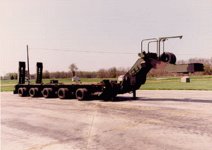

Fayetteville (NC) Observer
August 13, 2004
Landing------------------Offload----------Takeoff


Photos courtesy of USAF C-7 Caribou Association, www.c7acaribou.com great pics!

World - Reuters
November 12, 2004
Discussion Board on this DLS topic


wing airfoil section NACA -4412
wing area 1.76m²
canard span 168.8 cm
canard area 0.35 m²
canard airfoil section NACA-4412
vertical fin NACA-0012
Length overall 288 cm
Height overall 90.88 cm
Body diameter 25 cm
propeller Diameter 61 cm
Max. launching weight 83 kg
Max. payload weight 40 kg
Launching speed 64 Knots
Cruise speed 165 Knots
For longer than 5 km range a tracking system is essential.
Endurance is 1.5 h (Can be increased)
Engine Type WAE-342
No. of cylinder 2 cylander
Engine volume 342 cc
Max .power 25 hp
Max .R.P.M(with propeller installed)
7000-7500
Weight 8.5 kg
Fuel type Mixture of oil+Benzene
ceiling 8000-10000 ft
Max. Thrust 65-70 lb
Fuel tank capacity 17 lit
Vanckle Engin e p 73 rotary engine
Engine volume 208 cc chamber size
Max.power 30 hp
Max.RPM* 8000-8500 R.P.M
Weight 10 kg
Fuel type Mixture of oil+Benzene
Ceiling 15000-17000 ft
Max. Thrust 75-80 lb
DISTRIBUTION A:
Approved for public release; distribution is unlimited.
A LEAP IN FAITH
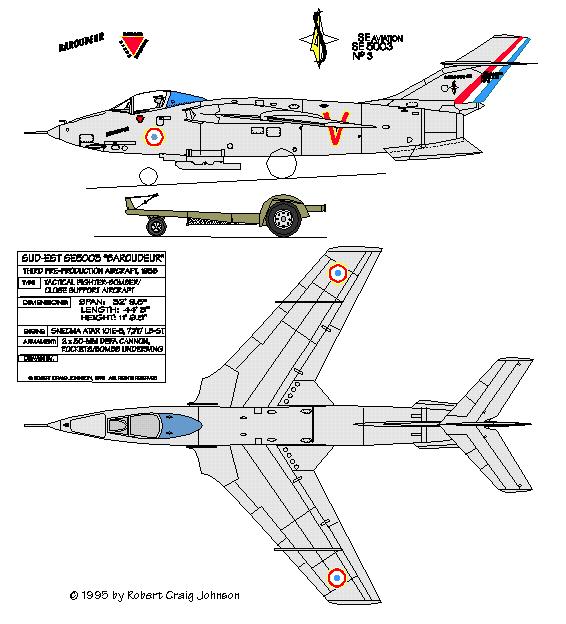

Monday, July 26, 2004
• Maximum Landing Weight 12,500 lbs. 5,670 kg
• Fuel Capacity 228 Gallons 863 liters
• Hopper Capacity (with Spray System) 710 Gallons 2,687 liters
• Hopper Capacity (with Fire Bomber Installation) 785 Gallons 2,971 liters
• Velocity Never Exceed 220 mph 355 kph
• Sea Level Rate of Climb at 12,500 lbs. 1,025 fpm 312 mpm
• Sea Level Rate of Climb at 14,150 lbs. 700 fpm 213 mpm
• Take-Off Distance @14,150 lbs. 1,100 ft. 355 mtrs.
• Landing Distance (as Usually Landed) 600 ft. 183 mtrs.
• Cruising Speed @ 55% Power 185 mph 298 kph
• Ferry Range @ 50% power 600 miles 966 kilometers
Posted on 01/02/2004 8:23:34 PM PST by Destro